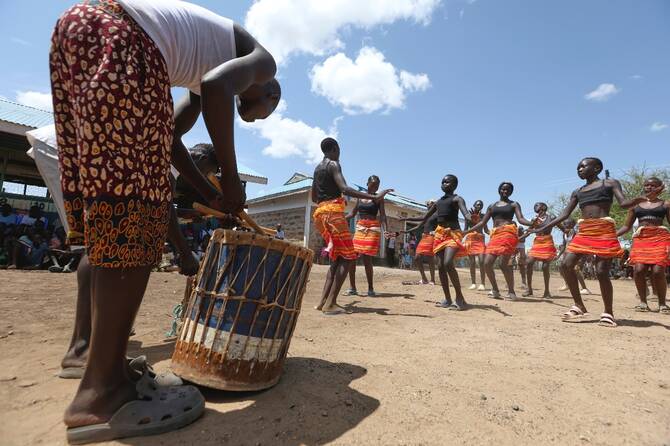
KALOBEYEI: Beads of sweat drip from the faces of young girls and boys as they dance to the rhythm of traditional drums and open calabashes, while their peers watch them in awe.
These are refugee children, some who were born in one of Africa’s largest camps — Kakuma, located in northern Kenya, where more than 300,000 refugees’ livelihoods have been affected by funding cuts that have halved monthly food rations.
The children use the Acholi traditional dance as a distraction from hunger and have perfected a survival skill to skip lunches as they stretch their monthly food rations that are currently at 30 percent of the UN nutritional recommendation per person.
The Acholi people, mostly from Uganda and South Sudan, are among refugees who live in Kakuma camp, which was established in 1992 as a safe haven for people fleeing conflict from dozens of east African countries.
For a moment, the melodious sound of one of the refugee mothers stops the playground buzz of activity as dozens of children sit down to enjoy the traditional dance performance.
The colorful swings doting the community center at Kakuma’s Kalobeyei Refugee Settlement were donated by a Swiss organization, Terre des hommes, which still manages the playground aptly named “Furaha” — Swahili for Happiness.
But the happiness of these children isn’t guaranteed now as funding cuts have affected operations here. Fewer resources and staff are available to engage the children and ensure their safety.
One of the dancers, Gladis Amwony, has lived in Kakuma for 8 years now. In recent years, she has started taking part in the Acholi traditional dances to keep her Ugandan roots alive.
The now 20-year-old doesn’t imagine ever going back to Uganda and has no recollection of life in her home village.
“I’m happiest when I dance, I feel connected to my ancestors,” the soft-spoken Amwony says after her dance session.
While Amwony and her friends are looking for a cultural connection, just about 5 kilometers (3 miles) from their village in neighboring Kalobeyei Village 3, some boys are in touch with modernity.
The five boys have been practicing a one-of-a-kind dance where they mimic robots, complete with face masks that hide their human faces.
They make their sharp synchronized moves that they have been perfecting for months.
The boys will be part of performances that will be showcased during this year’s World Refugee Day, as an example of the talent and resilience that exists among the refugee community.
This younger generation of dancers make precision moves in a small hall with play and learning items stored in a cabinet that is branded with an American flag, an indication that it was donated by the USgovernment.
Such donations are now scarce, with the United States having cut down on funding in March.
These cuts have affected operations here, with the future stardom hopes for these children dimming by the day.
The center, which previously featured daily programs such as taekwondo and ballet, may not be operational in a few months if the funding landscape remains as is.
“We are now reducing some of the activities because we are few. The staff are few and even per day we only have one staff remaining in the center and it is really hard for him/her to conduct 500 children,” said John Papa, a community officer for Terre des hommes in Kalobeyei Village 3.
These programs do more than entertain the children — they keep them away from issues such as child labor, abuse and crime which as a major concern for humanitarian organizations in Kakuma.
And as the children dance and play beneath the sweltering sun, the only hope is that these child friendly spaces remain operational for years.


![]()

Fusion between culture and modernity as children dance in Kenyan refugee camp
Short Url
https://arab.news/nph3j
Fusion between culture and modernity as children dance in Kenyan refugee camp
- The Acholi people, mostly from Uganda and South Sudan, are among refugees who live in Kakuma camp, which was established in 1992 as a safe haven for people fleeing conflict from dozens of east African countries


Latest updates




© 2026 SAUDI RESEARCH & PUBLISHING COMPANY, All Rights Reserved And subject to Terms of Use Agreement.