

Lawmakers scrap ‘revenge’ tax provision from Trump’s big bill after Treasury requests its removal

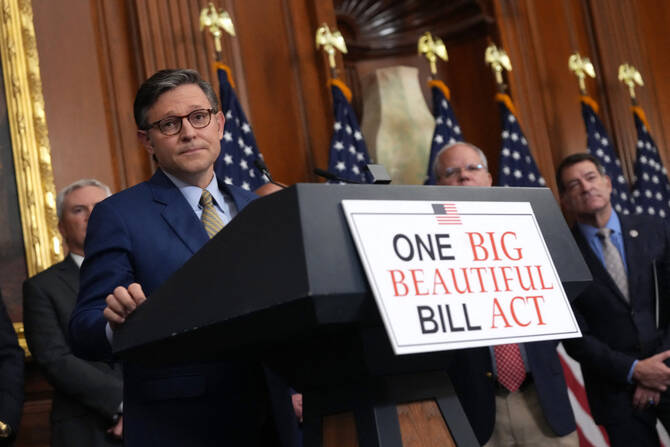
US Speaker of the House Mike Johnson speaks to the media after the House narrowly passed a bill forwarding President Donald Trump's agenda at the US Capitol on May 22, 2025 in Washington, DC. (AFP)
Short Url
Updated 27 June 2025
Follow

Lawmakers scrap ‘revenge’ tax provision from Trump’s big bill after Treasury requests its removal

  • Critics warned that Section 899 of the bill "will hurt the US more than it helps"
  • Global Business Alliance said the section could lead to 700,000 US jobs lost

WASHINGTON: Congressional Republicans agreed to remove the so-called revenge tax provision from President Donald Trump’s big bill Thursday after Treasury Secretary Scott Bessent asked members of Congress to do so earlier in the day.
The Section 899 provision would allow the federal government to impose taxes on companies with foreign owners, as well as investors from countries judged as charging “unfair foreign taxes” on US companies.
The measure was expected to lead many companies to avoid investing in the US out of concern that they could face steep taxes.
Bessent said in an X post that he made the request to lawmakers after reaching an agreement with other countries on the Organization for Economic Co-operation and Development Global Tax Deal. He said that after “months of productive dialogue,” they would “announce a joint understanding among G7 countries that defends American interests.”
After he made the request, Senate Finance Committee Chairman Mike Crapo, R-Idaho, and House Ways and Means Committee Chairman Jason Smith, R-Missouri, said “we will remove proposed tax code Section 899” from the bill and “Congressional Republicans stand ready to take immediate action if the other parties walk away from this deal or slow walk its implementation.”
The removal of the provision will provide “greater certainty and stability for the global economy and will enhance growth and investment in the United States and beyond,” Bessent said in his post.
An analysis by the Global Business Alliance, a trade group representing international companies such as Toyota and Nestlé, estimates that the provision would cost the US 700,000 jobs and $100 billion annually in lost gross domestic product.


Global Business Alliance infographic. (X: @GlobalBiz)

The Global Business Alliance was among several groups that signed a letter addressed to Senate Majority Leader John Thune of South Dakota and Senate Finance Committee Chairman Mike Crapo of Idaho, warning of the consequences of Section 899.
The removal of the provision adds a wrinkle to Republicans’ plans to try to offset the cost of the massive package. The non-partisan Congressional Budget Office estimates that the bill would spike deficits by at least $2.4 trillion over the next decade.
Republicans are rushing to finish the package this week to meet the president’s Fourth of July deadline for passage.
Earlier Thursday, the Senate parliamentarian advised that a Medicaid provider tax overhaul central to the spending bill does not adhere to the chamber’s procedural rules, delivering a crucial blow to Republicans, who are counting on big cuts to Medicaid and other programs to offset trillions of dollars in Trump tax breaks.


Venezuela says oil exports continue normally despite Trump blockade

Updated 9 sec ago
Follow

Venezuela says oil exports continue normally despite Trump blockade

  • Trump warned “Venezuela is completely surrounded by the largest Armada ever assembled in the History of South America”
  • Oil prices surged in early trading Wednesday in London on news of the blockade, which comes a week after US troops seized a sanctioned oil tanker

CARACAS: Venezuela struck a defiant note Wednesday, insisting that its crude oil exports were not impacted by US President Donald Trump’s announcement of a potentially crippling blockade.
Trump’s declaration on Tuesday marked a new escalation in his months-long campaign of military and economic pressure on Venezuela’s leftist authoritarian President Nicolas Maduro.
Venezuela, which has the world’s largest proven oil reserves, shrugged off the threat of more pain, insisting that it was proceeding with business as usual.
“Export operations for crude and byproducts continue normally. Oil tankers linked to PDVSA operations continue to sail with full security,” state oil company Petroleos de Venezuela (PDVSA) said.
Trump said Tuesday he was imposing “A TOTAL AND COMPLETE BLOCKADE OF ALL SANCTIONED OIL TANKERS going into, and out of, Venezuela.”
Referring to the heavy US military presence in the Caribbean — including the world’s largest aircraft carrier — he warned “Venezuela is completely surrounded by the largest Armada ever assembled in the History of South America.”
Oil prices surged in early trading Wednesday in London on news of the blockade, which comes a week after US troops seized a sanctioned oil tanker that had just left Venezuela with over 1 million barrels of crude.
Maduro held telephone talks with UN Secretary-General Antonio Guterres to discuss what he called the “escalation of threats” from Washington and their “implications for regional peace.”
Guterres’s spokesman said the UN chief was working to avoid “further escalation.”

- ‘We are not intimidated’ -

Venezuela’s economy, which has been in freefall over the last decade of increasingly hard-line rule by Maduro, relies heavily on petroleum exports.
Trump’s campaign appears aimed at undermining domestic support for Maduro but the Venezuelan military said Wednesday it was “not intimidated” by the threats.
The foreign minister of China, the main market for Venezuelan oil, defended Caracas in a phone call with his Venezuelan counterpart Yvan Gi against the US “bullying.”
“China opposes all unilateral bullying and supports all countries in defending their sovereignty and national dignity,” he said.
Last week’s seizure of the M/T Skipper, in a dramatic raid involving US forces rappelling from a helicopter, marked a shift in Trump’s offensive against Maduro.
In August, the US leader ordered the biggest military deployment in the Caribbean Sea since the 1989 US invasion of Panama — purportedly to combat drug trafficking, but taking particular aim at Venezuela, a minnow in the global drug trade.
US strikes on alleged drug-smuggling boats in the Caribbean and eastern Pacific have left at least 95 people dead since.
Caracas believes that the anti-narcotics operations are a cover for a bid to topple Maduro and steal Venezuelan oil.
The escalating tensions have raised fears of a potential US intervention to dislodge Maduro.
Mexican President Claudia Sheinbaum waded into the dispute on Wednesday, declaring that the United Nations was “nowhere to be seen” and asked that it step up to “prevent any bloodshed.”

- Oil lifeline -

The US blockade threatens major pain for Venezuela’s crumbling economy.
Venezuela has been under a US oil embargo since 2019, forcing it to sell its production on the black market at significantly lower prices, primarily to Asian countries.
The country produces one million barrels of oil per day, down from more than three million in the early 2000s.
Capital Economics analysts predicted that the blockade “would cut off a key lifeline for Venezuela’s economy” in the short term.
“The medium-term impact will hinge largely on how tensions with the US evolve — and what the US administration’s goals are in Venezuela.”