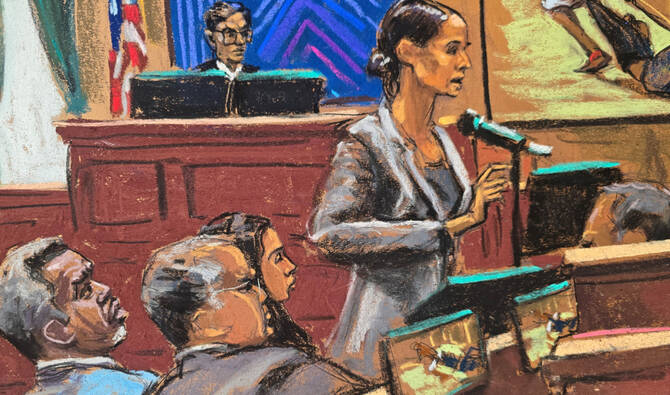
NEW YORK: Sean “Diddy” Combs used “power, violence, and fear” as the head of a decades-old criminal enterprise, a prosecutor said Thursday in closing arguments in his high-profile trial.
“He counted on silence and shame to keep his crimes hidden,” Christy Slavik told the jury as the government began wrapping up its case against the once-powerful music mogul.
The 55-year-old Combs was seated behind the prosecutor as she delivered her closing arguments, passing an occasional message to his lawyers.
Slavik methodically walked the jury through the charges against Combs, which include racketeering and sex trafficking.
“He used power, violence and fear to get what he wanted,” she said, and relied on a network of “loyal lieutenants” — none of whom testified at his trial — to cover up his crimes, which included forced labor, bribery and witness tampering.
“He became more powerful and more dangerous because of the support of his inner circle and his businesses,” she said. “This is Mr.Combs’s kingdom.”
Slavik told the jury the case was not about criminalizing unorthodox sex.
“It’s not about free choices at all,” she said.
The women involved were “drugged, covered in oil, sore, exhausted” as Combs made them have sex with escorts for hours, she said.
The famed producer coerced two women — the singer Casandra Ventura and later a woman who testified under the pseudonym Jane — into years of drug-addled sex with paid escorts, prosecutors say.
The most serious charge, racketeering — which includes the existence of a criminal enterprise that committed a pattern of offenses — could send Combs to prison for life.
He faces two charges of sex trafficking and two more for transportation for purposes of prostitution.
Combs denies it all. His lawyers have argued that the artist’s relationships were consensual and have sought to convince jurors that many of the witnesses who testified were doing so for financial gain or jealousy.
Along with alleged victims, government witnesses included former assistants and other employees, as well as escorts, friends and family of Ventura, and a hotel security guard who said he was bribed with $100,000 in a paper bag.
Combs opted against testifying on his own behalf, a common strategy of defense teams who are not required to prove innocence, only to cast doubt on government allegations of guilt.
The government’s evidence included thousands of pages of phone and text records, and hours of testimony involved meticulous readings of some of the most explicit and wrenching exchanges.
Many of those records appear to indicate distress on the part of the alleged victims. But a lot of the messages also show affection and desire — texts the defense underscored again and again.
Jurors have seen video evidence of the sex parties prosecutors say were criminal, while the defense has exhibited exchanges they say imply consent.
Also in evidence are reams of financial records — including CashApp payments to escorts — as well as flight and hotel records.
Since early May the proceedings have gripped the Manhattan federal courthouse where they’re taking place.
And though electronics are barred from the building, dozens of influencers and content creators have buzzed around the courthouse’s exterior every day, delivering hot takes to eager social media fans.
Combs is incarcerated and does not enter or exit the courthouse publicly. But some of the high-profile attendees and witnesses do, including members of the music mogul’s family and figures like Kid Cudi, the rapper who testified that Combs’s entourage torched his car.
The closing arguments by the prosecution are expected to wrap up on Thursday and the defense is likely to start its closing on Friday.
The jury of 12 New Yorkers could get the case as early as Friday afternoon.


Sean ‘Diddy’ Combs used ‘power, violence and fear’: prosecutor
https://arab.news/j6qsc
Sean ‘Diddy’ Combs used ‘power, violence and fear’: prosecutor


Filipinos master disaster readiness, one roll of the dice at a time
- In a library in the Philippines, a dice rattles on the surface of a board before coming to a stop, putting one of its players straight into the path of a powerful typhoon
MANILA: In a library in the Philippines, a dice rattles on the surface of a board before coming to a stop, putting one of its players straight into the path of a powerful typhoon.
The teenagers huddled around the table leap into action, shouting instructions and acting out the correct strategies for just one of the potential catastrophes laid out in the board game called Master of Disaster.
With fewer than half of Filipinos estimated to have undertaken disaster drills or to own a first-aid kit, the game aims to boost lagging preparedness in a country ranked the most disaster-prone on earth for four years running.
“(It) features disasters we’ve been experiencing in real life for the past few months and years,” 17-year-old Ansherina Agasen told AFP, noting that flooding routinely upends life in her hometown of Valenzuela, north of Manila.
Sitting in the arc of intense seismic activity called the “Pacific Ring of Fire,” the Philippines endures daily earthquakes and is hit by an average of 20 typhoons each year.
In November, back-to-back typhoons drove flooding that killed nearly 300 people in the archipelago nation, while a 6.9-magnitude quake in late September toppled buildings and killed 79 people around the city of Cebu.
“We realized that a lot of loss of lives and destruction of property could have been avoided if people knew about basic concepts related to disaster preparedness,” Francis Macatulad, one of the game’s developers, told AFP of its inception.
The Asia Society for Social Improvement and Sustainable Transformation (ASSIST), where Macatulad heads business development, first dreamt up the game in 2013, after Super Typhoon Haiyan ravaged the central Philippines and left thousands dead.
Launched six years later, Master of Disaster has been updated this year to address more events exacerbated by human-driven climate change, such as landslides, drought and heatwaves.
More than 10,000 editions of the game, aimed at players as young as nine years old, have been distributed across the archipelago nation.
“The youth are very essential in creating this disaster resiliency mindset,” Macatulad said.
‘Keeps on getting worse’
While the Philippines has introduced disaster readiness training into its K-12 curriculum, Master of Disaster is providing a jolt of innovation, Bianca Canlas of the Department of Science and Technology (DOST) told AFP.
“It’s important that it’s tactile, something that can be touched and can be seen by the eyes of the youth so they can have engagement with each other,” she said of the game.
Players roll a dice to move their pawns across the board, with each landing spot corresponding to cards containing questions or instructions to act out disaster-specific responses.
When a player is unable to fulfil a task, another can “save” them and receive a “hero token” — tallied at the end to determine a winner.
At least 27,500 deaths and economic losses of $35 billion have been attributed to extreme weather events in the past two decades, according to the 2026 Climate Risk Index.
“It just keeps on getting worse,” Canlas said, noting the lives lost in recent months.
The government is now determining if it will throw its weight behind the distribution of the game, with the sessions in Valenzuela City serving as a pilot to assess whether players find it engaging and informative.
While conceding the evidence was so far anecdotal, ASSIST’s Macatulad said he believed the game was bringing a “significant” improvement in its players’ disaster preparedness knowledge.
“Disaster is not picky. It affects from north to south. So we would like to expand this further,” Macatulad said, adding that poor communities “most vulnerable to the effects of climate change” were the priority.
“Disasters can happen to anyone,” Agasen, the teen, told AFP as the game broke up.
“As a young person, I can share the knowledge I’ve gained... with my classmates at school, with people at home, and those I’ll meet in the future.”


