

Iran’s supreme leader makes first public statement since ceasefire declared in Israel-Iran war

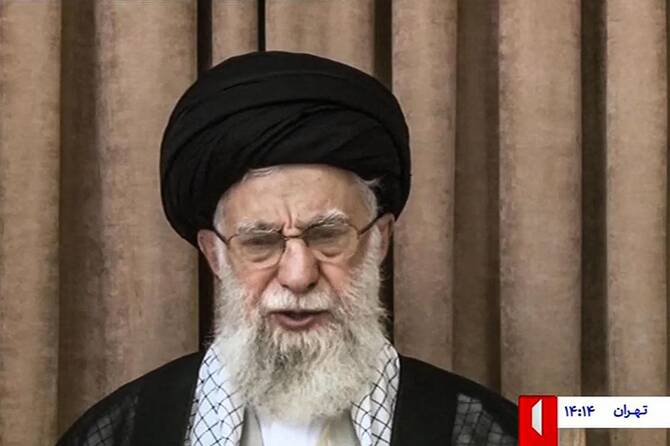
This image grab taken from footage broadcast by Iran's IRIB news agency on June 26, 2025, shows the Supreme Leader of the Islamic Republic Ayatollah Ali Khamenei addressing the nation. (AFP)
Short Url
Updated 26 June 2025
Follow

Iran’s supreme leader makes first public statement since ceasefire declared in Israel-Iran war

  • Khamenei hasn't been seen in public since taking shelter in a secret location after the outbreak of the war June 13

DUBAI: Iran’s Supreme Leader Ayatollah Ali Khamenei claimed victory over Israel and said his country had “delivered a hand slap to America’s face” on Thursday, in his first public comments since a ceasefire was declared in the war between the two countries.

Khamenei spoke in a video broadcast on Iranian state television, his first appearance since June 19, looking and sounding more tired than he did only a week ago.

He told viewers that the US had only intervened in the war because “it felt that if it did not intervene, the Zionist regime would be utterly destroyed.”

But he said, however, that the US “achieved no gains from this war."

“The Islamic Republic was victorious and, in retaliation, delivered a hand slap to America’s face,” he said, in apparent reference to an Iranian missile attack on an American base in Qatar on Monday, which caused no casualties.

The 86-year-old Khamenei hasn't been seen in public since taking shelter in a secret location after the outbreak of the war June 13 when Israel attacked Iranian nuclear facilities and targeted top military commanders and scientists.

Following an American attack on June 22 that hit the nuclear sites with bunker-buster bombs, U.S. President Donald Trump was able to help negotiate a ceasefire that came into effect on Tuesday.

In his appearance on Thursday, he sat in front of plain brown curtains to give his address, similar to his June 19 message.


Military drone attack on Sudan oil field kills dozens and threatens South Sudan’s economic lifeline

Updated 10 December 2025
Follow

Military drone attack on Sudan oil field kills dozens and threatens South Sudan’s economic lifeline

  • RSF said the oil field in Heglig was attacked a day after they seized the facility near the border with South Sudan
  • South Sudanese soldiers were among the dead in the attack by an Akinci drone

JUBA: Dozens of people were killed Tuesday evening in a drone strike near Sudan’s largest oil processing facility carried out by the Sudanese Armed Forces, according to the paramilitary Rapid Support Forces.
The RSF, which has been fighting Sudan’s military since 2023, said the oil field in Heglig was attacked a day after the RSF seized the facility near the border with South Sudan.
Both sides told The Associated Press that the exact number of dead and wounded could not immediately be confirmed. Local news outlets reported seven tribal leaders and “dozens” of RSF troopers were killed.
South Sudanese soldiers were among the dead in the attack by an Akinci drone, according to the RSF, which condemned the attack as a violation of international law.
Two Sudanese military officials confirmed the drone strike, which they said targeted RSF fighters.
The government of South Sudan’s Unity State confirmed three South Sudanese soldiers were killed. A South Sudanese solider, who witnessed the strike and spoke on condition of anonymity because he was not authorized to speak, estimated 25 people were killed.
South Sudanese commander Johnson Olony said in a statement that South Sudanese forces may have been sent to secure Heglig after its capture. South Sudan’s military spokesperson declined to comment.
South Sudan relies entirely on Sudanese pipelines to export its oil and has seen production repeatedly disrupted by the conflict, worsening its economic crisis.
Sudanese soldiers and oil workers began evacuating Heglig on Monday and the RSF took control of the facility without resistance. By Tuesday, about 3,900 Sudanese soldiers had surrendered their weapons to South Sudanese forces after crossing into Rubkona County, according to Unity State’s information ministry.
Video from South Sudan’s state broadcaster showed tanks, armored personnel carriers and artillery among the weapons handed over.
Thousands of civilians from Sudan began crossing the border into South Sudan on Sunday and were still arriving Wednesday, the South Sudan government said, adding that the exact number was not yet known. South Sudan insists it remains neutral in the conflict despite accusations of siding with the RSF.
Heglig’s capture is the latest in a string of RSF territorial gains, including the October fall of el-Fasher, the capital of North Darfur and the Sudanese army’s last stronghold in Darfur. The war, which began in April 2023, has killed an estimated 150,000 people, displaced millions and triggered multiple famines. Both sides face allegations of atrocities.
The capture of Heglig, a vital state asset, could be a significant bargaining chip for the RSF, analysts said. But the opaque nature of oil finances makes it difficult to determine how much the SAF, RSF or South Sudan will be impacted economically over the short term.