

REVIEW: ‘F1: The Movie’ — high-octane entertainment and old-school charm

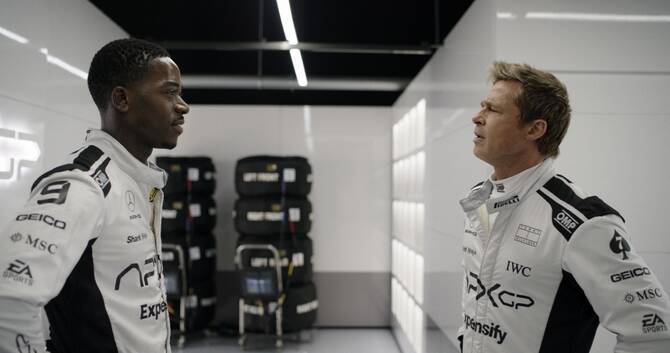
Damson Idris as Joshua Pearce and Brad Pitt as Sonny Hayes in 'F1: The Movie.' (Supplied)
Short Url
Updated 26 June 2025
Follow

REVIEW: ‘F1: The Movie’ — high-octane entertainment and old-school charm

DUBAI: There’s a moment in “F1: The Movie,” where you’ll feel like you're flying, all while strapped into a tiny metal box hurtling at a speed you can't comprehend. This is when you realize this isn’t just another sports drama; it’s a sleek love letter to Formula 1, anchored by Brad Pitt’s enduring star power and a surprisingly effective dynamic with relative newcomer Damson Idris.


A post shared by FORMULA 1 (@f1)

Pitt plays Sonny Hayes, a grizzled former driver lured back to the thrills of the pit lane for one last go. He’s all swagger and scars, but yes, he’s still got it. Pitt’s presence brings gravitas to a film that flirts with the edges of cheesiness but never forgets its emotional core. Whether he’s behind the wheel or delivering motivational growls in the garage, he sells it — and then some.

Opposite him is Idris as Joshua Pearce, a rising star struggling to reconcile his love for the sport with the noise that comes with the fame and money, who becomes Sonny’s reluctant protege. Idris brings a fresh, fiery intensity that balances Pitt’s seasoned cool. The strained mentor-mentee trope has been done to death, but it’s portrayed with sincerity and the right amount of tension here.

Additionally, Kerry Condon delivers a sharp, emotionally solid performance as the team’s no-nonsense engineer, anchoring the high-octane chaos with quiet authority. Her scenes with Pitt crackle with wit and chemistry, and deliver some of the bigger laughs.

Director Joseph Kosinski (“Top Gun: Maverick”) brings his signature high-octane style to the film, especially the race sequences. The sound design is impeccable, the cinematography breathtaking. And composer Hans Zimmer's layered, gorgeously synth-drenched background score goes well with a soundtrack that thumps out rock one minute and smooth R'n'B next.

The film builds toward a final showdown in Abu Dhabi, and while the climax is predictable, it’s executed with such unapologetic flair that you can’t help but cheer. The Yas Marina circuit has never looked more cinematic — it’s the perfect backdrop for a finish that’s equal parts cheesy and thrilling.

“F1” isn’t rewriting the sports-movie playbook, but it really doesn’t need to. It’s crowd-pleasing, adrenaline-fueled, masterfully executed entertainment with more than enough heart to keep it grounded. 


‘One in a Million’: Syrian refugee tale wows Sundance

Updated 24 January 2026
Follow

‘One in a Million’: Syrian refugee tale wows Sundance

PARK CITY: As a million Syrians fled their country's devastating civil war in 2015, directors Itab Azzam and Jack MacInnes headed to Turkey where they would meet a young girl who encapsulated the contradictions of this enormous migration.

In Ismir, they met Isra'a, a then-11-year-old girl whose family had left Aleppo as bombs rained down on the city, and who would become the subject of their documentary "One In A Million," which premiered at the Sundance Film Festival on Friday.

For the next ten years, they followed her and her family's travels through Europe, towards Germany and a new life, where the opportunities and the challenges would almost tear her family apart.

The film is by directors Itab Azzam and Jack MacInnes. (Supplied)

There was "something about Isra'a that sort of felt to us like it encapsulated everything about what was happening there," MacInnes told an audience at the Sundance Film Festival in Park City, Utah on Friday.

"The obvious vulnerability of her situation, especially as being a child going through this, but that at the same time, she was an agent.

"She wasn't sitting back, waiting for other people to save her. She was trying to fight, make her own way there."

The documentary mixes fly-on-the-wall footage with sit-down interviews that reveal Isra'a's changing relationship with Germany, with her religion, and with her father.

It is this evolution between father and daughter that provides the emotional backbone to the film, and through which tensions play out over their new-found freedoms in Europe -- something her father struggles to adjust to.

Isra'a, who by the end of the film is a married mother living in Germany, said watching her life on film in the Park City theatre was "beautiful."

And having documentarists follow her every step of the way as she grew had its upsides.

"I felt like this was something very special," she told the audience after the screening. "My friends thought I was famous; it made making friends easier and faster."