

NGOs: Environment fears over $6 billion Indonesia EV battery project

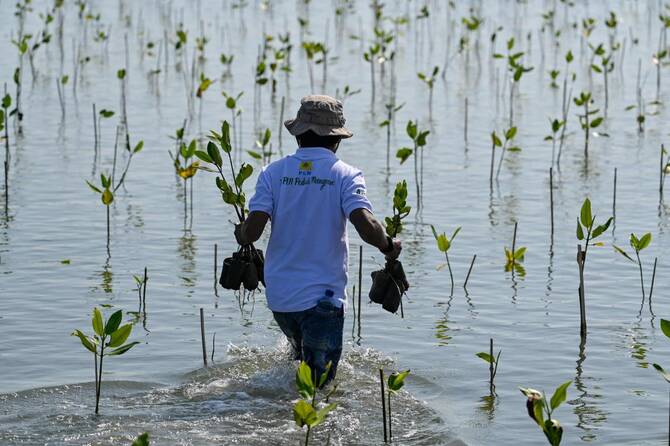
A volunteer plants mangrove seedlings at a beach that was devastated by the boxing day 2004 Indian Ocean earthquake and tsunami at Kajhu on the outskirts of Banda Aceh on June 26, 2025. (AFP)
Short Url
Updated 26 June 2025
Follow

NGOs: Environment fears over $6 billion Indonesia EV battery project

  • A CRI report this month warned the Indonesian government was allowing environmental damage to go unchecked around Weda Bay

JAKARTA: Environmental groups raised concerns Thursday over a $6 billion Indonesian EV battery megaproject backed by Chinese giant CATL which is set to open on a once-pristine island, as Jakarta exploits its huge supply of nickel.

Indonesia is both the world’s largest nickel producer and home to the biggest-known reserves, and a 2020 export ban has spurred a domestic industrial boom.

Indonesian President Prabowo Subianto will inaugurate the project — also backed by China’s Zhejiang Huayou Cobalt and Indonesia’s state-owned Antam — in the east of Halmahera in Indonesia’s Maluku islands on Sunday.

The complex will encompass a process from nickel mining to production of cathodes, state news agency Antara reported.

But NGOs say Indonesia and the Chinese firms involved have not given assurances about environmental protections at the site, located just kilometers from a huge industrial park where spikes in pollution and deforestation have been reported.

“CATL, Huayou Cobalt, PT Antam... must commit to respecting the rights of local communities and the environment before breaking ground,” said Brad Adams, executive director at Climate Rights International, in a statement.

“Communities are repressed, forests are cleared, and pollution goes unaddressed with impunity. This is a chance for the Prabowo government to show that it has learned from those failures.”

The presidential office did not immediately respond to an AFP request for comment.

Halmahera hosts the world’s largest nickel mine by production Weda Bay, where operations have grown and sparked reports of widespread environmental damage.

Greenpeace Indonesia said the new project carried “great responsibilities” and the environment and locals “must not take a back seat” to powering electric vehicles.

“If the environment and the rights of our most vulnerable people are not prioritized now... we will all pay a high price through worsening biodiversity and climate crises,” Arie Rompas, forest campaign team leader at Greenpeace, told AFP.

A CRI report this month warned the Indonesian government was allowing environmental damage to go unchecked around Weda Bay.

An AFP report last month detailed how the home of the nomadic Hongana Manyawa tribe was being eaten away by the mine.


Australia to deploy long-range reconnaissance plane to Gulf

Updated 59 min 33 sec ago
Follow

Australia to deploy long-range reconnaissance plane to Gulf

  • The government says there are about 115,000 Australian nationals across the Middle East, of whom about 2,600 have returned home.

SYDNEY: Australia will deploy a long-range military reconnaissance plane to the Gulf to protect civilians, Prime Minister Anthony Albanese said Tuesday.
An E-7A Wedgetail aircraft and supporting defense force personnel will be sent for an initial period of four weeks to help “protect and secure the airspace above the Gulf,” Albanese told a news conference.
Australia also plans to provide advanced, medium-range air-to-air missiles to the United Arab Emirates “in response to a request,” the prime minister said.
The UAE, in which there are an estimated 24,000 Australians, has shot down more than 1,500 rockets and drones fired by Iran in reprisal following US-Israeli strikes, he said.
Albanese said he decided to send the advanced radar surveillance plane to the Gulf following a discussion with UAE President Mohammed bin Zayed Al Nahyan.
“The first priority of my government is, and always will be, to keep Australians safe,” the prime minister said.
“Helping Australians means also helping the UAE and other Gulf nations to defend themselves against what are unprovoked attacks,” he added.
“My government has been clear that we’re not taking offensive action against Iran, and we’ve been clear that we are not deploying Australian troops on the ground in Iran.”
The government says there are about 115,000 Australian nationals across the Middle East, of whom about 2,600 have returned home.
“Significant challenges remain, and further work is underway to support those still seeking to leave,” Albanese said.
Australia said last week it had deployed a heavy transport plane and a fuel transport plane to the Middle East as part of plans to get its citizens out of the region.
Canberra has been careful to make clear that its forces are not engaging in offensive operations against Iran.
On Friday, Albanese revealed that Australian military personnel were aboard an American submarine that sank an Iranian navy ship off Sri Lanka.
The personnel were on the submarine as part of training arrangements under AUKUS, a multi-decade defense pact with Britain and the United States, he said, stressing that they did not take part in the attack.