

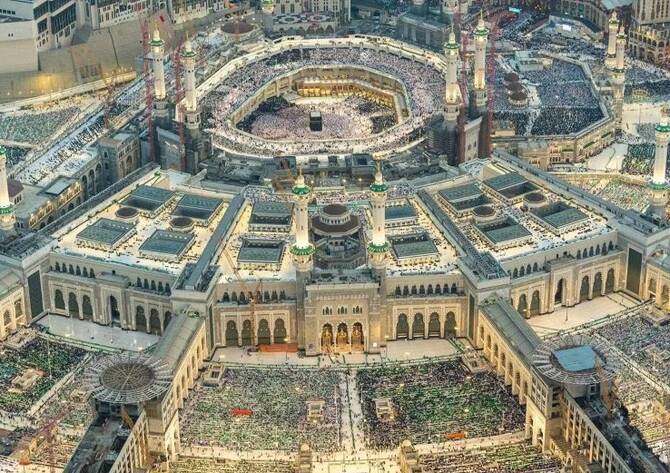
New climate study to shield the Two Holy Mosques from extreme weather

The initiative aims to develop sustainable solutions for extreme weather phenomena in the Two Holy Mosques’ urban environments. (SPA)
Short Url
Updated 25 June 2025
Follow

New climate study to shield the Two Holy Mosques from extreme weather

  • Study seeks sustainable solutions for extreme weather phenomena while supporting quality-of-life improvements
  • Includes analyzing climate effects on urban infrastructure and studying extreme weather patterns

RIYADH: The Regional Centre for Climate Change has launched an advanced scientific study to analyze the effects of climate change on urban environments in Makkah and Madinah, the Saudi Press Agency reported on Wednesday.

The study seeks sustainable solutions for extreme weather phenomena while supporting quality-of-life improvements in these religiously significant regions with unique urban planning requirements.

These include analyzing climate effects on urban infrastructure and studying extreme weather patterns through modern climate modeling techniques. The initiative also uses data to optimize urban planning and propose resilience solutions to ensure visitor safety and comfort at the Two Holy Mosques.

Ayman Salem Ghulam, the CEO of the Saudi National Center for Meteorology and general supervisor of the RCCC, said that this research is a fundamental pillar supporting adaptation strategies to climate variables for the Two Holy Mosques.

He said that the centers are committed to providing scientific solutions to enhance future projects’ efficiency at both holy cities.

Mazen Assiri, executive director of RCCC detailed the methodology, saying that the integrated scientific approach analyzes weather phenomena affecting urban environments, incorporating international best practices to deliver outputs that align with national development requirements.

He said that to ensure comprehensive solutions, the center held workshops with government and research entities, performed field studies in central Makkah and Madinah, and analyzed practical implementation pathways.

This initiative aligns with the RCCC’s mission to advance specialized climate knowledge and data-driven decision-making. It directly supports environmental sustainability in major developmental projects throughout the Kingdom, particularly those accommodating millions of pilgrims annually.

The study reinforces national efforts to address climate challenges in strategically vital regions while enhancing institutional cooperation in climate resilience planning.


Riyadh emerges as Gulf evacuation hub for wealthy amid regional escalation

Updated 52 min 25 sec ago
Follow

Riyadh emerges as Gulf evacuation hub for wealthy amid regional escalation

  • Saudi capital’s King Khalid International Airport is among the few major airports in the region still operating normally after Iranian missile and drone strikes

RIYADH: Riyadh has become a principal evacuation hub for wealthy residents and senior executives seeking to leave the Gulf amid escalating regional tensions, according to a report by Semafor.

The Saudi capital’s King Khalid International Airport is among the few major airports in the region still operating normally after Iranian missile and drone strikes targeted cities including Dubai and Abu Dhabi over the weekend, as well as locations in Qatar and Bahrain.

With airspace closures elsewhere, stranded executives and high-net-worth individuals have been travelling overland to Riyadh, in some cases undertaking a roughly 10-hour journey from Dubai, in order to board private or commercial flights out of the region.

Citing people familiar with the arrangements, Semafor reported that private security firms have been hiring fleets of SUVs to transport clients to the Saudi capital before arranging chartered aircraft departures.

Those being evacuated include senior figures at global financial institutions as well as affluent individuals who had been in the Gulf for business or leisure.

The surge in demand has sharply increased costs.

Ameerh Naran, chief executive of private jet brokerage Vimana Private, told Semafor that Riyadh is currently “the only real option” for those seeking to exit the region, with private jet charters from the Saudi capital to Europe reaching as much as $350,000.

Alternative routes have narrowed. Security providers initially explored using Oman as an exit corridor, but that option became unviable after reported Iranian strikes on the country’s port infrastructure and a tanker, leaving Riyadh as the most accessible transit point, the report said.

Riyadh’s role marks a notable shift in regional risk perception. In previous years, security concerns — including cross-border Houthi attacks during the Yemen conflict and earlier periods of regional instability — had led many expatriates and business leaders to favour other Gulf cities as transit hubs.

However, Saudi Arabia’s more flexible visa regime, which now allows many nationalities to obtain visas on arrival, combined with the kingdom’s ability so far to keep its airspace open, has reinforced its position as a temporary gateway out of the region.

While some schools have moved to remote learning and certain companies have advised staff to work from home, Semafor reported that daily life in Riyadh has largely continued uninterrupted compared with other Gulf cities that have faced direct attacks.