WASHINGTON: Humans are the only animal that lives in virtually every possible environment, from rainforests to deserts to tundra.
This adaptability is a skill that long predates the modern age. According to a new study published Wednesday in Nature, ancient Homo sapiens developed the flexibility to survive by finding food and other resources in a wide variety of difficult habitats before they dispersed from Africa about 50,000 years ago.
“Our superpower is that we are ecosystem generalists,” said Eleanor Scerri, an evolutionary archaeologist at the Max Planck Institute of Geoanthropology in Jena, Germany.
Our species first evolved in Africa around 300,000 years ago. While prior fossil finds show some groups made early forays outside the continent, lasting human settlements in other parts of the world didn’t happen until a series of migrations around 50,000 years ago.
“What was different about the circumstance of the migrations that succeeded — why were humans ready this time?” said study co-author Emily Hallett, an archaeologist at Loyola University Chicago.
Earlier theories held that Stone Age humans might have made a single important technological advance or developed a new way of sharing information, but researchers haven’t found evidence to back that up.
This study took a different approach by looking at the trait of flexibility itself.
The scientists assembled a database of archaeological sites showing human presence across Africa from 120,000 to 14,000 years ago. For each site, researchers modeled what the local climate would have been like during the time periods that ancient humans lived there.
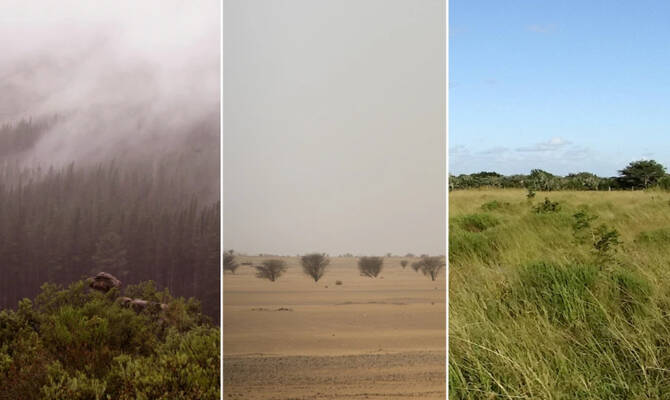
“There was a really sharp change in the range of habitats that humans were using starting around 70,000 years ago,” Hallett said. “We saw a really clear signal that humans were living in more challenging and more extreme environments.”
While humans had long survived in savanna and forests, they shifted into everything from from dense rainforests to arid deserts in the period leading up to 50,000 years ago, developing what Hallett called an “ecological flexibility that let them succeed.”
While this leap in abilities is impressive, it’s important not to assume that only Homo sapiens did it, said University of Bordeaux archaeologist William Banks, who was not involved in the research.
Other groups of early human ancestors also left Africa and established long-term settlements elsewhere, including those that evolved into Europe’s Neanderthals, he said.
The new research helps explain why humans were ready to expand across the world way back when, he said, but it doesn’t answer the lasting question of why only our species remains today.


![]()

Early humans survived in a range of extreme environments before global migration, study says
Short Url
https://arab.news/zasyg
Early humans survived in a range of extreme environments before global migration, study says
- This adaptability is a skill that long predates the modern age


Latest updates


© 2026 SAUDI RESEARCH & PUBLISHING COMPANY, All Rights Reserved And subject to Terms of Use Agreement.