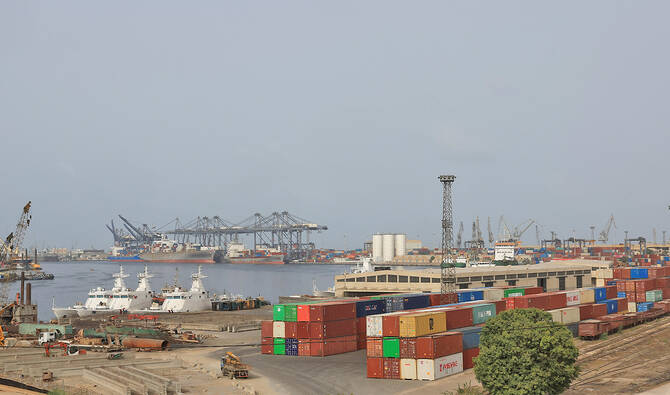

KARACHI: Pakistan’s trade deficit with Gulf nations widened by 14 percent to $12.4 billion in the outgoing fiscal year through May, even as the country pushes for a free trade agreement (FTA) with the six-member Gulf Cooperation Council (GCC) to boost exports and market access, official statistics show.
The trade gap stood at $10.9 billion during the same period last year, according to data from the State Bank of Pakistan (SBP). Pakistan’s exports to the region grew to $5.08 billion — up 16 percent — while imports rose 14 percent to $17.5 billion.
The GCC includes Saudi Arabia, the United Arab Emirates (UAE), Qatar, Kuwait, Oman and Bahrain.
Shankar Talreja, director of research at Topline Securities, attributed the widening trade imbalance primarily to surging imports from the UAE, Pakistan’s largest oil supplier in the bloc.
“Pakistan’s imports from the UAE have increased by 32 percent in 11MFY25,” Talreja told Arab News from Karachi. “This is a whopping increase of $1.5 billion.”
Overall, imports from the UAE jumped 46 percent to $8.33 billion, while exports to the country totaled $3.96 billion. In contrast, imports from Saudi Arabia dropped 15 percent to $3.47 billion.
The increase in oil imports comes as Pakistan, which heavily depends on petroleum products from the GCC, monitors global crude trends.
Prices spiked by 13 percent to $77 per barrel after Israel attacked Iran on June 13, before easing by 6 percent on June 24 following a ceasefire announcement.
“Pakistan largely relies on petroleum products from the GCC region and overall petroleum import bill in FY26 is unlikely to increase as oil prices are currently 10 percent lower than the average oil price of July-May period,” Talreja noted.
“This lower oil price may offset volumetric increase, leaving overall petroleum import bill unchanged,” he added.
Last year, Pakistan spent $17 billion on oil imports, more than twice the size of its most recent International Monetary Fund (IMF) loan package. The IMF has urged the government to ramp up exports to stabilize its fragile external account.
To that end, Islamabad is pursuing bilateral and multilateral trade deals, including FTAs with the GCC, South Korea, Vietnam, East Africa and Central Asian states.
While Commerce Ministry spokesperson Muhammad Ashraf did not respond to queries, another official confirmed the FTA was under negotiation.
“The FTA talks with the GCC nations are ongoing but I am not sure if they have finalized anything,” the ministry official said, requesting anonymity as he was not authorized to speak to the media.
Pakistan’s Economic Survey for FY2024-25 mentions both the Pakistan-GCC FTA and the Pakistan-UAE Comprehensive Economic Partnership Agreement as “upcoming agreements.”
However, Talreja expressed skepticism about the potential gains.
“Pakistan has never benefitted from FTAs, like in case of China our deficit with China has further increased,” he said.
Islamabad’s FTA with Beijing, signed in 2006, has consistently produced unfavorable trade outcomes. The bilateral trade deficit with China stands at $2.5 billion this fiscal year, according to SBP figures.
“In the case of the Middle East, I doubt that Pakistan will benefit as it’s a very competitive market due to the global access the GCC has,” Talreja added. “Islamabad could only benefit if it negotiated something extraordinary.”
Prime Minister Shehbaz Sharif’s government is also pushing to expand trade with the United States, Pakistan’s top textile buyer, by negotiating reciprocal tariffs. Talks are expected to conclude next week.
As part of these discussions under the Trade and Investment Framework Agreement, Islamabad is seeking greater access for mangoes, dates and beef in the US market.
Pakistan’s trade prospects in the European Union remain strong after its GSP+ status, granting zero-duty access on 66 percent of tariff lines, was renewed.
A preferential trade agreement with the eight-member Organization for Economic Cooperation also came into force in January.
Still, officials warn that the country’s export profile remains vulnerable due to over-reliance on a handful of markets.
“The overall export trajectory signals Pakistan’s reliance on a few core markets, highlighting the need for diversification and expanded global outreach to minimize exposure to external shocks,” the finance ministry said in its economic survey.