Turkiye’s Erdogan calls for permanent Iran-Israel ceasefire, Gaza truce

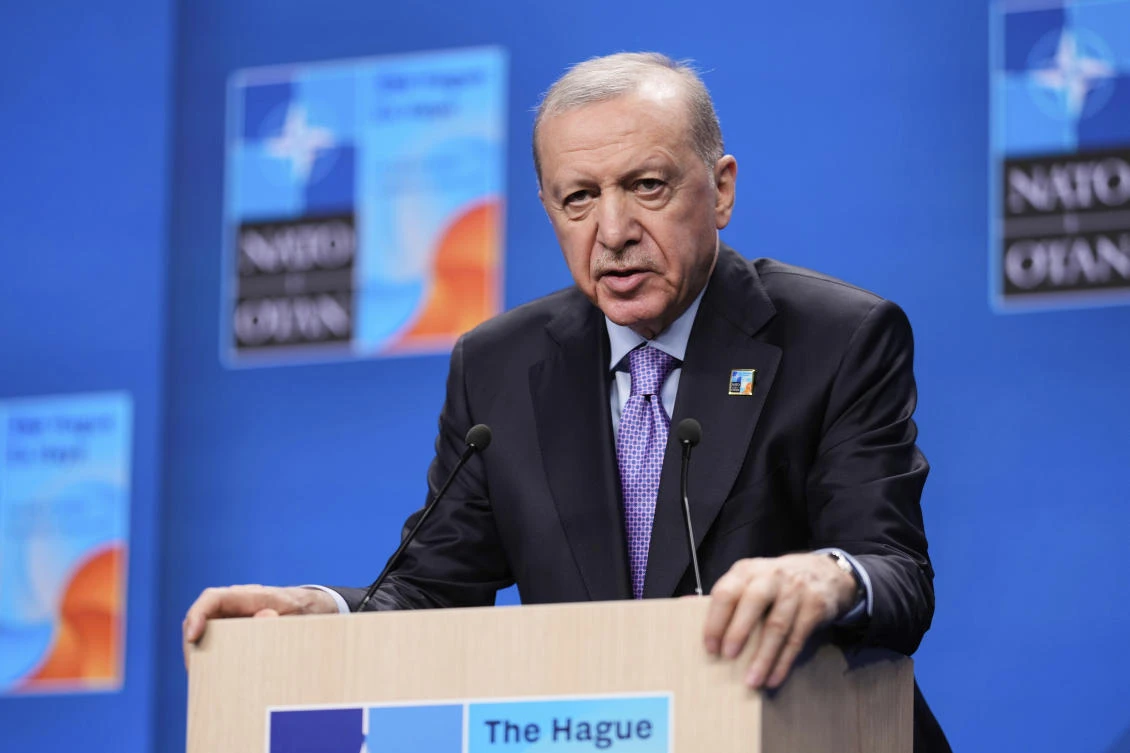
Turkish President Recep Tayyip Erdogan told NATO leaders he welcomed the ceasefire between Israel and Iran. (AP)
Short Url
Updated 25 June 2025
Follow

Turkiye’s Erdogan calls for permanent Iran-Israel ceasefire, Gaza truce

  • Turkish president tells NATO leaders that he welcomes ceasefire between Israel and Iran
  • Erdogan met Trump and held talks with leaders of France, Germany and Britain

ANKARA: Turkish President Tayyip Erdogan told leaders at a NATO summit on Wednesday that a ceasefire between Israel and Iran needed to be made permanent, his office said, and called for a ceasefire in Gaza to alleviate the humanitarian crisis there.
NATO member Turkiye has been fiercely critical of Israel and its assault against Palestinian Hamas militants in Gaza, which has been reduced to rubble after two years of war and had its population displaced.
Ankara has also said Israel’s “state terrorism” against Iran — with which it shares a 560-kilometer border — heightened the risks of a wider conflict, and welcomed the ceasefire between the two.
At the NATO summit in The Hague, Erdogan held talks with the leaders of France, Germany and Britain on regional tensions, bilateral ties and relations with the EU, and defense industry cooperation. Erdogan met US President Donald Trump late on Tuesday.
“Our President said he welcomed the ceasefire between Israel and Iran, that the de facto situation needs to turn into lasting calm as soon as possible, that the humanitarian crisis in Gaza is increasingly continuing, and that a lasting ceasefire is also needed there urgently,” Erdogan’s office said after his meeting with French President Emmanuel Macron.
He repeated that call to German Chancellor Friedrich Merz, adding that a solution needed to be found to the humanitarian crisis in Gaza.
Erdogan also told British Prime Minister Keir Starmer that “these tensions must not leave the humanitarian crisis in Gaza — which has reached a disastrous level — forgotten.”
Erdogan said the problems between Tehran and Washington could only be solved through diplomacy, adding that everyone must contribute to achieving lasting peace in the Middle East.
“We welcome the ceasefire achieved through the efforts of US President Trump,” he told a press conference following the summit. “We expect the parties to unconditionally abide by the call of my friend Trump.”
Syrian government and SDF agree to de-escalate after Aleppo violence

Updated 28 min 16 sec ago
Follow

Syrian government and SDF agree to de-escalate after Aleppo violence

  • Turkiye views the US-backed SDF, which controls swathes of northeastern Syria, as a ⁠terrorist organization and has warned of military action if the group does not honor the agreement

DAMASCUS: Syrian government forces and the Kurdish-led Syrian Democratic Forces agreed to de-escalate on Monday evening in the northern city of Aleppo, after a wave of attacks that both sides blamed on each other left at least two civilians dead and several wounded.
Syria’s state news agency SANA, citing the defense ministry, said the army’s general command issued an order to stop targeting the SDF’s fire sources. The SDF said in a statement later that it had issued instructions to stop responding ‌to attacks ‌by Syrian government forces following de-escalation contacts.

HIGHLIGHTS

• SDF and Syrian government forces blame each other for Aleppo violence

• Turkiye threatens military action if SDF fails integration deadline

• Aleppo schools and offices closed on Tuesday following the violence

The Syrian health ministry ‌said ⁠two ​people ‌were killed and several were wounded in shelling by the SDF on residential neighborhoods in the city. The injuries included two children and two civil defense workers. The violence erupted hours after Turkish Foreign Minister Hakan Fidan said during a visit to Damascus that the SDF appeared to have no intention of honoring a commitment to integrate into the state’s armed forces by an agreed year-end deadline.
Turkiye views the US-backed SDF, which controls swathes of northeastern Syria, as a ⁠terrorist organization and has warned of military action if the group does not honor the agreement.
Integrating the SDF would ‌mend Syria’s deepest remaining fracture, but failing to do ‍so risks an armed clash that ‍could derail the country’s emergence from 14 years of war and potentially draw in Turkiye, ‍which has threatened an incursion against Kurdish fighters it views as terrorists.
Both sides have accused the other of stalling and acting in bad faith. The SDF is reluctant to give up autonomy it won as the main US ally during the war, which left it with control of Daesh prisons and rich oil resources.
SANA, citing the defense ministry, reported earlier that the SDF had launched a sudden attack on security forces ⁠and the army in the Sheikh Maqsoud and Ashrafiyah neighborhoods of Aleppo, resulting in injuries.
The SDF denied this and said the attack was carried out by factions affiliated with the Syrian government. It said those factions were using tanks and artillery against residential neighborhoods in the city.
The defense ministry denied the SDF’s statements, saying the army was responding to sources of fire from Kurdish forces. “We’re hearing the sounds of artillery and mortar shells, and there is a heavy army presence in most areas of Aleppo,” an eyewitness in Aleppo told Reuters earlier on Monday. Another eyewitness said the sound of strikes had been very strong and described the situation as “terrifying.”
Aleppo’s governor announced a temporary suspension of attendance in all public and private schools ‌and universities on Tuesday, as well as government offices within the city center.