

Trump praises ‘very impressive’ Pakistan army chief, reiterates trade stopped Indo-Pak conflict

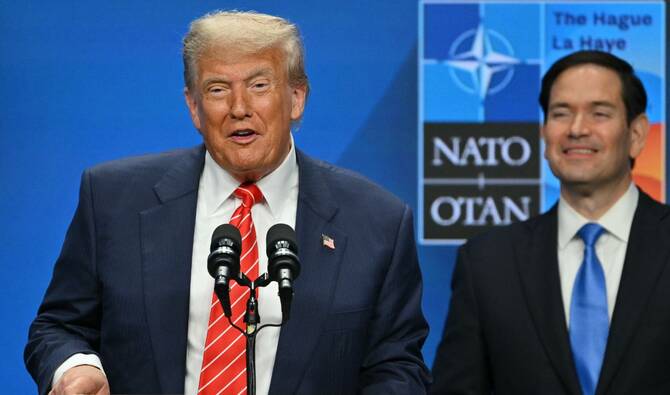
US Secretary of State Marco Rubio (R) reacts as US President Donald Trump addresses a press conference during a North Atlantic Treaty Organization (NATO) Heads of State and Government summit in The Hague on June 25, 2025. (AFP)
Short Url
Updated 25 June 2025
Follow

Trump praises ‘very impressive’ Pakistan army chief, reiterates trade stopped Indo-Pak conflict

  • US president hosted Field Marshal General Asim Munir for lunch at White House last week 
  • Trump announced a ceasefire between India and Pakistan last month after military standoff

ISLAMABAD: US President Donald Trump praised Pakistan’s army chief on Wednesday, describing him as “very impressive” while reiterating his earlier claim of preventing a nuclear war between Islamabad and New Delhi with trade deals last month. 

Trump hosted Field Marshal General Asim Munir for lunch last Wednesday in an unprecedented White House meeting. The American president had told reporters he was “honored” to meet the Pakistani general and that the two discussed the Iran-Israel conflict.

Nuclear-armed India and Pakistan engaged in a days-long military conflict before Trump announced a ceasefire between the two on May 10. Trump has repeatedly said he offered to help both nations with trade if they agreed to de-escalate.

At the NATO summit in The Hague, Trump was asked by a reporter why he had failed to stop the ongoing military conflict between Russia and Ukraine. The American president responded by saying he had stopped wars between Iran and Israel as well as India and Pakistan, saying the conflict “was getting very bad” between the nuclear-armed rivals. 

“And in fact I had the general, who was very impressive, the general from Pakistan was in my office last week,” Trump said. 

He described Indian Prime Minister Narendra Modi as a “great man, a great gentleman,” saying Washington helped both countries reason with each other at the height of the conflict. 

“I said we’re not going to do a trade deal if you’re going to fight and if you’re going to fight each other we’re not doing a trade deal and you know what, they said, ‘No, I want to do the trade deal.’ And we stopped a nuclear war.”

Pakistan’s government last week announced it would formally nominate Trump for what it called his “decisive diplomatic intervention” during the military standoff with India in May. 

The American president has also previously offered to mediate the decades-old Kashmir dispute between India and Pakistan, who both claim the disputed Himalayan region in full but administer only parts of it. 

While the ceasefire continues to persist, tensions simmer as New Delhi refuses to budge from its stance of suspending a decades-old water-sharing treaty with Pakistan. 

Pakistan has said any attempts to stop or divert its flow of water by India will be regarded as an “act of war” and will be responded to with full force. 


Pakistan, China to sign multiple MoUs at major agriculture investment conference today

Updated 18 January 2026
Follow

Pakistan, China to sign multiple MoUs at major agriculture investment conference today

  • Hundreds of Chinese and Pakistani firms to attend Islamabad event
  • Conference seen as part of expanding CPEC ties into agriculture, trade

KARACHI: Islamabad and Beijing are set to sign multiple memorandums of understanding (MoUs) to boost agricultural investment and cooperation at a major conference taking place in the capital today, Monday, with hundreds of Chinese and Pakistani companies expected to participate.

The conference is being billed by Pakistan’s Ministry of National Food Security and Research as a platform for deepening bilateral agricultural ties and supporting broader economic engagement between the two countries.

“Multiple memorandums of understanding will be signed at the Pakistan–China Agricultural Conference,” the Ministry of National Food Security said in a statement. “115 Chinese and 165 Pakistani companies will participate.”

The conference reflects a growing emphasis on expanding Pakistan-China economic cooperation beyond the transport and energy foundations of the flagship China-Pakistan Economic Corridor (CPEC) into agriculture, industry and technology.

Under its first phase launched in 2015, CPEC, a core component of China’s Belt and Road Initiative, focused primarily on transportation infrastructure, energy generation and connectivity projects linking western China to the Arabian Sea via Pakistan. That phase included motorways, power plants and the development of the Gwadar Port in the country's southwest, aimed at helping Pakistan address chronic power shortages and enhance transport connectivity.

In recent years, both governments have formally moved toward a “CPEC 2.0” phase aimed at diversifying the corridor’s impact into areas such as special economic zones, innovation, digital cooperation and agriculture. Second-phase discussions have highlighted Pakistan’s goal of modernizing its agricultural sector, attracting Chinese technology and investment, and boosting export potential, with high-level talks taking place between planning officials and investors in Beijing.

Agri-sector cooperation has also seen practical collaboration, with joint initiatives examining technology transfer, export protocols and value-chain development, including partnerships in livestock, mechanization and horticulture.

Organizers say the Islamabad conference will bring together government policymakers, private sector investors, industry associations and multinational agribusiness firms from both nations. Discussions will center on investment opportunities, technology adoption, export expansion and building linkages with global buyers within the framework of Pakistan-China economic cooperation.