

Eritrea seeks to end mandate of UN expert investigating abuses, document shows

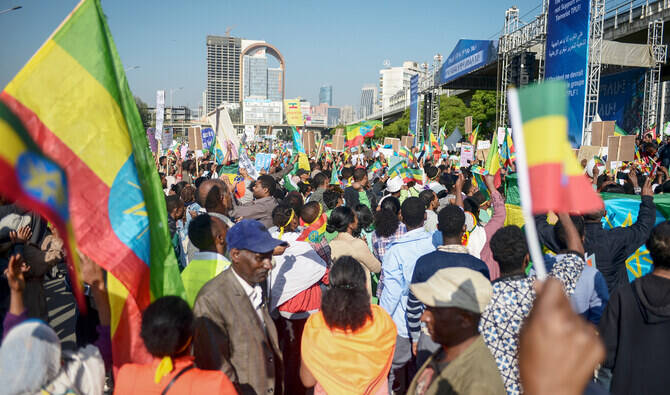
Eritrea is trying to cancel the mandate of a UN expert investigating alleged abuses, a document sent to the UN Human Rights Council showed, in a rare move that Western diplomats fear may set a precedent for states looking to escape scrutiny. (AP/File)
Short Url
Updated 25 June 2025
Follow

Eritrea seeks to end mandate of UN expert investigating abuses, document shows

  • The Special Rapporteur is mandated to document violations in Eritrea
  • The UN expert position was set up in 2012 by a group of African states

GENEVA: Eritrea is trying to cancel the mandate of a UN expert investigating alleged abuses, a document sent to the UN Human Rights Council showed, in a rare move that Western diplomats fear may set a precedent for states looking to escape scrutiny.

The Special Rapporteur, a position currently held by Sudanese human rights lawyer Mohamed Abdelsalam Babiker, is mandated to document violations in Eritrea, where civil society groups such as Human Rights Watch say impunity is widespread.

In a May report he described the situation as “critical,” highlighting cases of arbitrary detention, enforced disappearances and the use of lengthy national and military service terms that are driving thousands to flee.

Eritrea’s information ministry and its diplomatic mission in Geneva did not immediately respond to requests for comment.

Eritrea, which has long opposed the mandate, sent a large delegation to champion its proposal at a UN meeting in Geneva on Monday and voiced opposition to investigations targeting individual countries’ records.

States like Sudan, Russia and Iran backed it while the EU and Britain were among those who opposed it in a polarized debate, diplomats said.

The UN expert position was set up in 2012 by a group of African states and has been renewed annually by the Geneva-based council in an effort led recently by the European Union. But this year, Eritrea beat them to it and instead tabled a rival motion to discontinue the mandate, the document showed.

While states subject to UN investigations often lobby against them or try to dilute them, rights experts say there has never before been a proposal to end a mandate put before the council in its nearly 20-year history and worry it could embolden states looking to block accountability efforts. In 2023, Ethiopia tried to end a mandate early, before backing off.

“The EU recalls that the principles of sovereignty and non-interference in a state’s internal affairs do not free states from their obligations under international human rights law,” the EU delegate said in a statement shared with Reuters, arguing that Eritrea’s lack of consent “should not be used to escape international scrutiny.”

Many of the Geneva-based council’s other probes are typically brought by Western countries, such as those on Russia and Sudan. Sometimes the evidence they gather is used by international prosecutors.

A vote is expected next month.


Vietnam’s ruling Communist Party re-elects To Lam as general secretary

Updated 3 sec ago
Follow

Vietnam’s ruling Communist Party re-elects To Lam as general secretary

HANOI: Vietnam’s leader To Lam was re-elected Friday as the general secretary of its ruling Communist Party, securing a new five-year term in the country’s most powerful position and pledging to rev up economic growth in the export powerhouse.
Lam, 68, was reappointed unanimously by the party’s 180-member Central Committee at the conclusion of the National Party Congress, the country’s most important political conclave.
In a speech, he said he wanted to build a system grounded in “integrity, talent, courage, and competence,” with officials to be judged on merit rather than seniority or rhetoric.
No announcement was made about whether Lam will also become president. If he were to get both positions, he would be the country’s most powerful leader in decades, similar to Chinese leader Xi Jinping.
The Congress was framed by Vietnam’s defining national question: whether the country can transform itself into a high-income economy by 2045. During the meeting, Vietnam set a target of average annual GDP growth of 10 percent or more from 2026 to 2030.
The gathering brought together nearly 1,600 delegates to outline Vietnam’s political and economic direction through 2031. It also confirmed a slate of senior appointments, electing 19 members to the Politburo, the country’s top leadership body.
Beyond settling the question of who will lead Vietnam for the coming years, the Congress will also determine how the country’s single-party system responds to world grown increasingly turbulent as China and the United States wrangle over trade and Washington under President Donald Trump challenges a longstanding global order.
Vietnam’s transformation into a global manufacturing hub for electronics, textiles, and footwear has been striking. Poverty has declined and the middle class is growing quickly.
But challenges loom as the country tries to balance rapid growth with reforms, an aging population, climate risks, weak institutions and US pressure over its trade surplus. At the same time it must balance relations with major powers. Vietnam has overlapping territorial claims with China, its largest trading partner, in the South China Sea.
Lam has overseen Vietnam’s most ambitious bureaucratic and economic reforms since the late 1980s, when it liberalized its economy. Under his leadership, the government has cut tens of thousands of public-sector jobs, redrawn administrative boundaries to speed decision-making, and initiated dozens of major infrastructure projects.
Lam spent decades in the Ministry of Public Security before becoming its minister in 2016. He led an anti-corruption campaign championed by his predecessor, Nguyen Phu Trong. During his rise, Vietnam’s Politburo lost six of its 18 members during an anti-graft campaign, including two former presidents and Vietnam’s parliamentary head.