

Pakistan, UAE sign visa exemption deal for diplomatic, official passports 

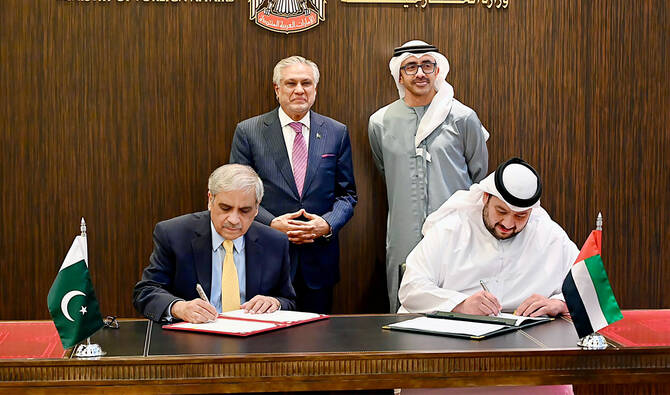
Pakistan Deputy Prime Minister Ishaq Dar (center left) and the United Arab Emirates Foreign Minister Sheikh Abdullah bin Zayed in Abu Dhabi (center right) observe the signing of the agreement after the 12th session of the Pakistan-UAE Joint Ministerial Commission (JMC), in Abu Dhabi, UAE, on June 24, 2025. (Pakistan's Foreign Office)
Short Url
Updated 25 June 2025
Follow

Pakistan, UAE sign visa exemption deal for diplomatic, official passports 

  • Dar meets UAE Foreign Minister Sheikh Abdullah bin Zayed in Abu Dhabi at 12th Joint Ministerial Commission
  • Revival of JMC after 12 years follows renewed push by Islamabad to deepen economic engagement with UAE

ISLAMABAD: Pakistan Deputy Prime Minister Ishaq Dar met with United Arab Emirates Foreign Minister Sheikh Abdullah bin Zayed in Abu Dhabi and signed a mutual visa exemption agreement for holders of diplomatic and official passports, Dar said on Wednesday.

The agreement was inked at the conclusion of the 12th session of the Pakistan-UAE Joint Ministerial Commission (JMC), held in Abu Dhabi after a gap of 12 years.

“My brother HH Sheikh Abdullah bin Zayed and I signed an agreement on mutual visa exemption for the holders of diplomatic & official passports of our two countries… This important step reflects our shared resolve to further strengthen our fraternal ties and deepen institutional collaboration across all levels,” In a post on X, Dar wrote.

The revival of the JMC follows a renewed push by Islamabad to deepen its economic engagement with the UAE, one of its closest regional partners and a major investor in infrastructure, energy and logistics projects, among others. 

Separately, Dar also met with Mohammed Saif Al Suwaidi, Director General of the Abu Dhabi Fund for Development (ADFD) on Tuesday, to discuss expanding cooperation in energy and infrastructure, and to explore new avenues for sustainable investment, state broadcaster Radio Pakistan said.

“They discussed enhancing development cooperation, expanding ADFD’s support for key infrastructure and energy projects in Pakistan, and exploring new avenues for sustainable investment,” Radio Pakistan said in a report.

Both sides reaffirmed their commitment to “deepening economic ties and promoting shared growth and prosperity.”

During the meeting, Dar presented Al Suwaidi with the Hilal-e-Quaid-e-Azam, one of Pakistan’s highest civil awards, on behalf of President Asif Ali Zardari, in recognition of his “exceptional contributions to the promotion of Pakistan-UAE cooperation.”
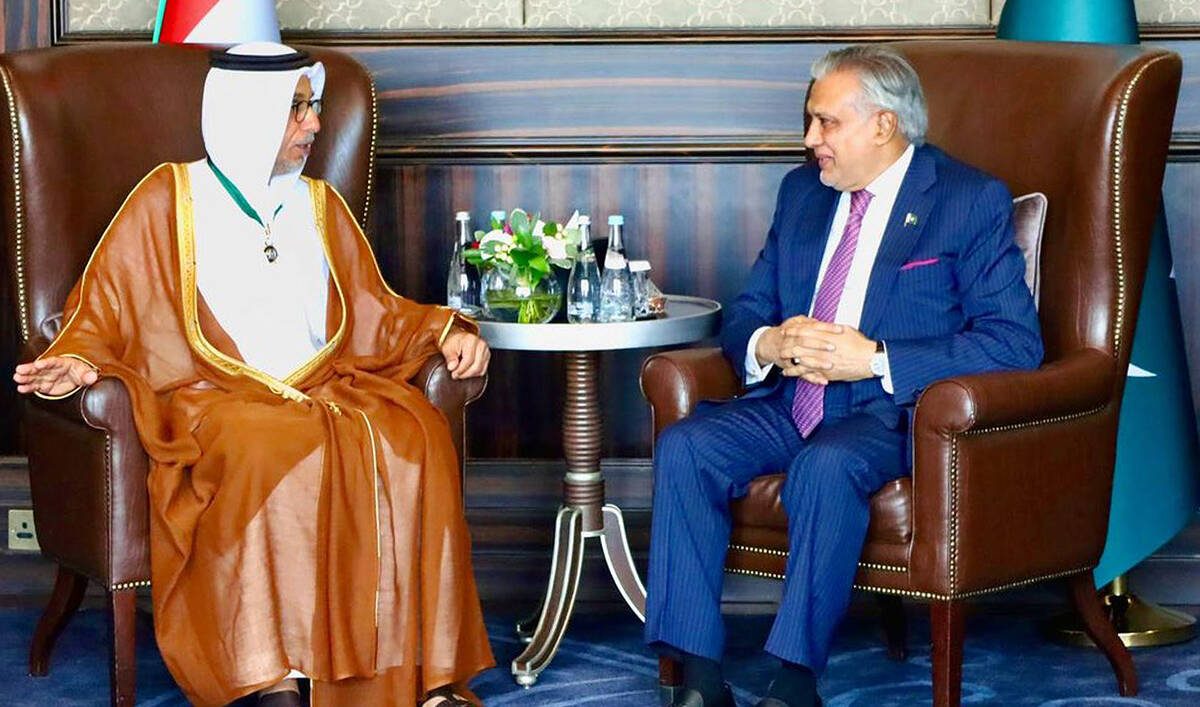


Pakistan Deputy Prime Minister and Foreign Minister Ishaq Dar (right) meets Director General of the Abu Dhabi Fund for Development (ADFD) Mohammed Saif Al-Suwaidi in Abu Dhabi on June 24, 2025. (Pakistan's Foreign Office)

The ADFD has backed several major development projects in Pakistan over the years, including highways, energy facilities, and airport upgrades.

The UAE is Pakistan’s third-largest trading partner after China and the United States. More than 1.5 million Pakistanis live and work in the UAE, sending back over $5 billion in remittances annually.

Bilateral trade reached approximately $10.9 billion in fiscal year 2023–24, including $2.08 billion in exports and $6.33 billion in imports, according to official Pakistani data.

Last year, the UAE pledged $10 billion in future investments in promising sectors of Pakistan’s economy.

Islamabad, struggling with high inflation and IMF-mandated fiscal tightening, has been courting strategic partners to help stabilize its economy and revive growth.


Pakistan says ensuring interfaith harmony key priority as nation marks Christmas

Updated 7 sec ago
Follow

Pakistan says ensuring interfaith harmony key priority as nation marks Christmas

  • Pakistan is home to over 3 million Christians, making it the third-largest religion in the country
  • PM Sharif economic well-being, equal opportunities for all in message to nation on Christmas

ISLAMABAD: Prime Minister Shehbaz Sharif on Thursday identified ensuring interfaith harmony and freedom of rights for all citizens, especially minorities, as his government’s key priorities as the nation marks Christmas today. 

Millions of Christians worldwide celebrate Dec. 25 as the birth of Jesus Christ, marking the day with religious and cultural festivities. The Christian community in Pakistan marks the religious festival every year by distributing gifts, decorating Christmas trees, singing carols and inviting each other to lavish feasts. 

Christianity is the third-largest religion in Pakistan, with results from the 2023 census recording over three million Christians, or 1.3 percent of the total population in the country. 

However, Christians have faced institutionalized discrimination in Pakistan, including being targeted for blasphemy accusations, suffering abductions and forced conversions to Islam. Christians have also complained frequently of being reserved for jobs considered by the masses of low status, such as sewage workers or brick kiln workers. 

“It remains a key priority of the Government of Pakistan to ensure interfaith harmony, protection of rights and freedoms, economic well-being, and equal opportunities for professional growth for all citizens without discrimination of religion, race, or ethnicity,” Sharif said in a statement issued by the Prime Minister’s Office (PMO). 

The Pakistani premier said Christmas was not only a religious festival but also a “universal message of love, peace, tolerance, and goodwill” for all humanity. 

Sharif noted the Christian community’s contributions to Pakistan’s socio-economic development were immense.

“Their significant services in the fields of education, health care, and other walks of life have greatly contributed to the promotion of social harmony,” the Pakistani prime minister said. 

Despite the government’s assurances of protection to minorities, the Christian community has endured episodes of violence over the past couple of years. 

In May 2024, at least 10 members of a minority Christian community were rescued by police after a Muslim crowd attacked their settlement over a blasphemy accusation in eastern Pakistan.

In August 2023, an enraged mob attacked the Christian community in the eastern city of Jaranwala after accusing two Christian residents of desecrating the Qur’an, setting Churches and homes of Christians on fire. 

In 2017, two suicide bombers stormed a packed church in southwestern Pakistan just days before Christmas, killing at least nine people and wounding up to 56. 

An Easter Day attack in a public park in 2016 killed more than 70 people in the eastern city of Lahore. In 2015, suicide attacks on two churches in Lahore killed at least 16 people, while a pair of suicide bombers blew themselves up outside a 130-year-old Anglican church in the northwestern city of Peshawar after Sunday Mass in 2013. 

The Peshawar blast killed at least 78 people in the deadliest attack on Christians in the predominantly Muslim country.