

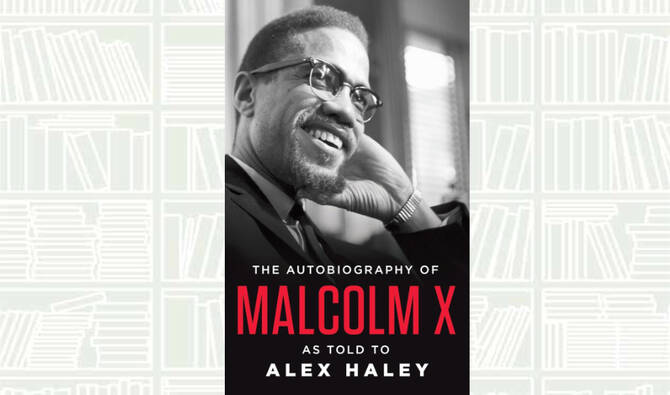
What We Are Reading Today: ‘The Autobiography of Malcolm X’

Photo/Supplied
Short Url
Updated 24 June 2025
Follow

What We Are Reading Today: ‘The Autobiography of Malcolm X’

  • Haley structures Malcolm’s blistering critiques — including his rejection of nonviolent protest and disillusionment with white liberalism — with journalistic precision

Author: Alex Haley

Malcolm X’s posthumously published 1965 autobiography, crafted with Alex Haley, remains an indispensable document of the 20th-century US.

Its visceral narrative traces an extraordinary metamorphosis — from street hustler to revolutionary thinker — and offers enduring lessons about systemic injustice and the power of self-reinvention.

The opening chapters detail the African American civil rights activist’s fractured youth: His father’s violent death (officially a car accident, though family attributed it to white supremacists), his mother’s mental collapse and his pivot to crime as “Detroit Red.”

What struck me most was how imprisonment became his unlikely crucible.

Through voracious self-education and conversion to the Nation of Islam, Malcolm X transformed into one of America’s most incisive racial commentators.

Haley structures Malcolm’s blistering critiques — including his rejection of nonviolent protest and disillusionment with white liberalism — with journalistic precision.

Malcolm X’s 1964 pilgrimage to Makkah proves the memoir’s most consequential pivot. Witnessing racial unity in the holy city fundamentally reoriented his worldview. He began advocating cross-racial coalition-building against oppression, a philosophical evolution abruptly halted by his February 1965 assassination.

Haley’s contribution deserves note: His disciplined prose tempers Malcolm’s polemical intensity, lending the narrative reflective depth without diluting its urgency.

While academics occasionally quibble over timeline specifics (notably Malcolm X’s early NOI chronology), the memoir’s moral core stands unchallenged.

What lingers for me is Malcolm X’s intellectual ferocity — how his advocacy for education as liberation weaponized knowledge against subjugation.

Malcolm X’s demand for Black self-determination continues to challenge America’s unresolved racial contradictions with unnerving relevance. Half a century later, the book remains essential reading not for easy answers, but for its uncompromising questions.


Book Review: ‘The Alchemist’ by Paulo Coelho

Updated 21 January 2026
Follow

Book Review: ‘The Alchemist’ by Paulo Coelho

I first picked up “The Alchemist” at a time when I felt restless; not unhappy but unsettled, with the quiet sense that I was meant for something more than routine and familiarity.

From the very first pages, Paulo Coelho’s novel felt less like a story I was reading and more like one that spoke to me gently.

The book follows Santiago, a young shepherd who dares to leave behind what is comfortable in search of a dream he cannot ignore. His journey across unfamiliar lands mirrors the internal journey many of us experience but rarely act on.

I found myself reflecting on my own hesitations, the dreams I had postponed, and the fears I had allowed to guide my decisions. 

What struck me most about “The Alchemist” was its simplicity. Coelho’s writing is clear and almost meditative, yet the ideas carry emotional weight.

The concept of a “personal legend” stayed with me long after I finished the book. It made me question whether I was truly listening to my own desires or simply following the path that felt safest. 

There were moments while reading when certain lines felt uncomfortably accurate, as if the book was holding up a mirror. It reminded me how easy it is to convince ourselves that timing is wrong, that circumstances are not ideal, or that dreams can wait. Coelho challenges that thinking, suggesting that the real risk lies in never trying at all. 

While some may find the book idealistic, I found comfort in its optimism. “The Alchemist” does not promise success without struggle, but it reframes setbacks as part of the journey rather than signs of failure. That perspective felt reassuring and grounding. 

By the time I reached the final pages, I did not feel like I had found all the answers, but I did feel more aware. “The Alchemist” encouraged me to trust my instincts, accept uncertainty and believe that ambition does not need justification.

For anyone who senses there is more waiting beyond fear and familiarity, this book has the power to gently shift how you see your own path.