

Pakistan boosts intelligence-sharing with Gulf states to curb drug trafficking

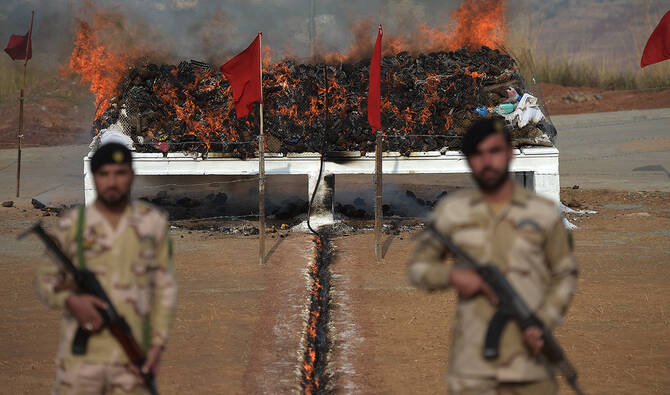
Seized drugs are burned in a pile by Pakistan's Anti-Narcotic Force (ANF) on the outskirts of Islamabad on December 24, 2019. (AFP/File)
Short Url
Updated 24 June 2025
Follow

Pakistan boosts intelligence-sharing with Gulf states to curb drug trafficking

  • The development comes months after Islamabad hosted the Pakistan-Gulf Cooperation Council Counter-Narcotics Conference
  • Oman has appointed its drug liaison officer in Pakistan, reflecting shared commitment to drug-free Gulf and South Asia

KARACHI: Pakistan and Gulf countries have intensified efforts to combat drug trafficking by enhancing intelligence-sharing, Pakistan’s Anti-Narcotics Force (ANF) said on Tuesday, with Oman appointing a drug liaison officer in Islamabad.

The development comes months after Islamabad hosted the Pakistan-Gulf Cooperation Council (Pak-GCC) Counter-Narcotics Conference, marking the first-ever formal assembly of anti-narcotics leadership from Pakistan and all six GCC member states, including Saudi Arabia, the United Arab Emirates, Qatar, Bahrain, Oman and Kuwait along with special observers from Italy.

For years, drug traffickers have exploited geographical and technological loopholes, using Pakistan as a transit hub and GCC nations as lucrative markets, according to the ANF. Despite ongoing efforts, the scale of smuggling seizures continues to expand, with traffickers now leveraging the dark web, cryptocurrency, and synthetic drug manufacturing to evade law enforcement agencies.

“During the conference, the Director-General of Narcotics of the Sultanate of Oman announced the appointment of drug liaison officer in Pakistan,” the ANF said in a statement.

“Acting on this decision, Mr. Suleiman Al-Hanai has been appointed as Oman’s first Drug Liaison Officer in Pakistan who has assumed his official responsibilities in Islamabad.”

The announcement signals a new phase in relations between the two countries as they align their efforts in the global war on drugs, according to the ANF. The appointment reflects a shared commitment by Pakistan and Oman to safeguard their societies and promote a drug-free environment across the Gulf and South Asian regions.

In recent years, the ANF has successfully intercepted tones of illicit drugs, dismantled trafficking rings through road, border, dry port, airport and sea routes, and strengthened global relationships. With its advanced intelligence capabilities and strategic operations, the ANF has intensified collaboration with GCC security agencies, ensuring that traffickers find no safe passage between these regions.

In June 2024, the ANF also stepped up its international cooperation against drug trafficking through a workshop backed by the United Nations Office on Drugs and Crime, uniting national, regional and global agencies to strengthen data-sharing and coordination.


UN torture expert decries Pakistan ex-PM Khan’s detention

Updated 12 December 2025
Follow

UN torture expert decries Pakistan ex-PM Khan’s detention

  • Khan’s party alleges government is holding him in solitary confinement, barring prison visits
  • Pakistan’s government rejects allegations former premier is being denied basic rights in prison

GENEVA: Pakistan’s former prime minister Imran Khan is being held in conditions that could amount to torture and other inhuman or degrading treatment, the United Nations’ special rapporteur on torture warned Friday.

Alice Jill Edwards urged Pakistan to take immediate and effective action to address reports of the 73-year-old’s inhumane and undignified detention conditions.

“I call on Pakistani authorities to ensure that Khan’s conditions of detention fully comply with international norms and standards,” Edwards said in a statement.

“Since his transfer to Adiala Jail in Rawalpindi on September 26, 2023, Imran Khan has reportedly been held for excessive periods in solitary confinement, confined for 23 hours a day in his cell, and with highly restricted access to the outside world,” she said.

“His cell is reportedly under constant camera surveillance.”

Khan an all-rounder who captained Pakistan to victory in the 1992 Cricket World Cup, upended Pakistani politics by becoming the prime minister in 2018.

Edwards said prolonged or indefinite solitary confinement is prohibited under international human rights law and constitutes a form of psychological torture when it lasts longer than 15 days.

“Khan’s solitary confinement should be lifted without delay. Not only is it an unlawful measure, extended isolation can bring about very harmful consequences for his physical and mental health,” she said.

UN special rapporteurs are independent experts mandated by the Human Rights Council. They do not, therefore, speak for the United Nations itself.

Initially a strong backer of the country’s powerful military leadership, Khan was ousted in a no-confidence vote in 2022, and has since been jailed on a slew of corruption charges that he denies.

He has accused the military of orchestrating his downfall and pursuing his Tehreek-e-Insaf (PTI) party and its allies.

Khan’s supporters say he is being denied prison visits from lawyers and family after a fiery social media post this month accusing army leader Field Marshal Asim Munir of persecuting him.

According to information Edwards has received, visits from Khan’s lawyers and relatives are frequently interrupted or ended prematurely, while he is held in a small cell lacking natural light and adequate ventilation.

“Anyone deprived of liberty must be treated with humanity and dignity,” the UN expert said.

“Detention conditions must reflect the individual’s age and health situation, including appropriate sleeping arrangements, climatic protection, adequate space, lighting, heating, and ventilation.”

Edwards has raised Khan’s situation with the Pakistani government.