

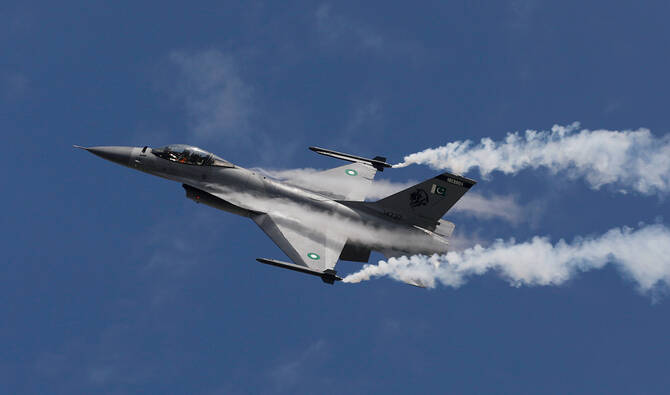
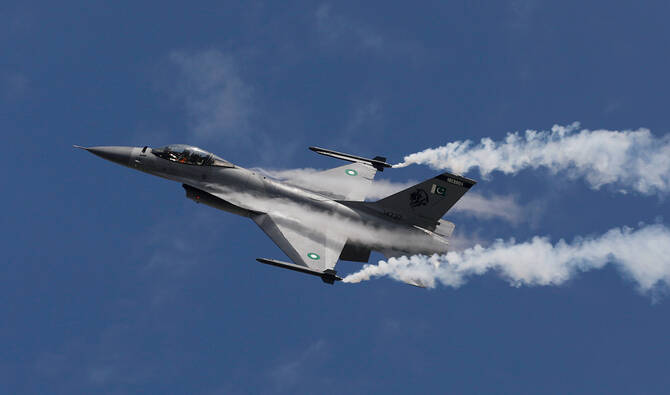
ISLAMABAD: A senior Pakistan Air Force (PAF) official said on Thursday that the PAF had downed eight Indian fighter jets during the brief military conflict between the two sides in May last year, stressing that Islamabad had not lost a single aircraft during the skirmishes.
Pakistani and Indian militaries engaged in the worst fighting between the neighbors in May last year. The conflict followed tensions that stemmed from India blaming Pakistan for an Apr. 22, 2025 attack in Pahalgam in Indian-administered Kashmir that killed 26 civilians, most of them tourists. Pakistan denied involvement and called for an independent investigation.
India launched cross-border strikes under “Operation Sindoor” on May 7, saying it had targeted militant infrastructure inside Pakistan and Pakistan-administered Kashmir. Pakistan said civilian areas were hit and responded days later with “Operation Bunyan-un-Marsoos,” targeting Indian military installations. Both countries exchanged drone and missile strikes, trading artillery fire as their fighter jets fought before agreeing to a ceasefire on May 10.
“I have to say that we (PAF) are at eight-zero, and our confirmed kills are four Rafales, one Su-30, one MiG-29, one Mirage 2000 jet and also one expensive multi-role unmanned aerial system,” PAF’s Air Vice Marshal Tariq Ghazi said.
Previously, Pakistan’s government and the military said it had shot down six Indian fighter jets.
The PAF official was speaking to reporters with Rear Admiral Shifaat Ali Khan of the Pakistan Navy and Pakistan military spokesperson Lt. Gen. Ahmed Sharif Chaudhry during a news briefing. The military personnel were speaking to the media as Pakistan marked one year since the conflict began.
Sharing details of the conflict, Ghazi said Pakistan’s cyber operations successfully disrupted Indian communications as the two militaries fought.
“Pakistan achieved early tactical superiority during the conflict and inflicted heavy losses on Indian aircraft,” the PAF official said.
During the briefing, Chaudhry highlighted what he described as strategic consequences of the May 2025 conflict, saying Pakistan had emerged stronger after the confrontation.
“Pakistan is consolidated as a net security stabilizer in the region,” he said. “We are a peace-loving country seeking peace within and beyond our borders.”
Chaudhry was referring to Islamabad’s recent mediation efforts amid the US-Iran conflict. Pakistan hosted the first round of talks between both sides and helped broker a ceasefire between the warring sides in April.
He said Pakistan was no longer viewed internationally as a source of regional “terrorism.”
“The Indian narrative of painting Pakistan as a source of terrorism stands buried forever,” Chaudhry said. “The international community now understands that Pakistan is not a perpetrator, but a victim of Indian-sponsored terrorism.”
Speaking on the occasion, Pakistan Navy’s deputy chief of staff said Islamabad was ready to strike the Indian Navy’s flagship carrier during the conflict.
“The Pakistan Air Force and Pakistan Navy were ready to hit the Indian ship Vikrant during Marka-e-Haq,” Khan said.
“But it did not dare come out of its safe haven.”
TENSIONS WITH KABUL
Chaudhry spoke about Pakistan’s recent tensions with Afghanistan. He said militant attacks in Pakistan had increased after the May conflict, accusing India of intensifying the use of proxies against Islamabad.
“We saw a surge in terrorist incidents post-Marka-i-Haq, (Battle for Truth)” Chaudhry noted.
Pakistan accuses India of backing militants that carry out attacks against its territory from Afghanistan. India and Afghanistan both deny these allegations.
Pakistan has been locked in conflict with Afghanistan since February this year, after the Afghan Taliban launched a surprise attack against Pakistan’s border forces for what they said was retaliation for earlier Pakistani strikes.
Pakistan launched a military operation in Afghanistan titled “Ghazab Lil Haq” or “Wrath for Truth,” claiming to have killed hundreds of Afghan Taliban members since February. Kabul alleges Pakistan has carried out deadly strikes on civilian infrastructure, including a hospital and a university, charges that Islamabad denies.
Responding to a question, he said the Afghan Taliban administration needed to choose between Pakistan and militants.
“Our choice is absolutely clear: it will always be Pakistan over everything,” Chaudhry said.


