

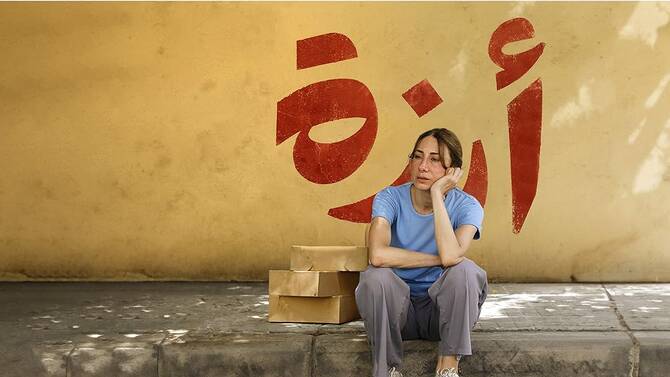
Review: Toronto Arab Film Festival screens searing ‘Arze’

Lebanese film “Arze” is directed by Mira Shabib. (Supplied)
Short Url
Updated 24 June 2025
Follow

Review: Toronto Arab Film Festival screens searing ‘Arze’

DUBAI: The Toronto Arab Film Festival, running from June 20- 29, screened the scathing yet poignant Lebanese film “Arze,” directed by Mira Shabib.

The ambitious “Arze” — which means "cedar" in Arabic — follows the story of Arze, a single mother supporting her teenage son and love-struck sister through a homemade pie delivery business. In an effort to improve their lives, she steals and sells her sister’s jewelry to buy a scooter for her son to use for deliveries. But when the scooter is stolen, mother and son embark on a frantic journey across Beirut to recover it.


On the surface, “Arze” tells a story that resonates deeply with many Lebanese families caught in financial limbo. It explores the emotional toll of such hardship, with questions arising as to whether one should leave the country or give up remnants of a once-comfortable life to survive Lebanon’s shifting socio-economic landscape.

Beneath the family drama lies sharp satire. Even the film’s title that references the cedar tree, a national symbol of Lebanese identity, carries layered meaning. Like the character herself, that identity appears fragmented, constantly lost amid the country’s sectarian divides. This is where the film truly shines: Arze, portrayed with emotional depth by Diamand Abou Abboud, dons various religious symbols and disguises to navigate Beirut’s fractured neighborhoods.


Shabib excels in exposing the farce of sectarianism, insinuating that Lebanon’s religious divisions are not deeply rooted but socially constructed and performative. Arze’s ability to blend into different communities simply by changing her appearance highlights how fragile and superficial these boundaries truly are.

In this sense, the film excels in its portrayal of a fourth main character: Beirut itself. Through Shabib’s lens, we are taken on a tour of a city so diverse it borders on overwhelming. Yet this diversity, rather than being a source of division, becomes a stage for a pointed critique, one that targets society’s fixation on appearances and its preference for the performative over lived reality.


Mohammed Bakri, filmmaker who championed Palestinian cause, dies aged 72

Updated 24 December 2025
Follow

Mohammed Bakri, filmmaker who championed Palestinian cause, dies aged 72

  • Bakri was known for his documentary “Jenin, Jenin” which denounced alleged Israeli war crimes in the Jenin refugee camp
  • The father of six also directed several socially conscious documentaries about the situation of Palestinian citizens of Israel

JERUSALEM: Actor and filmmaker Mohammed Bakri, a champion of the Palestinian cause, died on Wednesday aged 72, a hospital spokesperson said.
He was known for his documentary “Jenin, Jenin” and his commitment to the Palestinians, which led to frequent confrontations with Israeli authorities.
“Mohammed Bakri died this Wednesday at the Galilee Medical Center” in the northern Israeli city of Nahariya, hospital spokesperson Gal Zaid told AFP.
He died from heart and lung problems, according to his family.
Born in Galilee in 1953 into a Muslim family, Bakri was an Israeli citizen.
He appeared in leading Israeli films but was also directed by the French-Greek director Costa-Gavras and Italian filmmakers Paolo and Vittorio Taviani.
His role as a Palestinian inmate in an Israeli prison in the 1980s film “Beyond the Walls” earned him critical acclaim in Israel and around the world.
But his international renown grew with the release of 2002’s “Jenin, Jenin,” which denounced alleged Israeli war crimes in the Jenin refugee camp in the occupied West Bank during the Second Intifada.
The Israeli Supreme Court upheld a ban on the film in 2022, deeming it “defamatory.”
The father of six also directed several socially conscious documentaries about the situation of Palestinian citizens of Israel.
Arab-Israeli radio station A-Shams published a tribute on its social media, describing Bakri as a “free voice.”
“From his early days in theater, art was not simply a pastime for Mohammed Bakri, but a tool for raising awareness and engaging in dialogue,” the radio station said.
“The legacy left by Mohammed Bakri will remain, reminding us that art can be an act of resistance.”