

Pakistan stocks, rupee plunge as investors react to US strikes on Iran

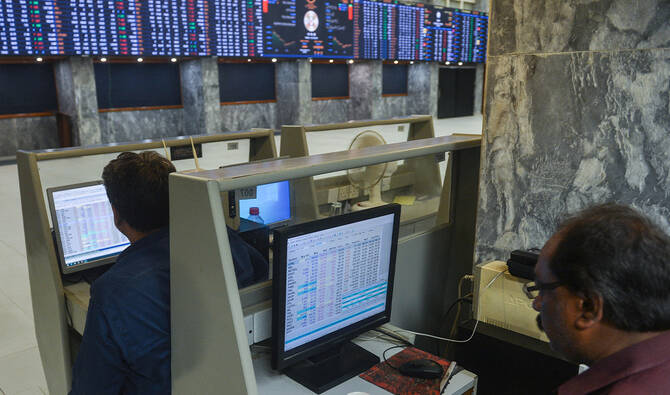
Brokers monitor the latests share prices at the Pakistan Stock Exchange in Karachi on February 14, 2023. (AFP/File)
Short Url
Updated 23 June 2025
Follow

Pakistan stocks, rupee plunge as investors react to US strikes on Iran

  • Benchmark KSE-10 Index dropped more than 3 percent to the lowest in over six weeks
  • Analysts say if there was no further escalation, value buying is expected to come through

KARACHI: Pakistan’s stocks and currency markets tumbled on Monday as investors reacted to the United States’ (US) foray into the Israel-Iran conflict, traders and analysts said.

The benchmark KSE-100 index dropped more than 3 percent to 116,167 points, the lowest in more than six weeks, while the rupee continued to weaken against the US dollar in the seventh consecutive session on Monday.

The index has plunged by nearly 5 percent since June 13 when Israel first hit Iranian military and nuclear targets in Natanz, Isfahan and Fordow, killing top generals and scientists among 78 people.

“Rising geopolitical tensions following a US strike on Iran shook investor confidence, causing the KSE-100 Index to drop by 3.2 percent,” Mohammad Waqas Ghani, head of research at JS Global Capital Ltd., told Arab News, adding that this was the fourth largest single-day decline in terms of points historically.

The attacks on Iran by the US, which followed Israeli strikes, have intensified the war and deepened geopolitical tensions in the Middle East, sending jitters to markets across the globe.

Monday’s 3.2 percent fall was the worst since May 8 when the index had plunged 5.9 percent day-on-day, according to Ghani.

“The spike in global oil prices has further intensified concerns about Pakistan’s external account vulnerabilities,” he added.

Cash-strapped Pakistan, which is trying to revive its debt-ridden economy with the help of International Monetary Fund’s $7 billion program, spent $17 billion on oil imports last year.

Raza Jafri, head of research at Intermarket Securities Ltd., attributed the day’s fall to redemptions at mutual funds and possible margin calls.

“Regional tensions are the main reason behind the weak sentiment,” he said, adding that if there was no further escalation, the value buying was expected to come through.

RUPEE DROP

The ongoing tensions have also impacted the Pakistani currency that lost another 0.06 percent as the greenback closed at Rs283.87, according to State Bank of Pakistan (SBP) data.

The rupee is constantly falling and has devalued 0.3 percent since the start of Iran-Israel conflict.

“The rupee is feeling the heat of this war, very negligibly though,” Zafar Paracha, secretary-general of the Exchange Companies Association of Pakistan, told Arab News.

“This stability in the exchange rate reflects the overall macroeconomic stability the country has achieved.”


Pakistan Navy launches fourth Hangor-class submarine ‘Ghazi’ in China 

Updated 6 sec ago
Follow

Pakistan Navy launches fourth Hangor-class submarine ‘Ghazi’ in China 

  • As per Islamabad’s agreement with Beijing, four of eight submarines will be built in China and the rest in Pakistan
  • Navy says all four submarines under construction in China undergoing sea trials, in final stages of being handed over

ISLAMABAD: The Pakistan Navy announced on Wednesday it has launched the fourth Hangor-class submarine named “Ghazi” at a Chinese shipyard in Wuhan, saying the development will help maintain peace in the region.

Pakistan’s government signed an agreement with China for the acquisition of eight Hangor-class submarines, the navy said in its press release. Under the contract, four submarines are being built in China while the remaining four will be constructed in Pakistan by the Karachi Shipyard and Engineering Works Ltd. company.

“With the launching of GHAZI, Pakistan Navy has achieved another significant milestone where all four submarines under construction in China are now undergoing rigorous sea trials and are in the final stages of being handed over to Pakistan,” the navy said. 

It further said that these submarines will be fitted with advanced weapons and sensors capable of engaging targets at standoff ranges. 

“Hangor-class submarines will be pivotal in maintaining peace and stability in the region,” the navy added. 

Pakistan’s agreement with China is set to strengthen its naval defenses, especially as ties with arch-rival India remain tense. 

India and Pakistan were involved in a four-day military confrontation in May this year before Washington intervened and brokered a ceasefire. Four days of confrontation saw the two countries pound each other with fighter jets, exchange artillery fire, missiles and drone strikes before peace prevailed. 

Pakistan’s air force used Chinese-made J-10 fighter jets in May to shoot down an Indian Air Force Rafale aircraft, made by France.

The altercation between the nuclear-armed neighbors surprised many in the military community and raised questions over the superiority of Western hardware over Chinese alternatives.

Islamabad has long been Beijing’s top arms customer, and over the 2020-2024 period bought over 60 percent of China’s weapons exports, according to data from the Stockholm International Peace Research Institute.