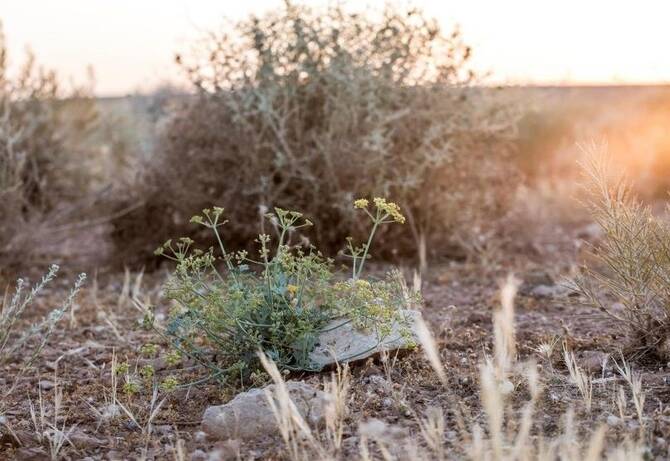
Hazaa plant flourishes in Saudi Arabia’s northern deserts

1 / 2
The Haza plant is rare to spot in the desert, especially since it also grows in rocky environments near water bodies. (SPA)
2 / 2
The Haza has a unique appearance that comes from its long, oval-shaped, gray-green leaves that have sharp points, making it easily recognizable in the wild. (SPA)
Short Url
Updated 24 June 2025
Follow

Hazaa plant flourishes in Saudi Arabia’s northern deserts

  • Due to its ability to handle high levels of drought and salinity, Hazaa has proved its ability to survive in difficult climatic conditions
  • Plant is known for its captivating aroma, and reaches a height of approximately 35 centimeters

RIYADH: Despite the harsh desert climate in Saudi Arabia’s Northern Borders province, native plants have found a way not only to survive but to thrive.

Among the local flora is the Hazaa plant, known scientifically as Ducrosia anethifolia.

The plant is native to the Arabian Peninsula, the Levant, Iran, Afghanistan and Pakistan, and is part of the Apiaceae family of plants, which includes crops and medicinal plants, according to the Saudi Press Agency.

Due to its ability to handle high levels of drought and salinity, Hazaa has proved its ability to survive in difficult climatic conditions.

The plant is known for its captivating aroma, and reaches a height of approximately 35 centimeters.

Haza is “A perennial plant that grows in areas close to valleys,” plant researcher Arwa Al-Otaibi told Arab News.

“After the seasonal floods in the spring period, between April and May, it appears abundantly, and its flowers resemble mint blossoms. It is most widespread in the Northern Borders region, specifically in Arar.”

“Regarding the environment, this plant is heat- and drought-tolerant, adapts well to the climate, and acts as a natural ground cover. It helps reduce desertification and lessens the winds that cause sandstorms. Most importantly, it requires very little water.”

“As for its benefits to humans, according to my mother, this medicinal plant was used extensively in the past. People used it to treat stomach ailments and bloating, to detoxify the body, and it also served as an anti-inflammatory remedy.”

Its unique appearance comes from its long, oval-shaped gray-green leaves that have sharp points, making the plant easily recognizable among other plants in the wild.

Along with its pleasant smell, the plant produces small, light yellow, umbrella-like flowers during the flowering season, with 12 to 18 flowers on each stem.

The Northern Borders region is also home to other plant species, including Reseda alba, Salsola tetrandra shrubs and lavender.


Absher Hackathon finalists highlight scale of Saudi tech talent

Updated 14 December 2025
Follow

Absher Hackathon finalists highlight scale of Saudi tech talent

  • World’s largest hackathon underscores growing national enthusiasm for tech innovation

RIYADH: Saudi Arabia’s push to position itself as a global hub for digital innovation was on display this weekend as the Absher Tuwaiq Hackathon 2025 — billed as the world’s largest hackathon — concluded with the announcement of finalist teams competing for prizes totaling SR1 million ($266,000). 

The three-day hackathon, organized by the Ministry of Interior in partnership with Tuwaiq Academy, brought together innovators from across the Kingdom to develop digital solutions aligned with the ministry’s digital transformation goals. 

The finalist teams recognized for their projects were: Shadow, Wusool, Watheeq , Tanabbah, HRS, Ikhlaa, Amal, Mustabiq, Al‑Dahna, Inspire, Saqour Al‑Watan, Thaqib, Sawt Al‑Mustaqbal, Manee, and YS Advance International. 

The finalists were announced at the end of the three-day Absher Tuwaiq Hackathon organized by the Ministry of Interior in partnership with Tuwaiq Academy. (AN photo/Supplied)

In addition to cash prizes, the competition offered SR450,000 in support from the National Technology Development Program, along with incubation opportunities at Invi Lab to help teams turn prototypes into market-ready products.   

Tariq Al‑Hamid, official spokesperson for the Absher Conference, told Arab News that the hackathon has generated strong momentum nationwide.  

This year’s event included more than 4,000 participants from all regions of the Kingdom — “a reflection of the growing national enthusiasm for digital innovation,” he said. 

HIGHLIGHT

The Absher Tuwaiq Hackathon brought together innovators from across the Kingdom to develop digital solutions aligned with the ministry’s digital transformation goals. 

According to Al‑Hamid, the 2025 event was structured around four specialized tracks: digital identity and security applications; artificial intelligence for predictive and proactive security; Internet of Things applications supporting field operations; and innovations to enhance or expand services on the Absher Platform. 

Tariq Al-Hamid (center) said that the hackathon’s impact extends beyond prize money. (Supplied)

He added that this focused approach allowed participants “to present high‑quality ideas and advanced prototypes at levels comparable to international competitions.” 

Participants also took part in more than 80 training programs delivered by global partners including Google Cloud, Meta, NVIDIA, and Huawei, an experience Al-Hamid said significantly strengthened both the competition and participants’ skills. 

Al-Hamid said that the hackathon’s impact extends beyond prize money. “More important than the cash reward is the opportunity to turn creative ideas into real products that make an impact on citizens, residents, and visitors.” 

Standout participants often attract the attention of leading national technology companies seeking new talent, he added. 

Participation was open to individuals and teams from across Saudi Arabia, from high school students to industry professionals, highlighting the inclusivity of the event and the breadth of the Kingdom’s innovation ecosystem.  

The hackathon forms part of the wider Absher Tuwaiq initiative, a core pillar of the upcoming Absher Conference 2025, which will empower more than 100,000 participants across seven technical tracks in 16 cities, in partnership with 20 local and international organizations. 

The conference, organized by the Ministry of Interior and Tuwaiq Academy, sponsored by Elm Company and held in strategic partnership with the Saudi Data and Artificial Intelligence Authority, will take place in Riyadh from Dec. 17 -19. 

The event will showcase national digital innovations and reinforce Saudi Arabia’s role in global technology.