

Saudi dentists bring new expertise home from South Korea’s top medical schools

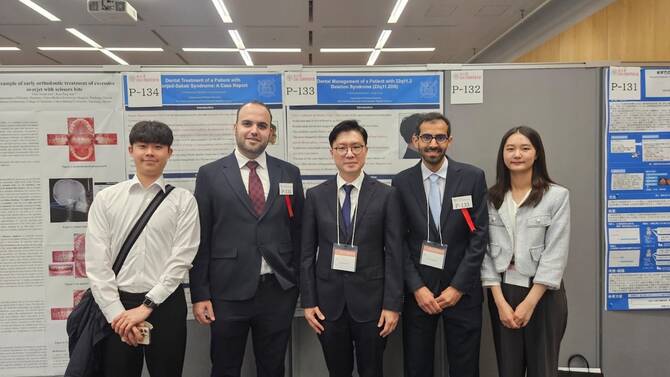
Saudi doctor Mohammed Al-Keshan, second left, participates in a conference at the Japanese Society of Pediatric Dentistry at Niigata University in May 2025. (Mohammed Al-Keshan)
Short Url
Updated 22 June 2025
Follow

Saudi dentists bring new expertise home from South Korea’s top medical schools

  • Around a dozen Saudi dentists begin residency programs in South Korea each year
  • They are part of a program by the health ministries of Saudi Arabia and South Korea

SEOUL: When Mohammed Al-Keshan left Makkah to study at South Korea’s top university, he found himself not just 8,000 km away from home, but also in a place where everything seemed different from what he was used to.

Al-Keshan was already 32 when he started his dentistry residency at Seoul National University in 2017. He neither knew the language nor culture — and at that time, there were not many other students in Saudi Arabia with the experience of pursuing medicine in South Korea.

“Then, there was loneliness and homesickness. The courses were more intense (than in Saudi Arabia), and it took me about two to three months to adapt,” he told Arab News.

“It is not easy to learn at this age and to adapt to the culture. But the Korean people are very kind and smart. They gave me a lot of advice and were very helpful.”

Al-Keshan became one of the pioneers in a growing medical exchange program under the Saudi and Korean ministries of health that places a special focus on dental sciences.

The Seoul National University School of Dentistry, where he was enrolled, is ranked among the world’s 30 best dental schools.

After completing his residency in 2021 and receiving certification from the Saudi board, he returned to South Korea in 2024 to pursue further professional development at a special facility that his school runs: the Seoul Dental Hospital for the Disabled.

While in other countries dental care for people with disabilities is usually part of general dental care or is provided at specialized departments within broader hospitals, the South Korean hospital is the only dedicated dental hospital in the world exclusively for patients with disabilities.

“Saudi Arabia does not have a whole dental hospital that is dedicated to special needs care like the one at SNU. So, I would like to coordinate with the Ministry of Health to create one when I go back to Saudi Arabia,” Al-Keshan said.

“I would like to help build something similar … because people with special needs have different dentistry needs.”

The Saudi-Korean medical exchange program, which began in 2015, initially accepted no more than five dentists per year. The number has since more than doubled.

“I was the second batch that the MOH was sending to Korea. The first batch was in 2015 … It was usually under five people,” Al-Keshan said.

“I think it is around 11 or 12. So, there are many more people now.”

For South Korea, the initiative has become a model for global cooperation in healthcare and is resulting in a wave of medical professionals bringing global expertise back to the Kingdom.

Prof. Lee Yong-moo, head of SNU Dental Hospital, vowed during this year’s commencement ceremony for Saudi doctors to continue the training program to “nurture talent to develop Saudi Arabia’s dentistry field” as the program “has become a milestone global exchange project that contributes to the growing friendship between the two countries.”


Saudi dentist Youssef Bajnaid after graduating from a Korean language course at the Hankuk University of Foreign Studies in 2024. (Youssef Bajnaid) 

As the program expands, more young Saudi dentists are coming to South Korea to study at its top institutions. One of them is Youssef Bajnaid, a 33-year-old dentist from Jeddah, who arrived in South Korea in 2023. He is currently completing his residency in prosthodontics at Kyung Hee University — another institution known for its strong dental program.

He studied dentistry for seven years in Saudi Arabia and after a year of learning Korean at the Hankuk University of Foreign Studies is now a resident in the prosthodontics department.

“My batch is 11 doctors … We want to know the (latest) treatment methods in the dentistry field,” he said.

“And I want to represent my country during my work. I get a lot of support from my professors at Kyung Hee … We have the same vision.”


Trump targets non-white immigrants in renewed xenophobic rants

Updated 43 min 38 sec ago
Follow

Trump targets non-white immigrants in renewed xenophobic rants

  • During a rally in Pennsylvania on Wednesday,  Trump doubled down on his tirade against Somali migrants
  • "Why is it we only take people from shithole countries,’ right? Trump told his cheering audience

WASHINGTON: Back in 2018, President Donald Trump disputed having used the epithet “shithole” to describe some countries whose citizens emigrated to the United States.
Nowadays, he embraces it and pushes his anti-immigrant and xenophobic tirades even further.
Case in point: during a rally in the northeastern state of Pennsylvania on Wednesday that was supposed to focus on his economic policy, the 79-year-old Republican openly ranted and reused the phrase that had sparked an outcry during his first term.
“We had a meeting and I said, ‘Why is it we only take people from shithole countries,’ right? ‘Why can’t we have some people from Norway, Sweden?’” Trump told his cheering audience.
“But we always take people from Somalia,” he continued. “Places that are a disaster. Filthy, dirty, disgusting, ridden with crime.”
Recently, he called Somali immigrants “trash.”
These comments are “more proof of his racist, anti-immigrant agenda,” Massachusetts Senator Ed Markey responded on X.

The Trump megaphone

Florida Republican lawmaker Randy Fine, on the other hand, defended Trump.
“Not all cultures are equal and not all countries are equal,” he said on CNN, adding “the president speaks in language that Americans understand, he is blunt.”
University of Albany history professor Carl Bon Tempo told AFP this type of anti-immigrant rhetoric has long thrived on the far-right.
“The difference is now it’s coming directly out of the White House,” he said, adding “there’s no bigger megaphone” in American politics.
On the campaign trail in 2023, Trump told a rally in New Hampshire that immigrants were “poisoning the blood of our country” — a remark that drew comparisons to Nazi dictator Adolf Hitler.
Now back in power, Trump’s administration has launched a sweeping and brutal deportation campaign and suspended immigration applications from nationals of 19 of the poorest countries on the planet.
Simultaneously, the president ordered white South African farmers to be admitted to the US, claiming their persecution.

No filter left

“Any filter he might have had is gone,” Terri Givens, a professor at the University of British Columbia in Canada and immigration policy expert, told AFP.
For Trump, it doesn’t matter whether an immigrant obeys the law, or owns a business, or has been here for decades, according to Syracuse University political science professor Mark Brockway.
“They are caught in the middle of Trump’s fight against an invented evil enemy,” Brockway told AFP.
By describing some immigrants as “killers, leeches, and entitlement junkies” — as Secretary of Homeland Security Kristi Noem did earlier this month — the White House is designating a target other than itself for American economic ire at a time when the cost of living has gone up and fears are growing over job security and loss of federal benefits.
But, Bon Tempo noted, “when immigration spikes as an issue, it spikes because of economics sometimes, but it also spikes because of these larger sort of foundational questions about what it means to be an American.”
On November 28, after an Afghan national attacked two National Guard soldiers in Washington, Trump took to his Truth Social network to call for “REVERSE MIGRATION.”
This notion, developed by European far-right theorists such as French writer Renaud Camus, refers to the mass expulsion of foreigners deemed incapable of assimilation.
Digging into the “Make America Great Again” belief system, many experts have noted echoes of the “nativist” current of politics from the 1920s in the US, which held that white, Anglo-Saxon, Protestant culture was the true American identity.
That stance led to immigration policies favoring Northern and Western Europe.
As White House senior adviser Stephen Miller recently wrote on X: “This is the great lie of mass migration. You are not just importing individuals. You are importing societies...At scale, migrants and their descendants recreate the conditions, and terrors, of their broken homelands.”