

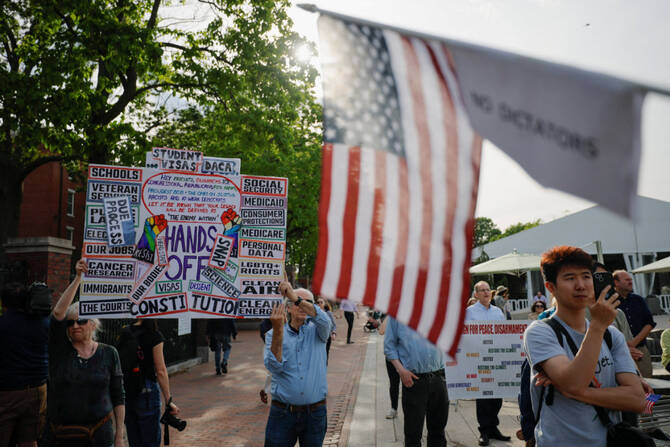

WASHINGTON: A federal judge on Friday blocked the Trump administration’s efforts to keep Harvard University from hosting international students, delivering the Ivy League school another victory as it challenges multiple government sanctions amid a battle with the White House.
The order from US District Judge Allison Burroughs in Boston preserves Harvard’s ability to host foreign students while the case is decided, but it falls short of resolving all of Harvard’s legal hurdles to hosting international students. Notably, Burroughs said the federal government still has authority to review Harvard’s ability to host international students through normal processes outlined in law.
Harvard sued the Department of Homeland Security in May after the agency abruptly withdrew the school’s certification to host foreign students and issue paperwork for their visas, skirting most of its usual procedures. The action would have forced Harvard’s roughly 7,000 international students — about a quarter of its total enrollment — to transfer or risk being in the US illegally. New foreign students would have been barred from coming to Harvard.
The university said it was experiencing illegal retaliation for rejecting the White House’s demands to overhaul Harvard policies related to campus protests, admissions, hiring and more. Burroughs temporarily had halted the government’s action hours after Harvard sued.
Less than two weeks later, in early June, President Donald Trump tried a new strategy. He issued a proclamation to block foreign students from entering the US to attend Harvard, citing a different legal justification. Harvard challenged the move, saying the president was attempting an end-run around the temporary court order. Burroughs temporarily blocked Trump’s proclamation as well. That emergency block remains in effect, and Burroughs did not address the proclamation in her order Friday.
“We expect the judge to issue a more enduring decision in the coming days,” Harvard said Friday in an email to international students. “Our Schools will continue to make contingency plans toward ensuring that our international students and scholars can pursue their academic work to the fullest extent possible, should there be a change to student visa eligibility or their ability to enroll at Harvard.”
Students in limbo
The stops and starts of the legal battle have unsettled current students and left others around the world waiting to find out whether they will be able to attend America’s oldest and wealthiest university.
The Trump administration’s efforts to stop Harvard from enrolling international students have created an environment of “profound fear, concern, and confusion,” the university said in a court filing. Countless international students have asked about transferring from the university, Harvard immigration services director Maureen Martin said.
Still, admissions consultants and students have indicated most current and prospective Harvard scholars are holding out hope they’ll be able to attend the university.
For one prospective graduate student, an admission to Harvard’s Graduate School of Education had rescued her educational dreams. Huang, who asked to be identified only by her surname for fear of being targeted, had seen her original doctoral offer at Vanderbilt University rescinded after federal cuts to research and programs related to diversity, equity and inclusion.
Harvard stepped in a few weeks later with a scholarship she couldn’t refuse. She rushed to schedule her visa interview in Beijing. More than a month after the appointment, despite court orders against the Trump administration’s policies, she still hasn’t heard back.
“Your personal effort and capability means nothing in this era,” Huang said in a social media post. “Why does it have to be so hard to go to school?”
An ongoing battle
Trump has been warring with Harvard for months after the university rejected a series of government demands meant to address conservative complaints that the school has become too liberal and has tolerated anti-Jewish harassment. Trump officials have cut more than $2.6 billion in research grants, ended federal contracts and threatened to revoke Harvard’s tax-exempt status.
On Friday, the president said in a post on Truth Social that the administration has been working with Harvard to address “their largescale improprieties” and that a deal with Harvard could be announced within the next week. “They have acted extremely appropriately during these negotiations, and appear to be committed to doing what is right,” Trump’s post said.
Trump’s administration first targeted Harvard’s international students in April. Homeland Security Secretary Kristi Noem demanded that Harvard turn over a trove of records related to any dangerous or illegal activity by foreign students. Harvard says it complied, but Noem said the response fell short and on May 22 revoked Harvard’s certification in the Student and Exchange Visitor Program.
The sanction immediately put Harvard at a disadvantage as it competed for the world’s top students, the school said in its lawsuit, and it harmed Harvard’s reputation as a global research hub. “Without its international students, Harvard is not Harvard,” the lawsuit said.
The action would have upended some graduate schools that recruit heavily from abroad. Some schools overseas quickly offered invitations to Harvard’s students, including two universities in Hong Kong.
Harvard President Alan Garber previously said the university has made changes to combat antisemitism. But Harvard, he said, will not stray from its “core, legally-protected principles,” even after receiving federal ultimatums.


