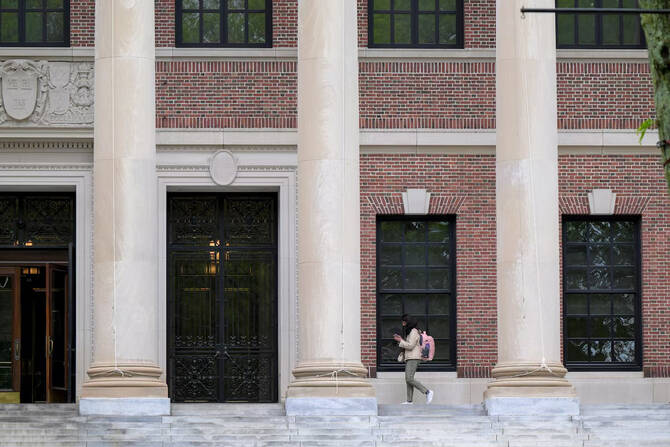
WASHINGTON: The US State Department directed all US missions abroad and consular sections to resume processing Harvard University student and exchange visitor visas after a federal judge in Boston last week temporarily blocked President Donald Trump’s ban on foreign students at the Ivy-League institution.
In a diplomatic cable sent on June 6 and signed by US Secretary of State Marco Rubio, the State Department cited parts of the judge’s decision, saying the fresh directive was “in accordance with” the temporary restraining order.
Under that order granted to Harvard late on Thursday, US District Judge Allison Burroughs blocked Trump’s proclamation from taking effect pending further litigation of the matter.
Trump had cited national security concerns as justification for barring international students from entering the United States to pursue studies at Harvard.
The Trump administration has launched a multi-pronged attack on the nation’s oldest and wealthiest university, freezing billions of dollars in grants and other funding and proposing to end its tax-exempt status, prompting a series of legal challenges.
Harvard argues the administration is retaliating against it for refusing to accede to demands to control the school’s governance, curriculum and the ideology of its faculty and students.
The State Department did not immediately respond to a request for comment.
In the cable, the State Department added that all other guidance regarding student visas remained in effect, including enhanced social media vetting and the requirement to review the applicants’ online presence.

US State Dept resumes processing Harvard student visas after judge’s ruling
https://arab.news/ba94h
US State Dept resumes processing Harvard student visas after judge’s ruling
- Under that order granted to Harvard late on Thursday, US District Judge Allison Burroughs blocked Trump’s proclamation from taking effect pending further litigation of the matter
Fourth Palestine Action activist ends hunger strike in UK prison
- Amy Gardiner-Gibson began eating again after 49 days of protest
- Govt rejects claims it ignored prison safety protocols
LONDON: A fourth Palestine Action activist imprisoned in the UK has ended her hunger strike.
Amy Gardiner-Gibson, who also uses the name Amu Gib, began eating again after 49 days of fasting, the campaign group Prisoners for Palestine said.
Qesser Zuhrah, another activist, ended her hunger strike last week after 48 days but said she might resume it next year, Sky News reported.
Four Palestine Action activists have now ended their hunger strikes while in prison, while four others are continuing to fast.
All of them are in prison on remand, awaiting trial for a series of high-profile alleged break-ins and criminal damage.
Palestine Action was proscribed as a terrorist organization and banned earlier this year.
On Tuesday, Swedish climate activist Greta Thunberg was arrested in central London at a rally in support of the hunger strikers.
The protesters are demanding that weapons factories in Britain with ties to Israel be shut down, as well as the removal of Palestine Action’s proscription.
They are also calling for immediate bail to be given to imprisoned pro-Palestine activists and an end to the alleged mistreatment of prisoners in custody.
Seven imprisoned members of Palestine Action have been transferred to hospital over the course of the hunger strike campaign. Doctors have highlighted concerns about the long-term impact of fasting on the activists.
Lawyers representing the group on Monday initiated legal action against the government over its alleged failure to follow prison safety regulations.
The government, however, has rejected this accusation, Sky News reported.
A Ministry of Justice spokesperson said: “Ministers do not intervene in individual cases. Where individuals are on remand, doing so would risk prejudicing ongoing legal proceedings and undermine the independence of the justice system.
“Concerns about welfare and process can be raised through established legal and administrative channels, including prison governors and ultimately the prison and probation ombudsman.
“Healthcare decisions are taken independently by qualified NHS professionals and appropriate care and oversight frameworks remain in place.”
The activists still on hunger strike include Heba Muraisi and Teuta Hoxha. Hoxha has been on remand for 13 months and her family told Sky News they feared she would die in prison.
Another of the activists, Kamran Ahmad, is believed to have been on hunger strike for 45 days and hospitalized three times.
Lewie Chiaramello, who has Type 1 diabetes, is on day 31 of his strike and taking part by fasting every other day.