

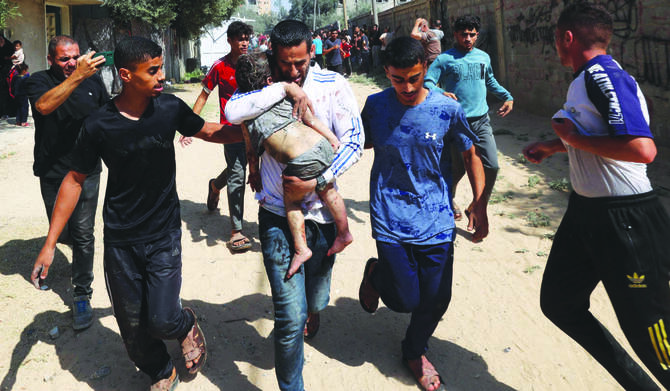

NEW YORK: Violence against children caught in multiple and escalating conflicts reached “unprecedented levels” last year, with the highest number of violations in Gaza and the West Bank, Congo, Somalia, Nigeria and Haiti, according to a UN report.
Secretary-General Antonio Guterres’ annual report on Children in Armed Conflict detailed “a staggering 25 percent surge in grave violations” against children under the age of 18 from 2023, when the number of such violations rose by 21 percent.
In 2024, the UN chief said children “bore the brunt of relentless hostilities and indiscriminate attacks, and were affected by the disregard for ceasefires and peace agreements and by deepening humanitarian crises.”
FASTFACT
UN Secretary-General Antonio Guterres said he is ‘appalled by the intensity of grave violations against children in the occupied Palestinian territories and Israel,’ and ‘deeply alarmed’by the increase in violations, especially the high number of children killed by Israeli forces.
He cited warfare strategies that included attacks on children, the deployment of increasingly destructive and explosive weapons in populated areas, and “the systematic exploitation of children for combat.”
Guterres said the UN verified 41,370 grave violations against children — 36,221 committed in 2024 and 5,149 committed earlier but verified last year.
The violations include killing, maiming, recruiting and abducting children, sexual violence against them, attacking schools and hospitals, and denying youngsters access to humanitarian aid.
The UN kept Israeli forces on its blacklist of countries that violate children’s rights for a second year, citing 7,188 verified grave violations by its military, including the killing of 1,259 Palestinian children and injury to 941 others in Gaza.
The Gaza Health Ministry has reported much higher figures, but the UN has strict criteria and said its process of verification is ongoing.
Guterres said he is “appalled by the intensity of grave violations against children in the occupied Palestinian territories and Israel,” and “deeply alarmed” by the increase in violations, especially the high number of children killed by Israeli forces.
He reiterated his calls on Israel to abide by international law requiring special protections for children, protection for schools and hospitals, and compliance with the requirement that attacks distinguish between combatants and civilians and avoid excessive harm to civilians.
The UN also kept Hamas and Palestinian Islamic Jihad on the blacklist.
Israel’s UN Mission did not immediately respond to a request for comment.
In Congo, the UN reported 4,043 verified grave violations against 3,418 children last year.
In Somalia, it reported 2,568 violations against 1,992 children.
In Nigeria, 2,436 grave violations were reported against 1,037 children. And in Haiti, the UN reported 2,269 verified grave violations against 1,373 children.
In the ongoing war following Russia’s February 2022 invasion of Ukraine, the UN kept the Russian armed forces and affiliated armed groups on its blacklist for a third year. The secretary-general expressed deep concern at “the sharp increase in grave violations against children in Ukraine” — 1,914 against 673 children.
He expressed alarm at the violations by Russian forces and their affiliates, singling out their verified killing of 94 Ukrainian children, injury to 577 others, and 559 attacks on schools and 303 on hospitals.
In Haiti, the UN put a gang, the Viv Ansanm coalition, on the blacklist for the first time.
Gangs have grown in power since the assassination of President Jovenel Moise in July 2021.
They are estimated to control 85 percent of the capital and have moved into surrounding areas.
In May, the US designated the powerful coalition representing more than a dozen gangs, whose name means “Living Together,” as a foreign terrorist organization.
Secretary-General Guterres expressed deep “alarm” at the surge in violations, especially incidents of gang recruitment and use, sexual violence, abduction, and denial of humanitarian aid.
The report said sexual violence jumped by 35 percent in 2024, including a dramatic increase in the number of gang rapes, but stressed that the numbers are vastly underreported.
“Girls were abducted for the purpose of recruitment and use, and for sexual slavery,” the UN chief said. In Haiti, the UN reported sexual violence against 566 children, 523 of them girls, and attributed 411 to the Viv Ansanm gang.
In Congo, the UN reported 358 acts of sexual violence against girls — 311 by armed groups and 47 by Congo’s armed forces. And in Somalia, 267 children were victims of sexual violence, 120 of them carried out by Al-Shabab extremists.
According to the report, violations affected 22,495 children in 2024, with armed groups responsible for almost 50 percent and government forces the main perpetrator of the killing and maiming of children, school attacks, and denial of humanitarian access.
The report noted a sharp rise in the number of children subjected to multiple violations — from 2,684 in 2023 to 3,137 in 2024.
“The cries of 22,495 innocent children who should be learning to read or play ball — but instead have been forced to learn how to survive gunfire and bombings — should keep all of us awake at night,” said Virginia Gamba, the UN special representative for children and armed conflict.
“We are at the point of no return,” she said, calling on the international community to protect children and the parties in conflict “to immediately end the war on children.”


