

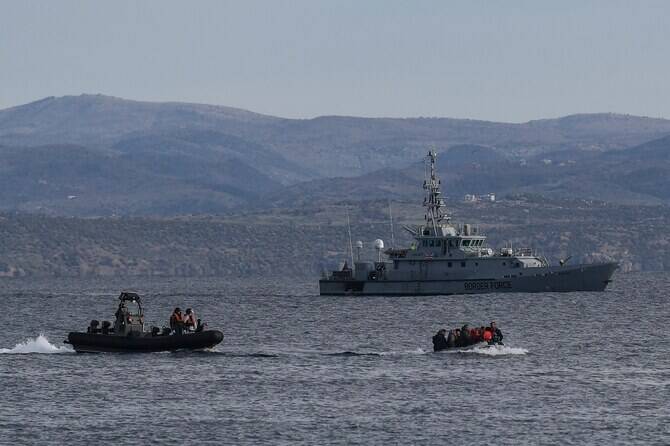
Greek coast guard says over 600 migrants rescued from 2 fishing boats

More than 600 migrants were rescued overnight and early Friday from two wooden fishing boats found sailing miles (kilometers) from the southernmost part of Greece, the country's coast guard said. (AFP/File)
Short Url
Updated 20 June 2025
Follow

Greek coast guard says over 600 migrants rescued from 2 fishing boats

  • The first fishing boat, carrying 352 people, was spotted overnight about 55 kilometers south of the tiny island of Gavdos
  • The second was found 90 kilometers south of the island of Crete with 278 people on board

ATHENS: More than 600 migrants were rescued overnight and early Friday from two wooden fishing boats found sailing miles (kilometers) from the southernmost part of Greece, the country’s coast guard said.

The first fishing boat, carrying 352 people, was spotted overnight about 30 nautical miles (35 miles, 55 kilometers) south of the tiny island of Gavdos, the coast guard said. Passengers were rescued by a ship from the European border patrol agency FRONTEX, aided by a coast guard patrol boat and four other vessels.

The second was found 50 nautical miles (about 60 miles, 90 kilometers) south of the island of Crete with 278 people on board. The passengers were picked up by a passing Portuguese-flagged cargo ship. In both cases, the migrants were transported to Crete.

There was no immediate information on the nationalities of those on board the two fishing boats.

Another two boats carrying migrants were located in the same area on Thursday, the coast guard said. One, carrying 73 men, was found south of Gavdos and another with 26 people, including one woman and three minors, was found near the coast of southern Crete.

The coast guard said those on the smaller boat told authorities they had set sail the previous evening from Tobruk in Libya, and had each paid smugglers either 4,000 euros ($5,500) for their passage to Greece. Two Sudanese teenagers, one aged 16 and the other 19, were arrested on suspicion of migrant smuggling after other passengers identified them as having been operating the boat.

Greece has been on one of the preferred routes into the European Union for people fleeing war and poverty in the Middle East, Africa and Asia for decades.

Arrivals from neighboring Turkiye to the east and the Libyan coast to the south spiked last year, with Greece recording more than 60,000 people arriving — the vast majority by sea — in 2024, compared to just over 48,000 the previous year, according to figures from the UN refugee agency.

As of June 15 this year, a total of 16,290 arrivals were recorded, with more than 14,600 of those by sea.

With authorities closely patrolling the eastern sea border with Turkiye to prevent migrant boats reaching nearby Greek islands, smugglers appear to be increasingly opting for the much longer and riskier Mediterranean Sea crossing from the north African coast to the southern tip of Greece, using larger boats into which they can cram more people.



In show of support, Canada, France open consulates in Greenland

Updated 50 min 11 sec ago
Follow

In show of support, Canada, France open consulates in Greenland

  • Decisions taken in a strong show of support for Greenland government amid threats by US President Trump to seize the island

COPENHAGEN, Denmark: Canada and France, which both adamantly oppose Donald Trump’s wish to control Greenland, will open consulates in the Danish autonomous territory’s capital on Friday, in a strong show of support for the local government.
Since returning to the White House last year, Trump has repeatedly insisted that Washington needs to control the strategic, mineral-rich Arctic island for security reasons.
The US president last month backed off his threats to seize Greenland after saying he had struck a “framework” deal with NATO chief Mark Rutte to ensure greater American influence.
A US-Denmark-Greenland working group has been established to discuss ways to meet Washington’s security concerns in the Arctic, but the details of the talks have not been made public.
While Denmark and Greenland have said they share Trump’s security concerns, they have insisted that sovereignty and territorial integrity are a “red line” in the discussions.
“In a sense, it’s a victory for Greenlanders to see two allies opening diplomatic representations in Nuuk,” said Jeppe Strandsbjerg, a political scientist at the University of Greenland.
“There is great appreciation for the support against what Trump has said.”
French President Emmanuel Macron announced Paris’s plans to open a consulate during a visit to Nuuk in June, where he expressed Europe’s “solidarity” with Greenland and criticized Trump’s ambitions.
The newly-appointed French consul, Jean-Noel Poirier, has previously served as ambassador to Vietnam.
Canada meanwhile announced in late 2024 that it would open a consulate in Greenland to boost cooperation.
The opening of the consulates is “a way of telling Donald Trump that his aggression against Greenland and Denmark is not a question for Greenland and Denmark alone, it’s also a question for European allies and also for Canada as an ally, as a friend of Greenland and the European allies also,” Ulrik Pram Gad, Arctic expert at the Danish Institute of International Studies, told AFP.
“It’s a small step, part of a strategy where we are making this problem European,” said Christine Nissen, security and defense analyst at the Europa think tank.
“The consequences are obviously not just Danish. It’s European and global.”

Recognition

According to Strandsbjerg, the two consulates — which will be attached to the French and Canadian embassies in Copenhagen — will give Greenland an opportunity to “practice” at being independent, as the island has long dreamt of cutting its ties to Denmark one day.
The decision to open diplomatic missions is also a recognition of Greenland’s growing autonomy, laid out in its 2009 Self-Government Act, Nissen said.
“In terms of their own quest for sovereignty, the Greenlandic people will think to have more direct contact with other European countries,” she said.
That would make it possible to reduce Denmark’s role “by diversifying Greenland’s dependence on the outside world, so that it is not solely dependent on Denmark and can have more ties for its economy, trade, investments, politics and so on,” echoed Pram Gad.
Greenland has had diplomatic ties with the European Union since 1992, with Washington since 2014 and with Iceland since 2017.
Iceland opened its consulate in Nuuk in 2013, while the United States, which had a consulate in the Greenlandic capital from 1940 to 1953, reopened its mission in 2020.
The European Commission opened its office in 2024.