

Chad hopes ‘green charcoal’ can save vanishing forests

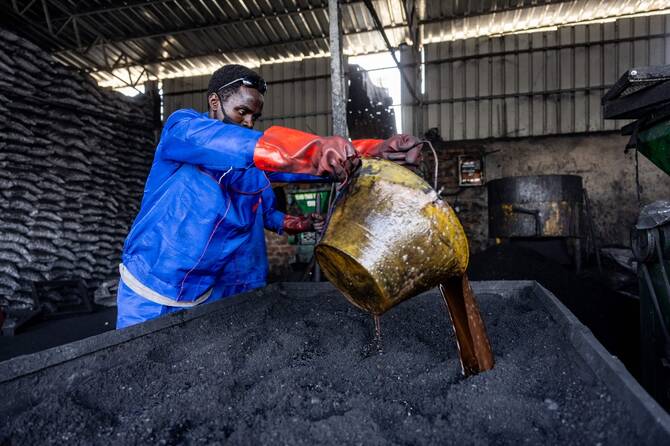
A worker pours a gum arabic-based binder at Grace International's green coal production site in N'Djamena, Chad. (AFP)
Short Url
Updated 20 June 2025
Follow

Chad hopes ‘green charcoal’ can save vanishing forests

  • Chad has lost more than 90 percent of its forest cover since the 1970s, hit by climate change and overexploitation of trees for household uses such as cooking

N’DJAMENA: As they zigzagged from one machine to another in the searing African sun, the workers were covered in black soot.
But the charcoal they were making is known as “green,” and backers hope it can save impoverished Chad from rampant deforestation.
Chad, a vast, landlocked country of 19 million people perched at the crossroads of north and central Africa, is steadily turning to desert.
It has lost more than 90 percent of its forest cover since the 1970s, hit by climate change and overexploitation of trees for household uses such as cooking, officials say.
“Green charcoal” aims to protect what forest is left.
Made from discarded plant waste such as millet and sesame stalks or palm fronds, it is meant to save trees from being chopped down for cooking.
The product “releases less emissions than traditional charcoal, it doesn’t blacken your pots, it has high energy content and lasts up to three times longer than ordinary charcoal,” said Ousmane Alhadj Oumarou, technical director of the Raikina Association for Socioeconomic Development (Adser).
“Using one kilogramme of green charcoal saves six kilogrammes of wood.”
The group has installed a production facility in Pont Belile, just north of the capital, N’Djamena.
There, workers grind up burnt plant waste, then mix it with gum arabic, which helps it ignite, and clay, which makes it burn more slowly.
The resulting black nuggets look like ordinary charcoal.
Like the traditional kind, it emits CO2 when it burns — but less, said Souleymane Adam Adey, an ecologist at the University of N’Djamena.
And “it contributes to fighting deforestation, by ensuring the trees that aren’t cut down continue to capture and store carbon,” he said.

The conflict in neighboring Sudan, which is facing one of the worst humanitarian crises in the world, is adding to pressure on Chad, which has become home to more than 800,000 Sudanese refugees since 2023 — double the 400,000 it already hosted.
“Desertification has progressed in the regions that have been hosting Sudanese refugees for the past two years,” said Adser’s director, 45-year-old businessman Ismael Hamid.
Adser invested 200 million CFA francs (about $350,000) to launch the project, then won backing from the World Bank, which buys the charcoal for 750 CFA francs per kilogramme.
The United Nations refugee agency, UNHCR, distributes the charcoal in refugee camps in eastern Chad.
But Hamid said he hoped to expand production and slash prices to 350 to 500 CFA francs per kilo to make “green charcoal” available and affordable nationwide.
The plant currently produces seven to nine tons per day.
“If we want to meet the country’s needs, we have to increase our output by at least a factor of 10,” said Hamid, calling for subsidies to support the budding sector.
Environment Minister Hassan Bakhit Djamous told AFP the government was working on a policy to promote such projects.
“We need to bet on green charcoal as an energy source for the future of our country,” he said.
jbo-emp/lnf/jhb/cw


Saudi ambassador becomes first foreign envoy to meet Bangladesh’s new PM

Updated 22 February 2026
Follow

Saudi ambassador becomes first foreign envoy to meet Bangladesh’s new PM

  • Tarique Rahman took oath as PM last week after landslide election win
  • Ambassador Abdullah bin Abiyah also meets Bangladesh’s new FM

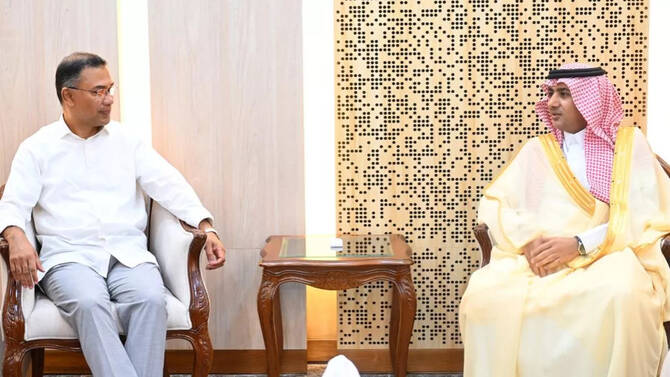
Dhaka: Saudi Arabia’s ambassador to Dhaka became on Sunday the first foreign envoy to meet Bangladesh’s new Prime Minister Tarique Rahman since he assumed the country’s top office.

Rahman’s Bangladesh Nationalist Party made a landslide win in the Feb. 12 election, securing an absolute majority with 209 seats in the 300-seat parliament.

The son of former Prime Minister Khaleda Zia and former President and BNP founder Ziaur Rahman, he was sworn in as the prime minister last week.

The Saudi government congratulated Rahman on the day he took the oath of office, and the Kingdom’s Ambassador Abdullah bin Abiyah was received by the premier in the Bangladesh Secretariat, where he also met Bangladesh’s new foreign minister.

“Among the ambassadors stationed in Dhaka, this is the first ambassadorial visit with Prime Minister Tarique Rahman since he assumed office,” Saleh Shibli, the prime minister’s press secretary, told Arab News.

“The ambassador conveyed greetings and best wishes to Bangladesh’s prime minister from the king and crown prince of Saudi Arabia … They discussed bilateral matters and ways to strengthen the ties among Muslim countries.”

Rahman’s administration succeeded an interim government that oversaw preparations for the next election following the 2024 student-led uprising, which toppled former leader Sheikh Hasina and ended her Awami League party’s 15-year rule.

New Cabinet members were sworn in during the same ceremony as the prime minister last week.

Foreign Minister Khalilur Rahman is a former UN official who served as Bangladesh’s national security adviser during the interim government’s term.

He received Saudi Arabia’s ambassador after the envoy’s meeting with the prime minister.

“The foreign minister expressed appreciation for the Saudi leadership’s role in promoting peace and stability in the Middle East and across the Muslim Ummah. He also conveyed gratitude for hosting a large number of Bangladeshi workers in the Kingdom and underscored the significant potential for expanding cooperation across trade, investment, energy, and other priority sectors, leveraging the geostrategic positions of both countries,” the ministry said in a statement.

“The Saudi ambassador expressed his support to the present government and his intention to work with the government to enhance the current bilateral relationship to a comprehensive relationship.”

Around 3.5 million Bangladeshis live and work in Saudi Arabia. They have been joining the Saudi labor market since 1976, when work migration to the Kingdom was established during the rule of the new prime minister’s father.

Bangladeshis are the largest expat group in the Kingdom and the largest Bangladeshi community outside Bangladesh and send home more than $5 billion in remittances every year.