
IRIBA, Chad: Nadjala Mourraou held her haggard two-year-old son in her henna-tattooed hands for the medics to examine. Then came the painful diagnosis: little Ahma, like many of his fellow Sudanese refugees, was severely malnourished.
The pair were toward the front of a long line snaking out of the doctors’ tent at an already overcrowded refugee camp in east Chad, creaking under the strain as more and more people fleeing the civil war across the nearby border with Sudan turn up.
“We’re suffering from a lack of food,” complained the mother, who fled the fighting in Nyala, in Sudan’s South Darfur region, with Ahma more than a year ago.
Since their arrival at the Touloum camp, Mourraou added that all she and Ahma had to eat each day was a bowl of assida, a porridge made from sorghum.
Yet, as with other conditions at the camp, this meagre ration could deteriorate further as the war between the Sudanese army and the paramilitary Rapid Support Forces drags on.
Besides killing tens of thousands, the two-year conflict has uprooted 13 million people, more than three million of whom have fled the country as refugees.
Chad has taken in more than 770,000 of them, according to the UN refugee agency — with many more likely on their way.
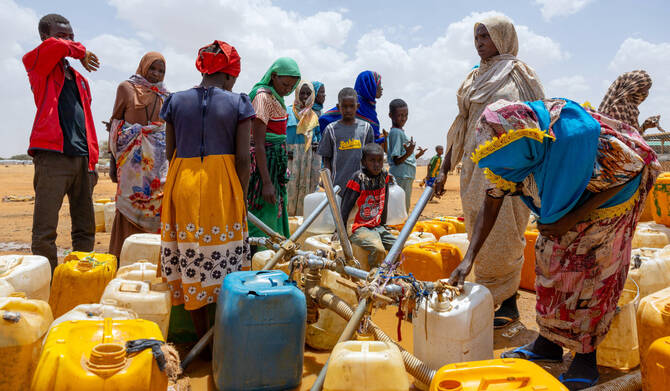
Between 25,000 and 30,000 Sudanese refugees already live in the makeshift sheet metal and white canvas tents, packed together across the arid Touloum camp, according to sources.
Recently, more and more of them have become malnourished, said Dessamba Adam Ngarhoudal, a nurse with medical charity Doctors Without Borders, or MSF.
“Out of 100 to 150 daily consultations, nearly half of them deal with cases of malnutrition,” said the 25-year-old medic.
The worst cases are sent to the Iriba district hospital, around half an hour’s drive away.
But the hospital was powerless to stop the first Sudanese infant dying of malnutrition under its care.
“Since the beginning of the month, we have already exceeded the capacity of the malnutrition ward at the hospital,” said MSF nurse Hassan Patayamou recently.
“And we expect admissions to continue to rise as the hot season progresses and temperatures rise above 40 degrees Celsius (104 degrees Fahrenheit).”
With the fighting set to grind on, Chad’s government fears the number of Sudanese refugees in the country could soon reach nearly a million.
That burden would be too heavy for impoverished Chad to bear alone, argues the UN High Commissioner for Refugees.
The refugee agency was seeking $409 million in aid to help the Sahel country — only 14 percent of which it had received by the end of February.
“The Chadian people have a tradition of welcoming their Sudanese brothers in distress,” said Djimbaye Kam-Ndoh, governor of Wadi Fira province where the Touloum camp is located.
“But the province’s population has practically doubled, and we’re asking for major support.”
Humanitarian groups are worried about the impact of US President Donald Trump’s move to freeze America’s foreign aid budget, while other donors, notably in Europe, have also made cuts to their financing.
“Hundreds of thousands of lives are at stake,” Alexandre Le Cuziat, the UN’s World Food Programme deputy director in Chad, said in a phone call.
Nearly 25 million people are suffering from acute food insecurity in Sudan itself, according to the WFP.
And with the rainy season just under two months away, medics fear outbreaks of diseases.
“We’re preparing for an explosion of cases of malnutrition and malaria,” said Samuel Sileshi, emergencies services coordinator for MSF in Central Darfur state.
“This year, we are also facing measles epidemics in Darfur,” he said.
That unhealthy cocktail of diseases, he warned, “could have devastating consequences,” not least for children.