Pakistan unveils new EV policy with over $353 million in subsidies for electric bikes, rickshaws

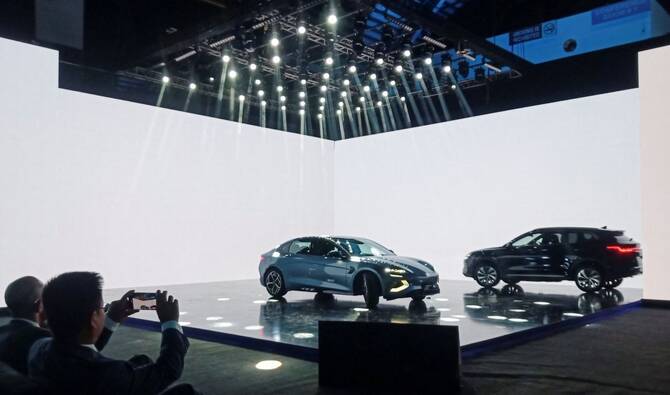
An attendee takes photos of the Chinese electric vehicle BYD models on display, during an event to announce the plans to open a car production plant in Pakistan, in Lahore, Pakistan August 17, 2024. (REUTERS)
Short Url
Updated 19 June 2025
Follow

Pakistan unveils new EV policy with over $353 million in subsidies for electric bikes, rickshaws

  • The new policy for 2025-30 aims to cut $1 billion in fuel costs and 4.5 million tons of emissions
  • Pakistan currently has about 70,000 electric motorcycles, 5,200 electric cars and 450 electric buses

ISLAMABAD: The government on Thursday unveiled Pakistan’s new Electric Vehicle (EV) Policy 2025-30, announcing a five-year subsidy of over Rs100 billion ($353 million) for electric bikes and rickshaws.

The move comes amid a steady rise in electric vehicle adoption in a market traditionally dominated by Japanese automakers. Pakistan’s urban areas exhibit some of the world’s highest levels of air pollution, with road transport being a major contributor.

Chinese and Korean EV brands are increasingly entering the local market, making these vehicles a more frequent sight in cities such as Islamabad, Lahore and Karachi.

“Total subsidy over five years will be over Rs100 billion and it will basically be focused on the two-and-three wheelers,” Haroon Akhtar Khan, a close aide to Prime Minister Shehbaz Sharif, told a news conference. “We will have subsidized financing for 116,053 electric bikes, 3,171 rickshaws.”

“A Rs9 billion [$31 million] subsidy will be allocated, and it is already there in the 2025-26 budget,” he continued.

Khan added the government also allocated a 25 percent quota for women to increase their mobility.

He projected the initiative will help with the annual savings of Rs283 billion ($1 billion) in fuel costs and a reduction of 4.5 million tons of carbon emissions.

Khan said Pakistan’s new EV policy was aimed at disincentivizing internal combustion engine vehicles and promoting electric mobility to help cut greenhouse gas emissions that damage the earth’s ozone layer.

He informed Pakistan has around 70,000 electric motorcycles, 5,200 electric cars and 450 electric buses, adding the government issued 61 manufacturing licenses for electric two- and three-wheelers including motorcycles and rickshaws.

Khan also acknowledged the country lacks adequate EV charging infrastructure and faces challenges related to the absence of safety and quality standards.

He said the government aims for 30 percent of all new vehicles produced over the next five years to be electric.

“So, we are establishing new electric vehicle testing rules, safety and emission standards,” he said.

“We have to make sure that if anybody is manufacturing an electric vehicle there are no emissions,” he continued. “Another thing is battery disposal. We don’t want to create any environmental problem that the battery is not disposed properly.”

The country previously approved an ambitious National Electric Vehicles Policy (NEVP) in 2019, aiming for electric vehicles to make up 30 percent of all passenger car and heavy-duty truck sales by 2030.

The policy set an even more ambitious target of making 90 percent of all vehicle sales electric by 2040.



Pakistan denies canceling UAE deal, adds Islamabad airport to privatization plan

Updated 4 sec ago
Follow

Pakistan denies canceling UAE deal, adds Islamabad airport to privatization plan

  • Government refutes media reports of scrapped airport lease, says no such deal was ever concluded
  • Pakistan says open bidding plan has no political or diplomatic basis and is driven by economic reasons

KARACHI: Pakistan on Saturday rejected media reports that it had canceled a proposed lease arrangement for the United Arab Emirates to run Islamabad airport, saying no such deal had ever been signed, while confirming that the aviation facility in the capital has been placed in the government’s active privatization program.

The statement followed media reports suggesting that Pakistan had abandoned a government-to-government arrangement with the UAE to outsource airport operations, citing delays by Abu Dhabi in nominating an operating entity and claiming that Pakistani authorities had inferred a loss of interest.

“The Privatization Commission has noticed some misleading reports that suggest ‘canceling of any proposed agreement for Islamabad International Airport’ and strongly refutes such reports,” the commission said in a statement.

“In this context, the claim that ‘Pakistan has canceled any lease agreement with the UAE’ is contrary to the facts and misleading, as no such agreement or lease was ever signed for any of the airports including Islamabad International Airport,” it added.

The statement said the government had decided in November last year to move away from a government-to-government framework and adopt an open bidding process for airport concessions after strong investor interest.

“This decision does not have any political or diplomatic background, and is based purely on economic and procedural reasons,” it said.

As part of that process, Islamabad International Airport has now been formally included in the active privatization program under a long-term concession model, aligning it with ongoing plans for airports in Karachi and Lahore.

The government said the competitive bidding process would provide a level playing field for domestic and international investors, including those from partner countries such as the UAE, as Pakistan seeks to modernize the aviation sector and attract private investment.