



THE HAGUE, Netherlands: Locals, art lovers and diplomats like to meet over a meal and a drink in the historic Gastrobar Berlage behind a landmark art museum in The Hague.
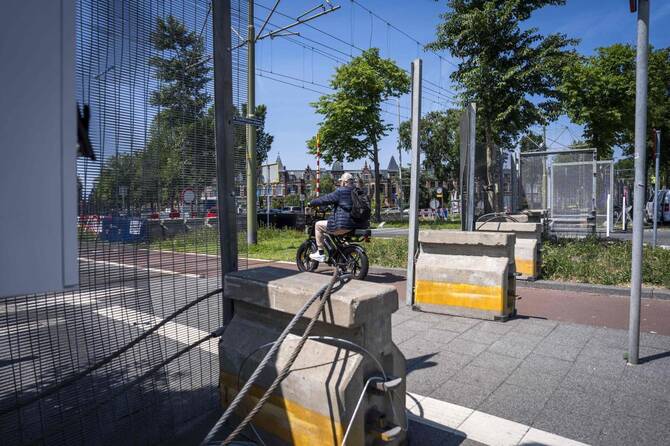
But the usual stream of visitors turned into a trickle when fences started rising outside as part of super-tight security around a meeting of NATO leaders that is smothering the Dutch city in a massive military and police operation called Orange Shield.
Parts of the usually laid-back city, where NATO Secretary General Mark Rutte used to ride his bicycle to work while munching on an apple when he was prime minister of the Netherlands, are turning into a military fortress.
“It’s dead,” Berlage owner Bianca Veenhof said as she looked at an almost empty terrace at the start of what should have been Wednesday’s lunchtime rush.
Parking spots have been blocked off by freshly installed security fencing, workers in nearby offices have been told to stay home and public transit lines near the grounds have been diverted.
The city that markets itself as the global hub of peace and justice because of the international courts it hosts is turning into a city of security and inconvenience for the June 24-25 meeting that is scheduled to feature leaders of the 32-nation alliance, including US President Donald Trump.
The summit comes as global geopolitical tensions soar and conflict escalates in the Middle East.
About half of the Netherlands’ police force will be on duty
In what they are calling the biggest security operation ever staged in the Netherlands, authorities are locking down parts of the city, closing off roads, and shutting down airspace.
Temporary barricades and metal mesh fences surrounding the World Forum summit venue are just a fraction of the measures that radiate out from The Hague.
Some 27,000 police officers – about half of the country’s entire force – will be on duty around the summit along with more than 10,000 defense personnel.
Military police will protect delegations. Frigates will patrol the North Sea, F-35 fighter jets and Apache helicopters will take to the skies and air defense systems will be on alert. Bomb squads will comb the venue for explosives.
Convoys carrying leaders will be whisked with military police escorts along closed-off highways from airports to their accommodations. While civilian drones are banned from the airspace around the summit and other key locations, police and military drones will buzz around the skies over the summit venue and other locations where leaders gather.
Police and riot police also will be on hand for several protests that have already been announced, including an effort by demonstrators to shut down a major highway into the city.
Then there are the less visible but no less important measures being taken to provide cybersecurity. The country’s top counterterrorism official declined to go into details.
Boosting NATO spending and Ukraine are on the agenda
The leaders are scheduled to have dinner with Dutch King Willem-Alexander at his palace in a forest in the city Tuesday night before a meeting the next day where they are expected to agree a new defense spending target.
While the leaders are dining with the Dutch royals, foreign and defense ministers from NATO nations will hold meetings at the summit venue to discuss issues including the war in Ukraine.
When the government heads meet Wednesday, they will seek agreement on ramping up military spending as Trump insists Europe must look after its own security, while Washington focuses on China and its own borders.
The Hague is known for hosting international courts
The summit venue is a conference center and theater close to the building that once housed the UN tribunal for the former Yugoslavia where Bosnian Serb leader Radovan Karadzic, his military chief Ratko Mladic, and others were convicted of war crimes.
The venue also is close to the headquarters of the Nobel Peace Prize-winning Organization for the Prohibition of Chemical Weapons and the European Union’s law enforcement and judicial cooperation agencies.
Just down the road is the International Criminal Court, whose chief prosecutor and four judges have been slapped with sanctions by Trump. Closer still is the top United Nations court, the International Court of Justice, whose judges settle disputes between nations.
Getting away from it all
Many residents near the summit are not sticking around to watch the event unfold.
At the end of the week, Berlage will close its doors and sunny terrace for a week, only reopening when the NATO bandwagon has moved on.
Veenhof estimates the enforced closure and weeks of plummeting bookings will cost the bistro up to €150,000 ($173,000) in lost earnings.
Veenhof and her partner Bauke van Schaik, who is the chef at Berlage, have had enough of the summit already and are fleeing the city for the duration.
“Good friends of ours live in Portugal, so we going there for a few days,” she said. “We’ll be a bit further away from all the misery and frustration.”


