

Trump hosts Pakistan army chief for unprecedented lunch, confirms Iran discussed

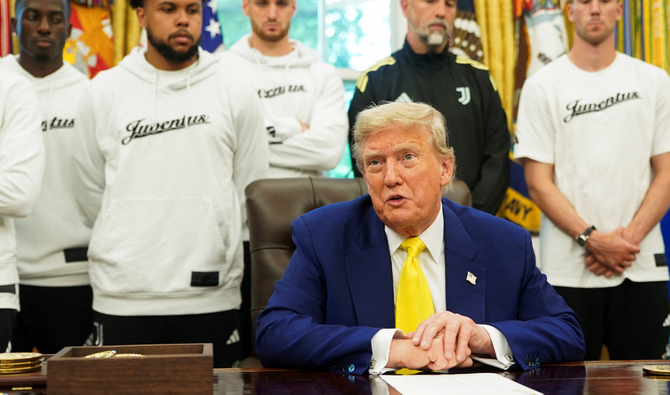
U.S. President Donald Trump speaks with the media as he meets with players of the Juventus soccer team in the Oval Office of the White House in Washington, D.C., U.S., June 18, 2025. (REUTERS)
Short Url
Updated 19 June 2025
Follow

Trump hosts Pakistan army chief for unprecedented lunch, confirms Iran discussed

  • This was the first time in years that a Pakistani army chief was hosted by a sitting US president at the White House
  • Munir was widely expected to press President Trump not to enter Israel’s war with Iran and to seek a ceasefire

ISLAMABAD: US President Donald Trump on Wednesday hosted Pakistan’s army chief for lunch in an unprecedented White House meeting, after which he told reporters he was “honored” to meet Field Marshal General Asim Munir and that the two had discussed the ongoing Iran-Israel crisis.

This was the first time in many years that a Pakistani army chief was hosted by a sitting US president at the White House, highlighting Washington’s renewed interest in maintaining influence in South Asia as regional tensions flare.

After the schedule for the lunch was announced this week, Pakistani media widely speculated that Munir would press Trump not to enter Israel’s war with Iran and to seek a ceasefire. A section of Pakistan’s embassy in Washington represents Iran’s interests in the United States as Tehran does not have diplomatic relations with the US.

Munir’s White House meeting during the ongoing Mideast conflict has also fueled speculation in Islamabad that Washington could push Pakistan to align more openly with the US position, which has historically been supportive of Israel. Such pressure could complicate Pakistan’s delicate balancing act in the Middle East, where it maintains close ties with Iran and other Gulf partners and sympathizes with the Palestinian cause but seeks to avoid getting dragged into regional rivalries that could inflame tensions at home.

“Well, they [Pakistan] know Iran very well, better than most, and they’re not happy about anything [Iran-Israel conflict],” Trump said in response to a question by a reporter after his meeting with Munir on whether Iran came up in the discussion.

“It’s not that they’re better with Israel. They [Pakistan] know them both actually, but they probably, maybe, know Iran better, but they [Pakistan] see what’s going on. And he [Field Marshal General Asim Munir] agreed with me.”

Trump did not specify what the Pakistani general had agreed with him on, and went on to talk about last month’s military conflict between India and Pakistan that the US president has publicly claimed credit for ending with a ceasefire.

Nuclear-armed neighbors India and Pakistan engaged in their fiercest military conflict in decades between May 7-10, exchanging drones, missiles and artillery for nearly four days before Trump announced he had brokered a truce.

“The reason I had him [Munir] here, I wanted to thank him for not going into the war [with India], just, you know, ending the war,” Trump said, also giving credit to Indian Prime Minister Narendra Modi. “So, I was honored to meet him [Munir] today.”

Tensions between Israel and Iran have spiked sharply since last Friday when Israeli forces struck multiple targets including Iranian nuclear sites and senior officials. Iran retaliated with attacks on Israeli territory, raising fears of a wider Middle East war that could threaten global energy supplies and regional stability.

Pakistan, which shares a long border with Iran and maintains historic ties with Tehran, has repeatedly called for de-escalation and a ceasefire in the region. Defense Minister Khawaja Asif told Pakistan’s Geo TV that Munir’s White House visit would give the army chief a chance to share Pakistan’s perspective on the conflict and push Washington to help prevent further escalation.

Pakistan’s military plays a key role in shaping the country’s foreign policy, and Munir’s high-profile White House invitation is being seen as part of Washington’s broader effort to recalibrate ties with Islamabad, a vital but often difficult ally for the US in South Asia.

Local media in Pakistan reported that Munir’s visit had been arranged weeks in advance. Analysts say the rare top-level contact underscores how the US wants to maintain strategic leverage in a region shaped by the rivalries of three nuclear powers — China, India and Pakistan — and rising instability in the Middle East.



Pakistan, global crypto exchange discuss modernizing digital payments, creating job prospects 

Updated 05 December 2025
Follow

Pakistan, global crypto exchange discuss modernizing digital payments, creating job prospects 

  • Pakistani officials, Binance team discuss coordination between Islamabad, local banks and global exchanges
  • Pakistan has attempted to tap into growing crypto market to curb illicit transactions, improve oversight

ISLAMABAD: Pakistan’s finance officials and the team of a global cryptocurrency exchange on Friday held discussions aimed at modernizing the country’s digital payments system and building local talent pipelines to meet rising demand for blockchain and Web3 skills, the finance ministry said.

The development took place during a high-level meeting between Finance Minister Muhammad Aurangzeb, Pakistan Virtual Assets Regulatory Authority (PVARA) Chairman Bilal bin Saqib, domestic bank presidents and a Binance team led by Global CEO Richard Teng. The meeting was held to advance work on Pakistan’s National Digital Asset Framework, a regulatory setup to govern Pakistan’s digital assets.

Pakistan has been moving to regulate its fast-growing crypto and digital assets market by bringing virtual asset service providers (VASPs) under a formal licensing regime. Officials say the push is aimed at curbing illicit transactions, improving oversight, and encouraging innovation in blockchain-based financial services.

“Participants reviewed opportunities to modernize Pakistan’s digital payments landscape, noting that blockchain-based systems could significantly reduce costs from the country’s $38 billion annual remittance flows,” the finance ministry said in a statement. 

“Discussions also emphasized building local talent pipelines to meet rising global demand for blockchain and Web3 skills, creating high-value employment prospects for Pakistani youth.”

Blockchain is a type of digital database that is shared, transparent and tamper-resistant. Instead of being stored on one computer, the data is kept on a distributed network of computers, making it very hard to alter or hack.

Web3 refers to the next generation of the Internet built using blockchain, focusing on giving users more control over their data, identity and digital assets rather than big tech companies controlling it.

Participants of the meeting also discussed sovereign debt tokenization, which is the process of converting a country’s debt such as government bonds, into digital tokens on a blockchain, the ministry said. 

Aurangzeb called for close coordination between the government, domestic banks and global exchanges to modernize Pakistan’s payment landscape.

Participants of the meeting also discussed considering a “time-bound amnesty” to encourage users to move assets onto regulated platforms, stressing the need for stronger verifications and a risk-mitigation system.

Pakistan has attempted in recent months to tap into the country’s growing crypto market, crack down on money laundering and terror financing, and promote responsible innovation — a move analysts say could bring an estimated $25 billion in virtual assets into the tax net.

In September, Islamabad invited international crypto exchanges and other VASPs to apply for licenses to operate in the country, a step aimed at formalizing and regulating its fast-growing digital market.