

WHO says Gaza health care at breaking point as fuel runs out

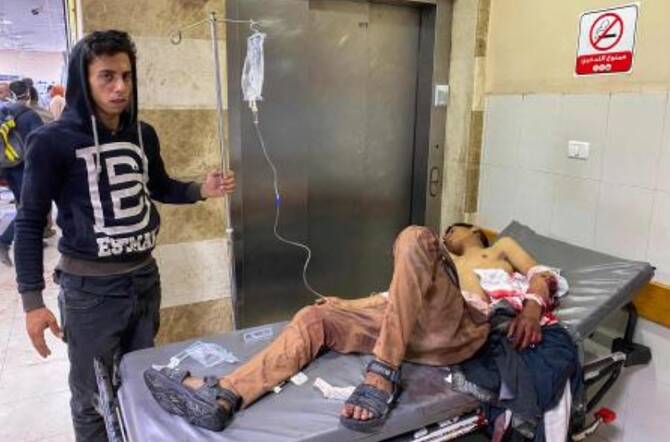
Palestinians who were injured in Israeli fire as they gathered near a food aid center, receive care at Khan Yunis’ Nasser hospital in the southern Gaza Strip on Jun. 17, 2025. (AFP)
Short Url
Updated 17 June 2025
Follow

WHO says Gaza health care at breaking point as fuel runs out

  • “For over 100 days, no fuel has entered Gaza and attempts to retrieve stocks from evacuation zones have been denied,” said Peeperkorn
  • Peeperkorn said only 17 of Gaza’s 36 hospitals were currently minimally to partially functional

GENEVA: The World Health Organization on Tuesday pleaded for fuel to be allowed into Gaza to keep its remaining hospitals running, warning the Palestinian territory’s health system was at “breaking point.”

“For over 100 days, no fuel has entered Gaza and attempts to retrieve stocks from evacuation zones have been denied,” said Rik Peeperkorn, the WHO’s representative in the Palestinian territories.

“Combined with critical supply shortages, this is pushing the health system closer to the brink of collapse.”

Peeperkorn said only 17 of Gaza’s 36 hospitals were currently minimally to partially functional. They have a total of around 1,500 beds — around 45 percent fewer than before the conflict began.

He said all hospitals and primary health centers in north Gaza were currently out of service.

In Rafah in southern Gaza, health services are provided through the Red Cross field hospital and two partially-functioning medical points.

Speaking from Jerusalem, he said the 17 partially functioning hospitals and seven field hospitals were barely running on a minimum amount of daily fuel and “will soon have none left.”

“Without fuel, all levels of care will cease, leading to more preventable deaths and suffering.”

Hospitals were already switching between generators and batteries to power ventilators, dialysis machines and incubators, he said, and without fuel, ambulances cannot run and supplies cannot be delivered to hospitals.

Furthermore, field hospitals are entirely reliant on generators, and without electricity, the cold chain for keeping vaccines would fail.

The war was triggered by an unprecedented Hamas attack on Israel on October 7, 2023, which resulted in the deaths of 1,219 people, according to official Israeli figures.

The health ministry in Hamas-run Gaza said on Monday that 5,194 people have been killed since Israel resumed strikes on the territory on March 18 following a truce.

The overall death toll in Gaza since the war broke out on October 7, 2023 has reached 55,493 people, according to the health ministry.

“People often ask when Gaza is going to be out of fuel; Gaza is already out of fuel,” said WHO trauma surgeon and emergency officer Thanos Gargavanis, speaking from the Strip.

“We are walking already the fine line that separates disaster from saving lives. The shrinking humanitarian space makes every health activity way more difficult than the previous day.”


Syria nears anniversary of Assad’s fall amid renewed ‘deeply troubling’ abuses, UN warns

Updated 22 sec ago
Follow

Syria nears anniversary of Assad’s fall amid renewed ‘deeply troubling’ abuses, UN warns

  • Early steps by interim leadership ‘encouraging but only the beginning’ of long process of accountability, human rights chief says
  • Concern that rising hate speech, both online and on the streets, has intensified violence against Alawite, Druze, Christian, Bedouin communities 

NEW YORK: Syria is days away from marking the first anniversary of the fall of President Bashar Assad’s regime, but the country’s interim authorities face mounting criticism over continuing abuses and a fragile security environment, the UN human rights chief said. 

In a statement on Friday, UN High Commissioner for Human Rights Volker Turk said early steps by the interim leadership, including the creation of national commissions for transitional justice and missing persons, and investigative bodies examining violence in coastal areas and in Suweida, were “encouraging but only the beginning” of a long process of accountability. 

Trials for suspects linked to last year’s coastal violence have begun, and a draft law on transitional justice has been announced. But Turk said the human rights situation remains deeply troubling. 

According to the UN, hundreds of people have been killed over the past year in summary executions, arbitrary killings, and abductions. Victims include members of minority communities and individuals accused of ties to the former government. Deaths were attributed to gunfire, stabbings, blunt-force attacks, shelling, hand grenades and explosive remnants of war. 

The UN said perpetrators include security forces under the interim authorities, armed groups aligned with them, remnants of the former government’s forces, local militias, and unidentified armed actors. 

Investigators also documented reports of sexual violence, arbitrary detention, looting, destruction of homes, forced evictions, and property confiscations, along with restrictions on free expression and peaceful assembly. 

Turk warned that rising hate speech, both online and on the streets, had intensified violence against Alawite, Druze, Christian, and Bedouin communities. 

The past year has also seen repeated Israeli military operations inside Syrian territory, including incursions and the occupation of additional areas. The UN said it had received reports of civilian casualties in a recent Israeli strike near Damascus, along with arrests and home searches carried out during military actions. 

Turk expressed concern that former armed groups have been integrated into new security forces without adequate human rights checks, raising the risk of repeat violations. 

“Proper vetting and comprehensive security sector reform are essential to prevent individuals responsible for serious abuses from entering the security forces,” he said. 

He urged Syria’s interim authorities to ensure independent and transparent investigations into all violations, past and present, and to hold those responsible to account. 

“Accountability, justice, peace, and the security of all Syrians are absolute prerequisites for a successful transition,” Turk said, adding that victims must have access to remedies and reparation. 

The UN Human Rights Office said its Damascus program is supporting efforts to advance inclusive transitional justice and strengthen the rule of law as Syria navigates a post-Assad transition.