

Gaza’s Al-Amal hospital ‘virtually out of service’: WHO

1 / 2
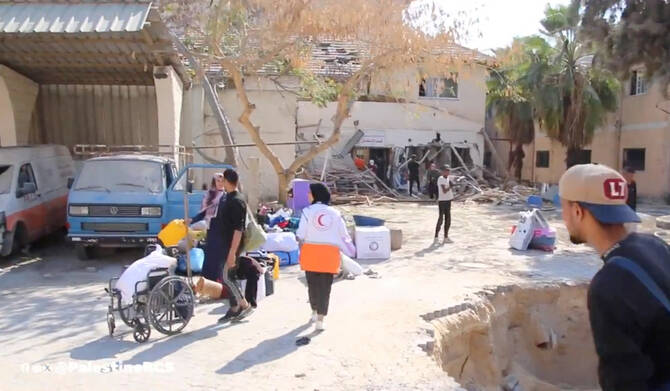
alestine Red Crescent Society member walks around the damaged PRCS Al-Amal Hospital, amid the ongoing conflict between Israel and Palestinian Islamist group Hamas, in Khan Younis, Gaza April 7, 2024, as seen in this screen grab taken from a handout video. (REUTERS)
2 / 2
People gather near bodies lined up for identification after they were unearthed from a mass grave found in the Nasser Medical Complex in the southern Gaza Strip on April 25, 2024, amid the ongoing conflict between Israel and the Palestinian militant group Hamas. (AFP)
Short Url
Updated 10 June 2025
Follow

Gaza’s Al-Amal hospital ‘virtually out of service’: WHO

  • The WHO said June 5 that Al-Nasser and Al-Amal hospitals were unable to fully treat the wounded that continue to pour in because of serious shortages of medicines and medical supplies after two months of total blockade

GENEVA: The Al-Amal Hospital in Gaza, one of the few still operating in the Palestinian territory, is now “virtually out of service” due to intense military activity, the head of the WHO said Monday.
“Access to the hospital is obstructed, preventing new patients from reaching care, and leading to more preventable deaths,” the World Health Organization’s director-general Tedros Adhanom Ghebreyesus posted on X.
Tedros said two emergency medical teams — one local, the other international — “are still doing their best to serve the remaining patients with the limited medical supplies left on the premises.”
“With the closure of Al-Amal, Nasser Medical Complex is now the only remaining hospital with an intensive care unit in Khan Younis,” he said.
The WHO said June 5 that Al-Nasser and Al-Amal hospitals were unable to fully treat the wounded that continue to pour in because of serious shortages of medicines and medical supplies after two months of total blockade.
Israeli authorities have recently allowed in some humanitarian aid, but way less than what is needed.
Nearly 20 months of relentless war, triggered by Hamas’ October 7, 2023 attacks on Israel, has created one of the most serious humanitarian crises in the world, with civilians exhausted by bombardments, forced displacement and hunger.


Hezbollah chief says supports state diplomacy to stop Israeli aggression

Updated 6 sec ago
Follow

Hezbollah chief says supports state diplomacy to stop Israeli aggression

  • The state has chosen “diplomacy to end the aggression and implement” a November 2024 ceasefire deal “and we support it continuing in this direction,” Qassem said
  • “They want to eliminate our existence,” Qassem said, but “we will defend ourselves”

BEIRUT: Hezbollah chief Naim Qassem on Friday said his group supported the Lebanese state’s pursuit of diplomacy to end Israeli attacks, while also criticizing the inclusion of a civilian representative in recent talks with Israel.
The state has chosen “diplomacy to end the aggression and implement” a November 2024 ceasefire deal “and we support it continuing in this direction,” Qassem said in a televised address.
Lebanese and Israeli civilian representatives held their first direct talks in decades on Wednesday under the auspices of the year-old ceasefire monitoring mechanism, a move Lebanon’s president said was to avoid prospects of another war in Lebanon.
Qassem criticized the move and urged authorities to reconsider.
“We consider this measure an additional misstep on top of the sin” of the government’s decision in August to task the army with disarming Hezbollah, he said.
“Have you made a gratuitous concession? This concession will not change the enemy’s position, nor its aggression or occupation,” Qassem said, accusing Israel and the United States of wanting Lebanese authorities to be negotiating “under fire.”
“They want to eliminate our existence,” Qassem said, but “we will defend ourselves, our people, our country. We are prepared to sacrifice everything, and we will not surrender.”
He accused Israel of violating the year-old ceasefire that sought to end more than a year of hostilities between Israel and his Iran-backed group, which emerged heavily weakened with its arsenal pummelled and senior commanders killed including former chief Hassan Nasrallah.
Qassem said his group was cooperating with the Lebanese authorities, and that America and Israel should have “no say in how we manage our domestic affairs,” calling their imposition of conditions on Lebanon as “unacceptable.”
Lebanese Prime Minister Nawaf Salam has said the new talks were strictly limited to fully implementing last year’s truce and did not amount to broader peace discussions.