Pakistan, UAE voice concern over Israel-Iran war as Trump seeks ‘end’ to nuclear threat

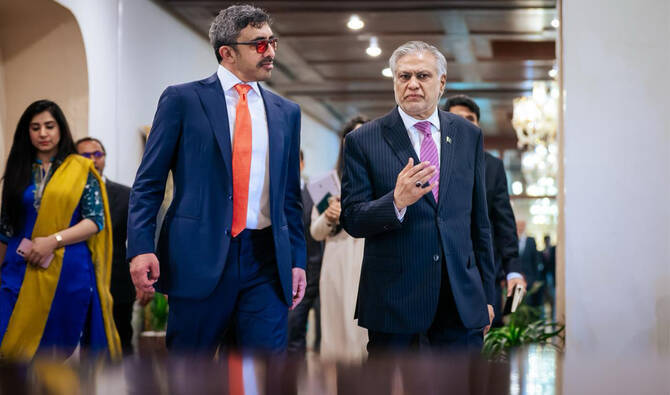
Pakistan’s Deputy Prime Minister and Foreign Minister Ishaq Dar (right) meets his UAE counterpart Sheikh Abdullah bin Zayed Al-Nahyan in Islamabad, Pakistan, on April 21, 2025. (UAE Ministry of Foreign Affairs/File)
Short Url
Updated 17 June 2025
Follow

Pakistan, UAE voice concern over Israel-Iran war as Trump seeks ‘end’ to nuclear threat

  • UAE and Pakistan stress urgent need to support efforts for regional peace and stability
  • Trump says reporters will ‘find out’ where the situation is headed in the next two days

ISLAMABAD: Pakistan and the United Arab Emirates expressed deep concern over Israel’s escalating war with Iran, the foreign office said on Tuesday, as US President Donald Trump said he wanted a “real end” to Iran’s nuclear program and warned of potential new developments in the coming days.

The exchange between Pakistan’s Deputy Prime Minister and Foreign Minister Ishaq Dar and his UAE counterpart, Sheikh Abdullah bin Zayed Al Nahyan, took place over a phone call, according to the official intimation.

The war between Iran and US ally Israel, which began on Friday when Israel launched airstrikes on Iranian nuclear and military facilities, has alarmed a region already on edge since Israel’s military assault on Gaza began in October 2023.

Iran launched its own retaliatory missile attacks, targeting dozens of strategic sites in Israel, as civilian casualties mounted on both sides. There has been no sign of de-escalation so far, with both sides continuing to strike military and economic targets, raising fears of a wider regional conflict.

“Deputy Prime Minister/Foreign Minister, Senator Mohammad Ishaq Dar received a call from the Deputy Prime Minister/Foreign Minister of UAE, Sheikh Abdullah bin Zayed Al Nahyan,” the foreign office of Pakistan said in a social media post.

“The two leaders discussed the evolving regional situation in the wake of Israel’s military strikes against the Islamic Republic of Iran,” it added. “They expressed deep concern over the escalating tensions and underscored the urgent need to support efforts for ensuring regional peace and stability.”

Earlier, Trump spoke to reporters aboard Air Force One while returning from a Group of Seven summit in Canada.

He said he may send US Middle East Envoy Steve Witkoff or Vice President JD Vance to Iran for talks, but added, “it depends on what happens when I get back.”

“Iran cannot have a nuclear weapon, it’s very simple,” he continued, adding that he wanted a “real end” to Iran’s nuclear ambitions, with Tehran “giving up entirely” on any weapons program.

The US president also warned residents in Tehran to evacuate amid fears of further escalation, but remained vague about Israel’s next steps in the conflict.

“You’re going to find out over the next two days,” he said. “Nobody’s slowed up so far.”

With input from Reuters


At ECO meeting, Pakistan proposes ‘Regional Innovation Hub’ to curb natural disasters

Updated 21 January 2026
Follow

At ECO meeting, Pakistan proposes ‘Regional Innovation Hub’ to curb natural disasters

  • Pakistan hosts high-level 10th ECO Ministerial Meeting on Disaster Risk Reduction in Islamabad
  • Innovation hub to focus on early warning technologies, risk informed infrastructure planning

ISLAMABAD: Pakistan has proposed to set up a “Regional Innovation Hub on Disaster Risk Reduction” that focuses on early warning technologies and risk informed infrastructure planning, the Press Information Department (PID) said on Wednesday, as Islamabad hosts a high-level meeting of the Economic Cooperation Organization (ECO).

The ECO’s 10th Ministerial Meeting on Disaster Risk Reduction (DRR) is being held from Jan. 21-22 at the headquarters of the National Disaster Management Authority (NDMA) in Pakistan’s capital. 

The high-level regional forum brings together ministers, and senior officials from ECO member states, representatives of the ECO Secretariat and regional and international partner organizations. The event is aimed to strengthen collective efforts toward enhancing disaster resilience across the ECO region, the PID said. 

“Key agenda items include regional cooperation on early warning systems, disaster risk information management, landslide hazard zoning, inclusive disaster preparedness initiatives, and Pakistan’s proposal to establish a Regional Innovation Hub on Disaster Risk Reduction, focusing on early warning technologies, satellite data utilization, and risk-informed infrastructure planning,” the statement said. 

The meeting was attended by delegations from ECO member states including Pakistan, Türkiye, Azerbaijan, Iran, Kyrgyzstan, Tajikistan, Turkmenistan and Uzbekistan. Representatives of regional and international organizations and development partners were also in attendance.

Discussions focused on enhancing regional coordination, harmonizing disaster risk reduction frameworks, and strengthening collective preparedness against transboundary and climate-induced hazards impacting the ECO region, the PID said. 

ECO members states such as Pakistan, Türkiye, Afghanistan and others have faced natural calamities such as floods and earthquakes in recent years that have killed tens of thousands of people. 

Heavy rains triggered catastrophic floods in Pakistan in 2022 and 2025 that killed thousands of people and caused damages to critical infrastructure, inflicting losses worth billions of dollars. 

Islamabad has since then called on regional countries to join hands to cooperate to avert future climate disasters and promote early warning systems to avoid calamities in future.