G7 leaders on Monday called for "de-escalation" in the Middle East starting with the Israel-Iran conflict, as US President Donald Trump hastily left the group's summit.
Trump, who was making his return to the international diplomatic calendar, departed the gathering in the Canadian Rockies a day early as ally Israel pounded Iran.
After a day of statements backing diplomacy, Trump ominously took to social media to sound a warning to people in the Iranian capital, whose population is nearly 10 million.
"Everyone should immediately evacuate Tehran!" he wrote on his Truth Social platform.
Having earlier hesitated at backing a joint statement on the crisis, Trump relented during a dinner at a forested lodge under the snow-capped mountains in Kananaskis.
"We urge that the resolution of the Iranian crisis leads to a broader de-escalation of hostilities in the Middle East, including a ceasefire in Gaza," said the joint statement released by Canada.
The statement said that Israel "has a right to defend itself" and stressed "the importance of the protection of civilians," as the growing attacks kill civilians on both sides.
The leaders of the club of industrial democracies -- Britain, Canada, France, Germany, Italy, Japan and the United States -- stated their conviction that Iran "can never have a nuclear weapon."
Trump for weeks said he favored diplomacy, and his envoy Steve Witkoff met five times with Iranian envoys, but he quickly backed Israel's strikes and said that Tehran's clerical state should have agreed to his terms.
At a group photo with fellow G7 leaders before the dinner, Trump said: "I have to be back as soon as I can. I wish I could stay for tomorrow, but they understand, this is big stuff."
French President Emmanuel Macron suggested that the United States was ready to make a diplomatic overture.
"There was an offer made for a meeting and an exchange," Macron told reporters.
Trump told reporters before his decision was announced to leave early: "As soon as I leave here, we're going to be doing something."
He has repeatedly declined to say if the United States would participate in Israeli military action, although he has said Washington was not involved in initial strikes and the White House said that US forces remained in a defensive posture.
Trump earlier said that Iran would be "foolish" not to agree to a negotiated settlement.
"It's painful for both parties, but I'd say Iran is not winning this war, and they should talk, and they should talk immediately, before it's too late," Trump told reporters as he met Canadian Prime Minister Mark Carney.
The US president will miss a day of G7 meetings that was expected to include discussions with the leaders of Ukraine and Mexico.
Since Friday, Israel has struck major nuclear and military sites and killed leading commanders and nuclear scientists in Iran, which has responded with its own volley of drones and missiles on Israel.
Macron voiced objections to what increasingly appeared to be Israel's goal -- toppling the clerical state that took power after the 1979 revolution toppled the pro-Western shah.
"All who have thought that by bombing from the outside you can save a country in spite of itself have always been mistaken," he said.
Iran, since Trump pulled out of an earlier nuclear deal in 2018, has ramped up uranium enrichment but not yet at levels to create an atomic bomb.
Israel is widely known to have nuclear weapons but does not acknowledge them publicly.
The summit comes after months of tumult on the global stage since Trump's return to the White House.
Seeking to shatter a decades-old US-led global economic order, Trump has vowed sweeping tariffs on friends and foes alike although he has postponed implementation until July 9.
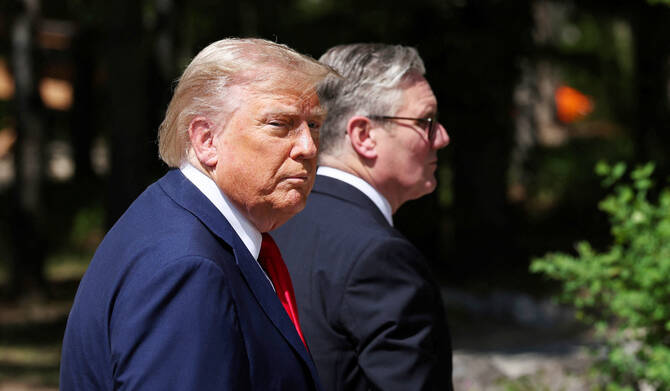
But Trump voiced optimism about a resolution with Canada and signed documents with UK Prime Minister Keir Starmer to confirm an agreement with Britain.
Trump has previously mocked host Canada, stating that the vast but less populated neighbor should become the 51st US state.
But Trump has appeared to show more respect to Canada since Carney, a staid former central banker, took over from the more flamboyant Justin Trudeau in March.
Trump had taken office seeking diplomacy both on Iran and Ukraine, which Russia invaded in 2022.
He has since voiced frustration that Russian President Vladimir Putin has not accepted a US proposal for a ceasefire.
Trump said Monday that Putin was "very insulted" by Russia's 2014 expulsion from the G8 and that if Russia were still a member, "you wouldn't have a war right now."


![]()

G7 urges Iran de-escalation as Trump makes hasty summit exit
Short Url
https://arab.news/2s463
G7 urges Iran de-escalation as Trump makes hasty summit exit
- Asked what it would take for the US to get involved in the conflict militarily, Trump said Monday morning, “I don’t want to talk about that”
- The G7, which originated as a 1973 finance ministers’ meeting to address the oil crisis and evolved into a yearly summit meant to foster personal relationships among world leaders and address global problems


Latest updates



© 2026 SAUDI RESEARCH & PUBLISHING COMPANY, All Rights Reserved And subject to Terms of Use Agreement.