

Pakistan police, security forces kill 12 militants in separate operations

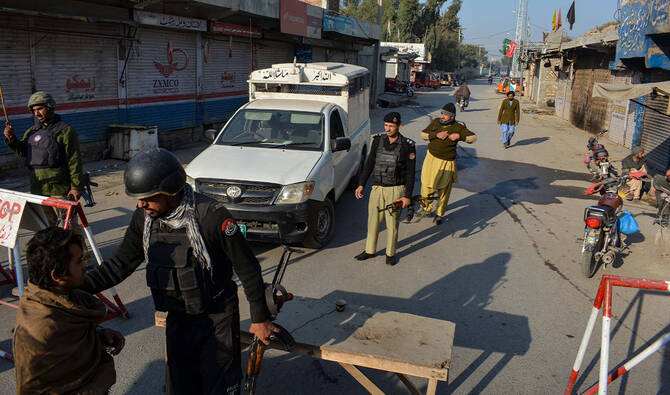
Police stand guard along a road they blocked after Taliban militants seized a police station in Bannu on December 19, 2022. (AFP/ file)
Short Url
Updated 28 December 2025
Follow

Pakistan police, security forces kill 12 militants in separate operations

  • The operations were conducted in Khyber Pakhtunkhwa’s Karak, Balochistan’s Kalat districts
  • The country is currently battling twin insurgencies in both provinces that border Afghanistan

ISLAMABAD: Pakistan’s police and security forces have gunned down 12 militants in separate operations in two western provinces that border Afghanistan, authorities said on Sunday.

Police launched an operation in a mountainous area of Karak district in Pakistan’s northwestern Khyber Pakhtunkhwa (KP) province, following reports of militant presence, according to Karak police spokesman Shaukat Khan.

The operation resulted in the killing of at least eight militants, while several others were wounded in the exchange of fire with law enforcers. Karak police chief Saud Khan led the heavy police contingent alongside personnel from intelligence agencies.

“Several militant hideouts located in the mountainous terrain between Kohat and Karak districts were dismantled during the operation,” Khan told Arab News on Sunday evening, adding the operation was still ongoing.

Separately, security forces killed four “Indian-sponsored” separatist militants in an intelligence-based operation in Kalat district of the southwestern Balochistan province, according to the Inter-Services Public Relations (ISPR), the Pakistani military’s media wing.

“Weapons, ammunition and explosives were also recovered from the terrorists, who remained actively involved in numerous terrorist activities in the area,” the ISPR said in a statement.

“Sanitization operations are being conducted to eliminate any other Indian sponsored terrorist found in the area.”

Pakistan, which has been facing a surge in militancy, has long accused Afghanistan of allowing its soil and India of backing militant groups, including the TTP, for attacks against Pakistan. Kabul and New Delhi have consistently denied this.



Pakistani, Bangladeshi officials discuss trade, investment and aviation as ties thaw

Updated 53 min 45 sec ago
Follow

Pakistani, Bangladeshi officials discuss trade, investment and aviation as ties thaw

  • Pakistan and Bangladesh were once one nation, but they split in 1971 as a result of a bloody civil war
  • Ties between Pakistan, Bangladesh have warmed up since last year and both nations have resumed sea trade

ISLAMABAD: Pakistan's High Commissioner to Bangladesh Imran Haider on Sunday met Chief Adviser Muhammad Yunus in Dhaka, the latter's office said on, with the two figures discussing trade, investment and aviation.

Pakistan and Bangladesh were once one nation, but they split in 1971 as a result of a bloody civil war, which saw the part previously referred to as East Pakistan seceding to form the independent nation of Bangladesh.

Ties between Pakistan and Bangladesh have warmed up since former prime minister Sheikh Hasina’s ouster as a result of a student-led uprising in August 2024. Relations remain frosty between Dhaka and New Delhi over India’s decision to grant asylum to Hasina.

Pakistan has attempted to forge closer ties with Bangladesh in recent months and both South Asian nations last year began sea trade, followed by efforts to expand government-to-government commerce.

"During the meeting, both sides discussed ways to expand cooperation in trade, investment, and aviation as well as scaling up cultural, educational and medical exchanges to further strengthen bilateral relations between the two South Asian nations," Yunus's office said in a statement on X.

In 2023-24 Pakistan exported goods worth $661 million to Bangladesh, while its imports were only $57 million, according to the Trade Development Authority of Pakistan. In Aug. this year, the Pakistani and Bangladeshi commerce ministries signed a memorandum of understanding to establish a Joint Working Group on Trade, aiming to raise their bilateral trade volume to $1 billion in the financial year that began in July.

The Pakistani high commissioner noted that bilateral trade has recorded a 20 percent growth compared to last year, with business communities from both countries actively exploring new investment opportunities, according to the statement.

He highlighted a significant increase in cultural exchanges, adding that Bangladeshi students have shown strong interest in higher education opportunities in Pakistan, particularly in medical sciences, nanotechnology, and artificial intelligence. Haider also said that Dhaka-Karachi direct flights are expected to start in January.

"Chief Adviser Professor Muhammad Yunus welcomed the growing interactions between the two countries and emphasized the importance of increased visits as well as cultural, educational and people-to-people exchanges among SAARC (South Asian Association for Regional Cooperation) member states," the statement read.

"Professor Yunus also underscored the need to further boost Bangladesh–Pakistan trade and expressed hope that during Mr. Haider’s tenure, both countries would explore new avenues for investment and joint venture businesses."