

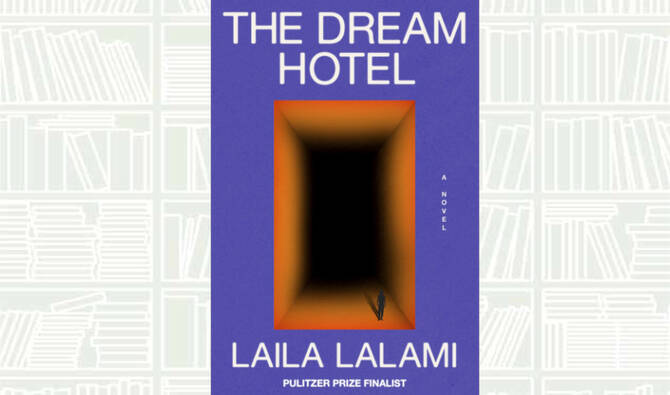
What We Are Reading Today: ‘The Dream Hotel’

Photo/Supplied
Short Url
Updated 16 June 2025
Follow

What We Are Reading Today: ‘The Dream Hotel’

  • “The Dream Hotel” is more than a compelling narrative; it is a reflection on the complexities of freedom and the influence of technology on our lives

Author: Laila Lalami

Reading Moroccan-American novelist Laila Lalami’s “The Dream Hotel” was an eye-opening experience that left me simultaneously captivated and unsettled.

The novel weaves a story about one woman’s fight for freedom in a near-future society where even dreams are under surveillance.

The narrative centers on Sara, who, upon returning to Los Angeles International Airport, is pulled aside by agents from the Risk Assessment Administration.

The chilling premise — that an algorithm has determined she is at risk of harming her husband — immediately drew me in. Lalami’s portrayal of Sara’s descent into a retention center, where she is held alongside other women labeled as “dreamers,” is both fascinating and disturbing.

What struck me most was how Lalami explores the seductive nature of technology. I found myself reflecting on our current relationship with data and surveillance.

The idea that our innermost thoughts could be monitored and judged felt unsettlingly familiar. As Sara navigates the oppressive rules of the facility, I felt a growing frustration at the injustice of her situation, which echoes broader societal concerns about privacy and autonomy.

Lalami’s writing is lyrical yet accessible, drawing readers into the emotional depth of each character. The interactions among the women in the retention center are especially poignant, showing how strength can emerge from solidarity.

As the story unfolds, I was reminded of the resilience of the human spirit, even under dehumanizing conditions. The arrival of a new resident adds a twist, pushing Sara toward a confrontation with the forces trying to control her. This development kept me invested in seeing how she would reclaim her agency.

“The Dream Hotel” is more than a compelling narrative; it is a reflection on the complexities of freedom and the influence of technology on our lives. It left me considering how much of ourselves we must guard to remain truly free.

In conclusion, Lalami has crafted a thoughtful and resonant novel that lingers after the final page. It is well worth reading for those interested in the intersections of identity, technology and human experience.


Book Review: ‘A Long Walk from Gaza’ by Asmaa Alatawna

Updated 14 January 2026
Follow

Book Review: ‘A Long Walk from Gaza’ by Asmaa Alatawna

JEDDAH: Asmaa Alatawna’s “A Long Walk from Gaza,” translated from Arabic by Caline Nasrallah and Michelle Hartman, depicts a Gaza — with its people, streets, routines, and rhythms of life — that no longer exists.

In that sense, the novel is not purely the story of a young woman’s search for freedom. It is also a form of preservation, a historical record of a society that has been largely obliterated by Israeli occupation forces.

The novel was published in 2024 by Palestinian American publisher Interlink Books and tells a story that parallels the author’s own background of growing up in Gaza and moving to Toulouse. 

The unnamed narrator’s tale takes on a complex and nonlinear structure and unfolds in reverse, moving backward through memories. It opens at a moment when she is inching toward a tentative sense of liberation and relief after arriving in Europe as a refugee. 

It then gradually moves to her teenage years and early childhood marked by Israeli military occupation, the suffocating control of her father’s authority, and the rush of first love, rebellion and loss. 

Nasrallah and Hartman’s translation is precise and sensitive, carrying the immediacy of the narrator’s inner world and textures of Palestinian life.

The narrative structure mimics the way memory can flow for someone living with trauma: Liberation is not clean or complete and exists in conversation with what came before. 

What makes “A Long Walk from Gaza” so arresting is its commitment to a young woman’s voice and experiences, without apology.

The novel makes room for difficult conversations about patriarchy and misogyny in Palestinian society, without reducing them to defining traits. Instead, they are situated within the broader realities of colonization and military occupation, showing how cycles of violence can settle into families. This makes the protagonist’s efforts to break away and build a different life for herself both arduous and personal. 

At one point, she notes, “What happened to me shouldn’t affect people’s perception of the Palestinian cause or obscure the suffering of the entire Palestinian people.” 

Her disclaimer exposes the cruel calculus of optics, under which personal pain is sometimes weighed against political utility. It makes one wonder how many stories remain untold for this reason. 

Alatawna does not romanticize suffering and also refuses to flatten Palestinian life into a single story. Moments of humor, friendship, and joy appear alongside violence and fear.

“A Long Walk from Gaza” was first published in Arabic in 2019, making it not only a powerful work of literature, but also an archive of memory. To read it now is to be reminded that storytelling can sometimes embody the refusal to be forgotten.