Military-linked Fauji Fertilizer to bid for stake in Pakistan’s PIA

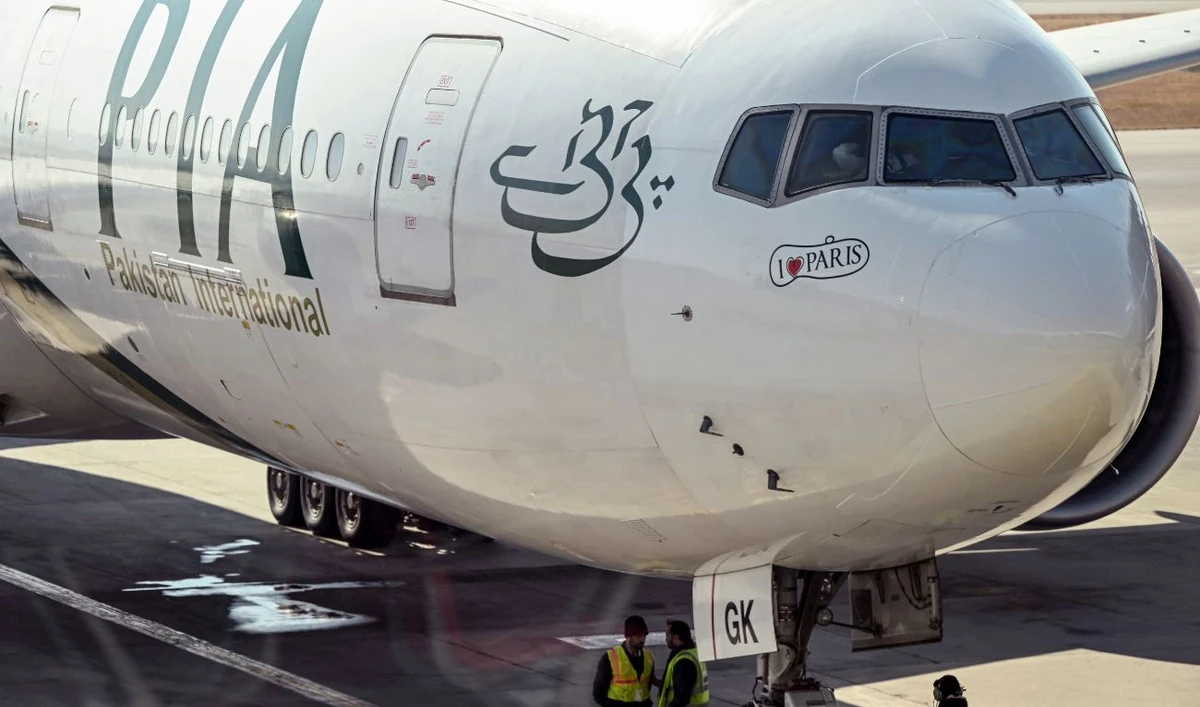
Ground staff stand next to the Pakistan International Airline (PIA) aircraft ahead of its takeoff for Paris at the Islamabad International Airport on January 10, 2025. (AFP/file)
Short Url
Updated 16 June 2025
Follow

Military-linked Fauji Fertilizer to bid for stake in Pakistan’s PIA

  • Islamabad is trying to offload 51-100 percent stakes in PIA under $7 billion IMF program to overhaul state-owned firms
  • 2024 auction drew only one offer of $36 million, far below government’s $305-million floor price, and was rejected

ISLAMABAD: Fauji Fertilizer Company Ltd. (FFC), a unit of the Pakistan army-run Fauji Foundation, said on Monday its board had approved submitting an expression of interest to acquire a stake in loss-making national carrier PIA, according to a filing with the Pakistan Stock Exchange (PSX).

Islamabad is trying to offload a controlling stake of 51-100 percent in PIA under a $7 billion International Monetary Fund program aimed at overhauling state-owned firms. Authorities last month pushed back the deadline for expressions of interest to June 19. 

“The board … has approved submission of an expression of interest and pre-qualification documents to the Privatization Commission … and undertaking a comprehensive due-diligence exercise,” FFC said in the filing. 

FFC is Pakistan’s biggest fertilizer maker and has diversified interests in energy, food and finance. Any deal on PIA would expand the military group’s footprint into aviation, though final terms will hinge on the government’s privatization process and regulatory approvals.

FFC’s move marks Pakistan’s second attempt to sell PIA. 

A 2024 auction drew only one offer – Rs10 billion ($36 million) for 60 percent of the airline from real-estate developer Blue World City – far below the government’s Rs85 billion ($305 million) floor price and was rejected. 

Pakistan had offloaded nearly 80 percent of the airline’s legacy debt and shifted it to government books ahead of the privatization attempt. The rest of the debt was also cleaned out of the airline’s accounts after the failed sale attempt to make it more attractive to potential buyers, according to the country’s privatization ministry.

In April, PIA posted an operating profit of Rs9.3 billion ($33.1 million) for 2024, its first in 21 years.

The airline has for years survived on government bailouts as its operational earnings were eaten up by debt servicing costs.

Officials say offloading the debt burden and recent reforms like shedding staff, exiting unprofitable routes and other cost-cutting measures led to the profitable year.

Ahead of the attempt to sell the airline last year, PIA had faced threats of being shut down, with planes impounded at international airports over its failure to pay bills and flights canceled due to a shortage of funds to pay for fuel or spare parts.

The state carrier’s 34-plane fleet commands only 23 percent of Pakistan’s domestic market, while Middle Eastern rivals take about 60 percent of overall traffic, thanks to wider route networks and direct connections. 

Pakistan drops 8,000 MW power procurement, claims $17 billion savings amid IMF-driven reforms

Updated 11 sec ago
Follow

Pakistan drops 8,000 MW power procurement, claims $17 billion savings amid IMF-driven reforms

  • Government says decision taken “on merit” as it seeks to cut losses, circular debt, ease consumer pressure 
  • Power minister says losses fell from $2.1 billion to $1.4 billion, circular debt dropped by $2.8 billion

ISLAMABAD: Pakistan has abandoned plans to procure around 8,000 megawatts of expensive electricity, the power minister said on Sunday, adding that the decision was taken “purely on merit” and would save about $17 billion.

The power sector has long been a major source of Pakistan’s fiscal stress, driven by surplus generation capacity, costly contracts and mounting circular debt. Reforming electricity pricing, reducing losses and limiting new liabilities are central conditions under an ongoing $7 billion IMF program approved in 2024.

Pakistan has historically contracted more power generation than it consumes, forcing the government to make large capacity payments even for unused electricity. These obligations have contributed to rising tariffs, budgetary pressure and repeated IMF bailouts over the past two decades.

“The government has abandoned the procurement of around 8000 megawatts of expensive electricity purely on merit, which will likely to save 17 billion dollars,” Power Minister Sardar Awais Ahmed Khan Leghari said while addressing a news conference in Islamabad, according to state broadcaster Radio Pakistan.

He said the federal government was also absorbing losses incurred by power distribution companies rather than passing them on to consumers.

The minister said the government’s reform drive was already showing results, with losses reduced from Rs586 billion ($2.1 billion) to Rs393 billion ($1.4 billion), while circular debt declined by Rs780 billion ($2.8 billion) last year. Recoveries, he added, had improved by Rs183 billion ($660 million).

Leghari said electricity tariffs had been reduced by 20 percent at the national level over the past two years and expressed confidence that prices would be aligned with international levels within the next 18 months.

Power sector reform has been one of the most politically sensitive elements of Pakistan’s IMF-backed adjustment program, with higher tariffs and tighter enforcement weighing on households and industry. The government says cutting losses, improving recoveries and avoiding costly new capacity are essential to stabilizing public finances and restoring investor confidence.