Military-linked Fauji Fertilizer to bid for stake in Pakistan’s PIA

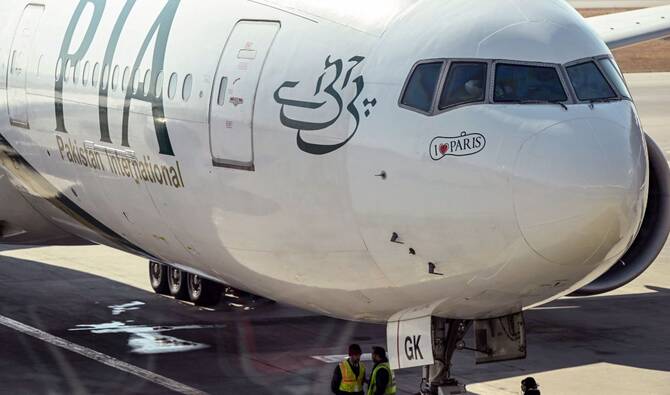
Ground staff stand next to the Pakistan International Airline (PIA) aircraft ahead of its takeoff for Paris at the Islamabad International Airport on January 10, 2025. (AFP/file)
Short Url
Updated 16 June 2025
Follow

Military-linked Fauji Fertilizer to bid for stake in Pakistan’s PIA

  • Islamabad is trying to offload 51-100 percent stakes in PIA under $7 billion IMF program to overhaul state-owned firms
  • 2024 auction drew only one offer of $36 million, far below government’s $305-million floor price, and was rejected

ISLAMABAD: Fauji Fertilizer Company Ltd. (FFC), a unit of the Pakistan army-run Fauji Foundation, said on Monday its board had approved submitting an expression of interest to acquire a stake in loss-making national carrier PIA, according to a filing with the Pakistan Stock Exchange (PSX).

Islamabad is trying to offload a controlling stake of 51-100 percent in PIA under a $7 billion International Monetary Fund program aimed at overhauling state-owned firms. Authorities last month pushed back the deadline for expressions of interest to June 19. 

“The board … has approved submission of an expression of interest and pre-qualification documents to the Privatization Commission … and undertaking a comprehensive due-diligence exercise,” FFC said in the filing. 

FFC is Pakistan’s biggest fertilizer maker and has diversified interests in energy, food and finance. Any deal on PIA would expand the military group’s footprint into aviation, though final terms will hinge on the government’s privatization process and regulatory approvals.

FFC’s move marks Pakistan’s second attempt to sell PIA. 

A 2024 auction drew only one offer – Rs10 billion ($36 million) for 60 percent of the airline from real-estate developer Blue World City – far below the government’s Rs85 billion ($305 million) floor price and was rejected. 

Pakistan had offloaded nearly 80 percent of the airline’s legacy debt and shifted it to government books ahead of the privatization attempt. The rest of the debt was also cleaned out of the airline’s accounts after the failed sale attempt to make it more attractive to potential buyers, according to the country’s privatization ministry.

In April, PIA posted an operating profit of Rs9.3 billion ($33.1 million) for 2024, its first in 21 years.

The airline has for years survived on government bailouts as its operational earnings were eaten up by debt servicing costs.

Officials say offloading the debt burden and recent reforms like shedding staff, exiting unprofitable routes and other cost-cutting measures led to the profitable year.

Ahead of the attempt to sell the airline last year, PIA had faced threats of being shut down, with planes impounded at international airports over its failure to pay bills and flights canceled due to a shortage of funds to pay for fuel or spare parts.

The state carrier’s 34-plane fleet commands only 23 percent of Pakistan’s domestic market, while Middle Eastern rivals take about 60 percent of overall traffic, thanks to wider route networks and direct connections. 


OIC’s COMSTECH stresses academic collaborations across Muslim world in Islamabad meeting

Updated 4 sec ago
Follow

OIC’s COMSTECH stresses academic collaborations across Muslim world in Islamabad meeting

  • COMSTECH holds annual meeting in Islamabad featuring 30 delegates from Iran, Somalia, Palestine, Indonesia and other OIC states
  • Limited pool of skilled professionals one of the foremost challenges facing Muslim world, notes COMSTECH secretary general 

ISLAMABAD: The OIC Standing Committee on Scientific and Technological Cooperation (COMSTECH) called for stronger academic collaboration across Islamic states to secure the future of higher education in the Muslim world, state-run media reported on Saturday. 

COMSTECH’s Coordinator General Prof. Dr. Muhammad Iqbal Choudhary was speaking at the Annual Meeting of the COMSTECH Consortium of Excellence at the organization’s Secretariat in Islamabad. The event brought together vice chancellors, rectors, and senior representatives from leading universities across OIC member and observer states. 

Nearly 30 international delegates representing universities from Iran, Somalia, Palestine, Indonesia, Malaysia, Thailand, Uganda, Bangladesh, Benin, Cameroon, Gabon, Côte d’Ivoire, and Senegal joined their counterparts from several Pakistani institutions at the meeting. Participants attempted to chart a collective path forward for tertiary education in OIC countries.

“Collaborations, knowledge sharing, best practices, exchange of scholars, technology transfer and joint academic programs are vital for overcoming the educational challenges faced across the OIC region,” Choudhary said, according to the state-run Associated Press of Pakistan (APP).

The COMSTECH secretary general noted that one of the foremost developmental challenges facing OIC nations remains the limited pool of skilled professionals and workforce. 

He said this gap can only be bridged through strengthened tertiary education systems and expanded opportunities for knowledge transfer.

Discussions at the event highlighted the urgent need for competency-driven education, modern pedagogical tools, university–industry partnerships and collaborative training programs designed to equip graduates with the skills necessary to address emerging global challenges.

“The Annual Meeting served as a vital platform for reviewing progress achieved over the past year, identifying future priorities, and deepening academic cooperation to promote scientific excellence and sustainable development across the OIC region,” the APP said.