

Macron rejects Trump’s idea for Putin to mediate Israel-Iran crisis

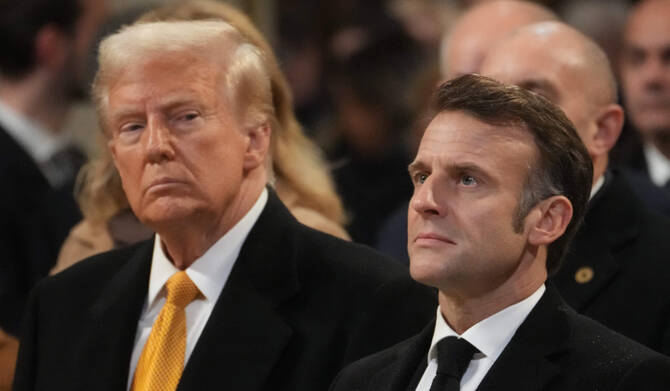
US President-elect Donald Trump (L) looks towards French President Emmanuel Macron (R) during a ceremony to mark the re-opening of the landmark Notre-Dame Cathedral in central Paris on December 7, 2024. (AFP)
Short Url
Updated 17 June 2025
Follow

Macron rejects Trump’s idea for Putin to mediate Israel-Iran crisis

  • “Greenland is not to be sold, not to be taken,” he said, adding that he has spoken with Trump ahead of his trip, and would speak with him about Greenland at the G7

PARIS/COPENHAGEN: French President Emmanuel Macron, during a visit to Greenland to offer his support to the Arctic island, said on Sunday that Russia lacked the credibility to mediate the crisis between Israel and Iran as US President Donald Trump has suggested.
In an interview with ABC News on Sunday, Trump said he was open to Putin, whose forces invaded Ukraine and who has resisted Trump’s attempts to broker a ceasefire with Kyiv, mediating between Israel and Iran. Macron said he rejected such an idea.
“I do not believe that Russia, which is now engaged in a high-intensity conflict and has decided not to respect the UN Charter for several years now, can be a mediator,” Macron said.

HIGHLIGHTS

• Macron is first foreign leader to visit since Trump threats

• Macron says his visit is show of European solidarity

• French president invited by leaders of Greenland and Denmark

He also said France did not take part in any of Israel’s attacks against Iran.
Macron was visiting Greenland, a self-governing part of Denmark with the right to declare independence that Trump has threatened to take over, ahead of a trip to Canada for the Group of Seven Leaders’ summit.
In a press conference alongside Denmark’s Prime Minister Mette Frederiksen and Greenland’s Prime Minister Jens-Frederik Nielsen, Macron said the island was threatened by “predatory ambition,” and that its situation was a wakeup call for all Europeans.
“Greenland is not to be sold, not to be taken,” he said, adding that he has spoken with Trump ahead of his trip, and would speak with him about Greenland at the G7. “I think there is a way forward in order to clearly build a better future in cooperation and not in provocation or confrontation.”
However, Macron said he ultimately doubted the United States would invade Greenland.
“I don’t believe that in the end, the US, which is an ally and a friend, will ever do something aggressive against another ally,” he said, adding he believed “the United States of America remains engaged in NATO and our key and historical alliances.”
Trump has said he wants the United States to take over the mineral-rich, strategically located Arctic island, and has not ruled out force. His vice president, JD Vance, visited a US military base there in March. Macron is the first foreign leader to visit Greenland since Trump’s explicit threats to “get” the island.
According to an IFOP poll for NYC.eu published on Saturday, 77 percent of French people and 56 percent of Americans disapprove of an annexation of Greenland by the US and 43 percent of the French would back using French military power to prevent a US invasion.
Denmark’s Frederiksen made several visits to Paris after Trump’s threats to seek French and European backing, and has placed orders for French-made surface-to-air missiles, in a shift of focus for Copenhagen.


Only 4% women on ballot as Bangladesh prepares for post-Hasina vote

Updated 26 January 2026
Follow

Only 4% women on ballot as Bangladesh prepares for post-Hasina vote

  • Women PMs have ruled Bangladesh for over half of its independent history
  • For 2026 vote, only 20 out of 51 political parties nominated female candidates

DHAKA: As Bangladesh prepares for the first election since the ouster of its long-serving ex-prime minister Sheikh Hasina, only 4 percent of the registered candidates are women, as more than half of the political parties did not field female candidates.

The vote on Feb. 12 will bring in new leadership after an 18-month rule of the caretaker administration that took control following the student-led uprising that ended 15 years in power of Hasina’s Awami League party.

Nearly 128 million Bangladeshis will head to the polls, but while more than 62 million of them are women, the percentage of female candidates in the race is incomparably lower, despite last year’s consensus reached by political parties to have at least 5 percent women on their lists.

According to the Election Commission, among 1,981 candidates only 81 are women, in a country that in its 54 years of independence had for 32 years been led by women prime ministers — Hasina and her late rival Khaleda Zia.

According to Dr. Rasheda Rawnak Khan from the Department of Anthropology at Dhaka University, women’s political participation was neither reflected by the rule of Hasina nor Zia.

“Bangladesh has had women rulers, not women’s rule,” Khan told Arab News. “The structure of party politics in Bangladesh is deeply patriarchal.”

Only 20 out of 51 political parties nominated female candidates for the 2026 vote. Percentage-wise, the Bangladesh Socialist Party was leading with nine women, or 34 percent of its candidates.

The election’s main contender, the Bangladesh Nationalist Party, whose former leader Zia in 1991 became the second woman prime minister of a predominantly Muslim nation — after Pakistan’s Benazir Bhutto — was the party that last year put forward the 5 percent quota for women.

For the upcoming vote, however, it ended up nominating only 10 women, or 3.5 percent of its 288 candidates.

The second-largest party, Jamaat-e-Islami, has not nominated a single woman.

The 4 percent participation is lower than in the previous election in 2024, when it was slightly above 5 percent, but there was no decreasing trend. In 2019, the rate was 5.9 percent, and 4 percent in 2014.

“We have not seen any independent women’s political movement or institutional activities earlier, from where women could now participate in the election independently,” Khan said.

“Real political participation is different and difficult as well in this patriarchal society, where we need to establish internal party democracy, protection from political violence, ensure direct election, and cultural shifts around female leadership.”

While the 2024 student-led uprising featured a prominent presence of women activists, Election Commission data shows that this has not translated into their political participation, with very few women contesting the upcoming polls.

“In the student movement, women were recruited because they were useful, presentable for rallies and protests both on campus and in the field of political legitimacy. Women were kept at the forefront for exhibiting some sort of ‘inclusive’ images to the media and the people,” Khan said.

“To become a candidate in the general election, one needs to have a powerful mentor, money, muscle power, control over party people, activists, and locals. Within the male-dominated networks, it’s very difficult for women to get all these things.”