

MP calls out lack of bomb shelters in Arab-Israeli communities

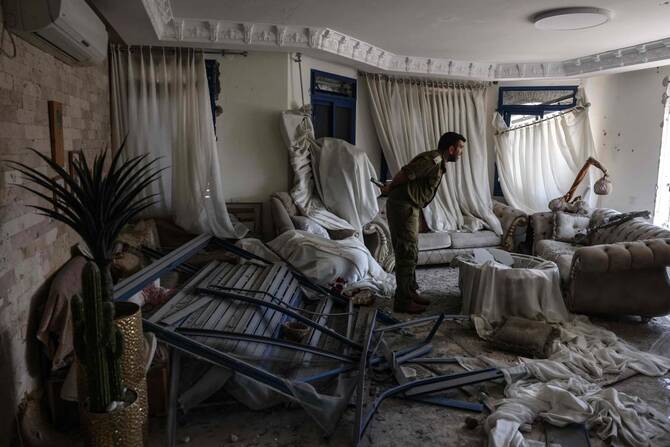
An Israeli sodlier checks the damage inside a flat in the northern Israeli town of Tamra, following an overnight missile attack from Iran on June 15, 2025, where four people, including a child, were reported killed. (AFP)
Short Url
Updated 17 June 2025
Follow

MP calls out lack of bomb shelters in Arab-Israeli communities

JERUSALEM: Ayman Odeh, an Israeli member of parliament of Palestinian descent, accused the government on Sunday of failing to provide Arab-Israeli communities with enough shelters after an Iranian missile killed four people in the city of Tamra.

“The state, unfortunately, still distinguishes between blood and blood,” Odeh lamented on X, after touring the city of 37,000 predominantly Arab residents.

A house there was destroyed by a missile launched by Iran overnight in response to Israel’s unprecedented attacks on the Islamic republic’s military and nuclear sites.

“Four civilians were killed yesterday: Manar Al-Qassem Abu Al-Hija Khatib (39), her two daughters Hala (13) and Shada (20), and their relative Manar Diab Khatib (41),” Odeh said, adding that “dozens more” were wounded

Cars and buildings were also damaged by the strike on the community in the Israeli region of Galilee, an AFP journalist at the scene reported.

“Tamra is not a village. It is a city without public shelters,” Odeh said, adding that this was the case for 60 percent of “local authorities” — the Israeli term for communities not officially registered as cities, many of which are Arab-Israeli.

Arab-Israelis are Palestinians who remained in what is now Israel after its creation in 1948, and represent about 20 percent of the country’s population.

The community frequently professes to face discrimination from Israel’s Jewish majority.

With Israel and Iran engaged in their most intense confrontation ever, Odeh, a communist MP for over 10 years, warned of “a threat of unprecedented destruction (that) will not distinguish” between Arabs and Jews.

He also accused the government of “neglect” toward citizens of Palestinian descent.

A video shared on social media Sunday night caused outrage after showing families apparently rejoicing in Hebrew as missiles fell on Tamra.

In some Arab neighborhoods, missiles launched toward Israel have also been welcomed with joy, AFP journalists reported.


Hundreds mourn in Syria’s Homs after deadly mosque bombing

Updated 27 December 2025
Follow

Hundreds mourn in Syria’s Homs after deadly mosque bombing

  • Officials have said the preliminary investigations indicate explosive devices were planted inside the mosque but have not yet publicly identified a suspect

HOMS: Hundreds of mourners gathered Saturday despite rain and cold outside of a mosque in the Syrian city of Homs where a bombing the day before killed eight people and wounded 18.
The crowd gathered next to the Imam Ali ibn Abi Talib Mosque in the Wadi Al-Dhahab neighborhood, where the population is predominantly from the Alawite minority, before driving in convoys to bury the victims.
Officials have said the preliminary investigations indicate explosive devices were planted inside the mosque but have not yet publicly identified a suspect.
A little-known group calling itself Saraya Ansar Al-Sunna claimed responsibility for the attack in a statement posted on its Telegram channel, in which it indicated that the attack intended to target members of the Alawite sect, an offshoot of Shia Islam whom hard-line Islamists consider to be apostates.
The same group had previously claimed a suicide attack in June in which a gunman opened fire and then detonated an explosive vest inside a Greek Orthodox church in Dweil’a, on the outskirts of Damascus, killing 25 people as worshippers prayed on a Sunday.
A neighbor of the mosque, who asked to be identified only by the honorific Abu Ahmad (“father of Ahmad“) out of security concerns, said he was at home when he heard the sound of a “very very strong explosion.”
He and other neighbors went to the mosque and saw terrified people running out of it, he said. They entered and began trying to help the wounded, amid blood and scattered body parts on the floor.
While the neighborhood is primarily Alawite, he said the mosque had always been open to members of all sects to pray.
“It’s the house of God,” he said. “The mosque’s door is open to everyone. No one ever asked questions. Whoever wants to enter can enter.”
Mourners were unable to enter the mosque to pray Saturday because the crime scene remained cordoned off, so they prayed outside.
Some then marched through the streets chanting “Ya Ali,” in reference to the Prophet Muhammad’s cousin and son-in-law whom Shiite Muslims consider to be his rightful successor.