

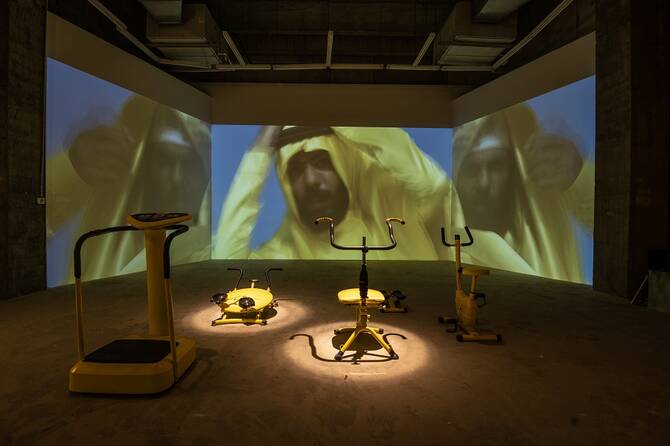

RIYADH: This month, Saudi artist Ahaad Alamoudi is turning up the heat at Basel Social Club — which runs until June 21 in the Swiss city — with her latest installation, “The Social Health Club.”
Freshly conceived, but rooted in the artist’s past works, the yellow-drenched installation offers a layered, sensory experience — and sharp cultural commentary — as well as a first for the artist: a live-performance element.
Jeddah-based Alamoudi is known for creating immersive multimedia installations drawing from and exploring the complex dynamics of her evolving homeland. “The Social Health Club” is built around pieces found in Jeddah’s Haraj market in 2018 — a range of exercise equipment including a rowing machine.

Ahaad Alamoudi. (Supplied)
“These are pieces I collected from thrifting. I like the fact that no instructions came with the machines — I don’t have their name or the source of where they came from or who made them. But they’ve become part of the urban landscape that I’ve been in. And I was trying to create fun within the space,” Alamoudi told Arab News.
In “The Social Health Club,” the equipment, painted predominantly in vibrantly-saturated monochrome yellow, stands untouched, serving as symbols of a culture obsessed with self-optimization. At the core of the installation is a cameo from a yellow-painted iron previously featured in her 2020 video work “Makwah Man.” (Makwah means iron in Arabic.)

Part of Ahaad Alamoudi's 'The Social Health Club' at Basel Social Club. (Supplied)
“A lot of my pieces stem from a narrative I create within a video. In ‘Makwah Man,’ this man wearing a yellow thobe is ironing a long piece of yellow fabric in the middle of the desert. And as he’s ironing, he tells us how to live our lives. But in the process of him telling us how to live our lives, he also starts questioning his own in the process — understanding the role of power, understanding the pressure of change, adaptation,” Alamoudi explained.
“The yellow exists within the video piece, but he’s also wearing yellow thobe in the video piece. And (in this iteration at Art Basel) there’s also a rack of yellow thobes twirling in the exhibition. For me, the yellow thobe is like a unifying symbol. I’m trying to say that we’re all experiencing this in different ways. So in the performance (for “The Social Health Club”) a man (a local body builder) in a yellow thobe will be performing on these machines. He has no rule book. He doesn’t know anything; he doesn’t know how to ‘properly’ use the equipment. He’s going to go into the space and do things with the machines.
“The performance will be recorded. But I think it’s more like an activation,” she continued. “It’s not the piece itself. The piece itself exists as the machines.”
“The Social Health Club” was shaped through close collaboration with curator Amal Khalaf, who combed Jeddah’s market with Alamoudi in search of “machines that were a little bit abnormal, like not your typical machines that people would directly know what it is in the gym,” Alamoudi said.
“She’s quite incredible,” she continued. “And we really built the space together. Essentially, the main thing that I created was the video; everything else was built off of that. She really helped. She really looked at social change and how we navigate that. Our collaboration was perfect.”
Yellow dominates every inch of the piece—deliberately and intensely.
“I obsess over symbols within certain works I create. And with that also comes a color,” Alamoudi said. “I wanted to showcase something that was luxurious, colorful, almost like gold, but it’s not gold. It’s quite stark in its appearance.”
Yellow is both invitation and warning. “I think that yellow is also quite deceptive. I like it as a color to get people excited to come closer and see what’s happening, but at the same time question what it is — it’s so aggressive that it becomes a bit uncomfortable.”

A still from Alamoudi's 2020 video work 'Makwah Man,' which is also part of 'The Social Health Club'. (Supplied)
The viewer’s interaction is critical to the piece’s meaning.
“I think the machines represent something and they carry something, but they really are activated by the people — what people are doing with them,” Alamoudi said. “And that’s why I’m encouraging a lot of viewers to engage with and use the pieces, or try to use them without any instruction. A lot of people entering into the space (might) fear even touching or engaging with them. Having the performer there activating the structures is going to add another layer to the piece itself.”
She hopes visitors feel free to explore, unburdened by expectations.
“People are meant to use it any way that they want to use it. They can sit on it, stand on it, touch it — they can leave it alone,” she concluded with a laugh.


