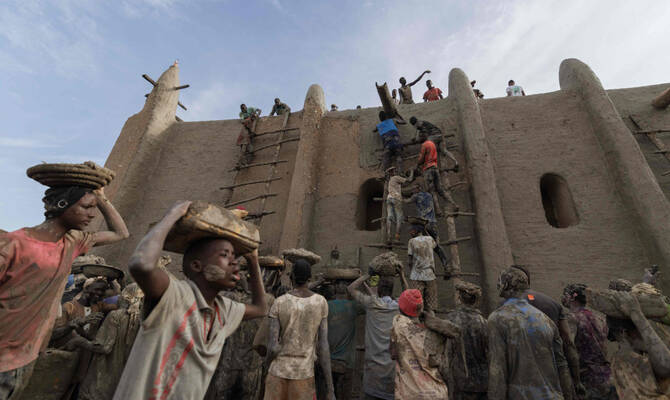
DJÉNNÉ, Mali: Thousands of Malians have replastered the iconic earthen mosque in the historic city of Djenne during an annual ceremony that helps preserve the World Heritage site.
To the sound of drums and festive music, townsmen on Thursday coated the towering three-minaret mosque with fresh mud plaster.
The annual replastering with “banco” — a mix of earth and water — shields the mosque from harsh weather ahead of the Sahel region’s often violent rainy season.
“This mosque belongs to the whole world,” said Aboubacar Sidiki Djiteye, his face streaked with mud as he joined the “unifying” ritual.
“There’s no bigger event in Djenne than this,” he told AFP.
“Replastering the mosque is a tradition handed down from generation to generation,” said Bayini Yaro, one of the women tasked with carrying water for the plaster mix.
Locals prepared the mix themselves, combining water, earth, rice bran, shea butter and baobab powder — a hallmark of Sahel-Sudanese architecture.
Chief mason Mafoune Djenepo inspected the fresh coating.
“The importance of this mosque is immense. It’s the image on all Malian stamps,” he said.
A blessing ceremony followed the replastering, with Qur’anic verses recited in the mosque courtyard. Participants then shared dates and sweets.
First erected in the 13th century and rebuilt in 1907, the mosque is considered the world’s largest earthen structure, according to the United Nations’ cultural body, UNESCO.
Djenne, home to around 40,000 residents and known for preserving its traditional banco houses, has been on UNESCO’s World Heritage list since 1988.
The site was added to the endangered heritage list in 2016 due to its location in central Mali, where jihadist fighters linked to Al-Qaeda and the Daesh group, as well as ethnic militias and criminal gangs, have waged a violent insurgency since 2012.

Ancient Malian city celebrates annual replastering of mosque
https://arab.news/mv2hr
Ancient Malian city celebrates annual replastering of mosque
- The annual replastering with “banco” — a mix of earth and water — shields the mosque from harsh weather
Philippines seeks to regain Chinese visitors as arrivals lag behind regional rivals
- 262,000 Chinese tourists visited Philippines in 2025, compared to 1.7m in 2019
- Vietnam is top destination for Chinese travelers, with about 4.8m visitors this year
MANILLA: The Philippines is trailing behind other countries in Southeast Asia in winning back Chinese tourists, with arrivals well below a quarter of pre-pandemic levels so far this year, latest data showed.
Known for its white sandy beaches, famous diving spots and diverse culture, the Philippines was welcoming an increasing number of Chinese tourists in the period before the pandemic, with the number peaking at over 1.7 million in 2019, when it was the second-largest source market after South Korea.
But the post-pandemic rebound has been slow, with China ranking sixth among international arrivals and the number of Chinese visitors reaching only 262,000 as of Dec. 20, according to data from the Philippine Department of Tourism.
“China remains one of the country’s largest and most important source markets,” the tourism department said earlier this week.
Chinese arrivals this year are equivalent to only around 15 percent of the numbers in 2019 and there is stiff competition with regional rivals like Vietnam, Thailand, Malaysia, Singapore and Indonesia each welcoming at least 1 million tourists from China in 2025.
Vietnam has become Chinese travelers’ top travel destination in Southeast Asia with around 4.8 million visitors so far this year, followed by Thailand, which has recorded about 4.36 million.
China is Singapore’s top source market, with nearly 3 million visitors as of November.
To attract more visitors from China, the Philippines reintroduced electronic visas for Chinese travelers in November, after suspending the system for two years.
“The eVisa resumption is a critical step forward and a clear signal that the Philippines is open, ready, and eager to welcome our Chinese friends,” said Ireneo Reyes, the tourism attache to China.
“While the timing meant that its full benefits could not be felt within the peak booking periods of 2025, we expect a more visible impact beginning the first quarter of 2026.”
The Philippine tourism department said that “recovery has also been constrained by reduced flight capacity, with China-Philippines routes operating at only about 45 percent of pre-pandemic levels,” adding that officials were working closely with relevant stakeholders to “rebuild connectivity and confidence.”
Tourism is an important sector in the Philippine economy, according to a report by the ASEAN+3 Macroeconomic Research Office, accounting for about 13.2 percent of the country’s gross domestic product last year and making up around 13.8 percent of its labor force.


