

UN urges Security Council to pressure Houthis for peace and release of detainees

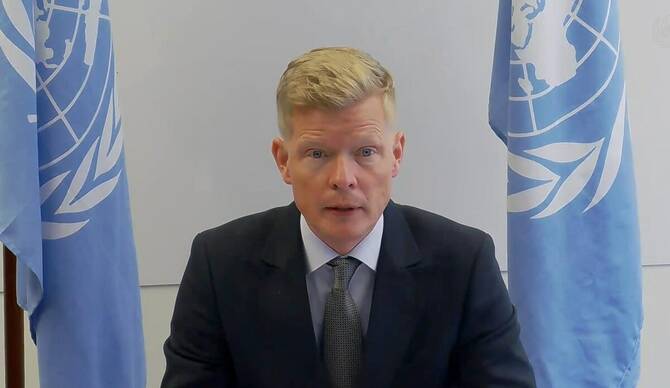
The UN’s special envoy for Yemen, Hans Grundberg. (@OSE_Yemen)
Short Url
Updated 12 June 2025
Follow

UN urges Security Council to pressure Houthis for peace and release of detainees

  • With Yemen’s economy in free fall and millions in need amid a worsening humanitarian crisis, they say time is running out to turn ‘hope into progress’
  • A year after dozens of UN and other humanitarian workers were arbitrarily arrested, the UN’s envoy for Yemen says: ‘Their continued imprisonment is shameful’

NEW YORK CITY: Top UN officials on Wednesday warned the Security Council that there is a risk the fragile situation in Yemen could rapidly deteriorate, as they called for both intensified diplomatic efforts and increased humanitarian funding to stave off further instability and ease human suffering.

With Yemen’s economy in free fall and millions in need, they said time is running out to turn “hope into progress.”

The UN’s special envoy for Yemen, Hans Grundberg, and deputy emergency relief coordinator, Joyce Msuya, also highlighted the ongoing detention of UN workers and employees of nongovernmental organizations by the Houthis, a year after dozens were arbitrarily arrested.

“Their continued imprisonment is shameful,” said Grundberg. “I call again, in the strongest terms, for their immediate and unconditional release.”

Msuya echoed this condemnation, saying: “Twenty-three UN staff remain detained. I join the special envoy and the (UN) secretary-general in calling for their immediate release.”

The detentions, some dating back as far as 2021, have cast a long shadow over ongoing diplomatic efforts to reach a comprehensive peace agreement in Yemen, where multiple front lines remain active in the civil war and recent regional escalations have complicated a fragile status quo.

The Houthis, the official name for whom is Ansar Allah, have launched missile attacks on Israel in recent weeks, including one that targeted Ben Gurion Airport. Israel in turn struck Houthi-controlled infrastructure, including the destruction of a civilian aircraft at Sanaa International Airport. Grundberg warned that such escalations directly harm ordinary citizens.

“Yemenis living in Ansar Allah-controlled areas are unable to fly commercially from Sanaa Airport to seek medical treatment abroad, to travel for Hajj or visit their families,” he said.

He described the reopening of the airport in May 2022 as a key peace dividend of a now-lapsed truce agreement that year.

Meanwhile, the humanitarian crisis in Yemen continues to deepen. Msuya described a deteriorating health and food-security situation affecting millions.

“Over 17 million people, or nearly half of Yemen’s population, are acutely hungry,” she told council members.

“Malnutrition affects 1.3 million pregnant and breastfeeding women and 2.3 million children under 5. Without sustained humanitarian support, an estimated 6 million more people could end up in emergency levels of food insecurity.”

Despite the challenges, Msuya noted some progress has been made, including the reopening of a key route between Aden and Sanaa via Al-Dhalea, which had been closed for nearly seven years.

“This development … shows that Yemen is not on a fixed, downhill trajectory,” she said. “With trust and the right tools, there remains hope.”

Grundberg also pointed to this development as a positive sign.

“I commend, again, the local facilitators across the front lines who worked to make this happen,” he said. “Yemen’s economy is in dire need of positive and trust-building steps such as these.”

However, the path forward in the country remains uncertain. Grundberg reported increased tensions around Marib, and troop movements in several governorates, warning that “conditions can change rapidly and unpredictably.”

Both officials reiterated that a long-term solution will require a political settlement and increased support from regional authorities.

Grundberg said he has held talks with the Yemeni government, the Houthis, and regional authorities including Saudi Arabia, Iran and Oman, and noted that there is a shared view that only negotiation can end the conflict.

He urged council members to “use your powerful voices, your diplomatic channels and your influence, to exert maximum pressure” on the Houthis both in the pursuit of peace and to secure the release of detainees.

Msuya concluded her remarks with three direct appeals: “Take the lead of the Senior Officials Meeting in May and follow up with scaled-up, flexible funding; take real action to see that UN and other detained colleagues are released…; (and) maintain your unified support for efforts toward lasting peace.”


’No one to back us’: Arab bus drivers in Israel grapple with racist attacks

Updated 4 sec ago
Follow

’No one to back us’: Arab bus drivers in Israel grapple with racist attacks

  • “People began running toward me and shouting at me, ‘Arab, Arab!’” recalled Khatib, a Palestinian from east Jerusalem

JERUSALEM: What began as an ordinary shift for Jerusalem bus driver Fakhri Khatib ended hours later in tragedy.
A chaotic spiral of events, symptomatic of a surge in racist violence targeting Arab bus drivers in Israel, led to the death of a teenager, Khatib’s arrest and calls for him to be charged with aggravated murder.
His case is an extreme one, but it sheds light on a trend bus drivers have been grappling with for years, with a union counting scores of assaults in Jerusalem alone and advocates lamenting what they describe as an anaemic police response.
One evening in early January, Khatib found his bus surrounded as he drove near the route of a protest by Israel’s ultra-Orthodox Jewish community.
“People began running toward me and shouting at me, ‘Arab, Arab!’” recalled Khatib, a Palestinian from east Jerusalem.
“They were cursing at me and spitting on me, I became very afraid,” he told AFP.
Khatib said he called the police, fearing for his life after seeing soaring numbers of attacks against bus drivers in recent months.
But when no police arrived after a few minutes, Khatib decided to drive off to escape the crowd, unaware that 14-year-old Yosef Eisenthal was holding onto his front bumper.
The Jewish teenager was killed in the incident and Khatib arrested.
Police initially sought charges of aggravated murder but later downgraded them to negligent homicide.
Khatib was released from house arrest in mid-January and is awaiting the final charge.

- Breaking windows -

Drivers say the violence has spiralled since the start of the Gaza war in October 2023 and continued despite the ceasefire, accusing the state of not doing enough to stamp it out or hold perpetrators to account.
The issue predominantly affects Palestinians from annexed east Jerusalem and the country’s Arab minority, Palestinians who remained in what is now Israel after its creation in 1948 and who make up about a fifth of the population.
Many bus drivers in cities such as Jerusalem and Haifa are Palestinian.
There are no official figures tracking racist attacks against bus drivers in Israel.
But according to the union Koach LaOvdim, or Power to the Workers, which represents around 5,000 of Israel’s roughly 20,000 bus drivers, last year saw a 30 percent increase in attacks.
In Jerusalem alone, Koach LaOvdim recorded 100 cases of physical assault in which a driver had to be evacuated for medical care.
Verbal incidents, the union said, were too numerous to count.
Drivers told AFP that football matches were often flashpoints for attacks — the most notorious being those of the Beitar Jerusalem club, some of whose fans have a reputation for anti-Arab violence.
The situation got so bad at the end of last year that the Israeli-Palestinian grassroots group Standing Together organized a “protective presence” on buses, a tactic normally used to deter settler violence against Palestinians in the Israeli-occupied West Bank.
One evening in early February, a handful of progressive activists boarded buses outside Jerusalem’s Teddy Stadium to document instances of violence and defuse the situation if necessary.
“We can see that it escalates sometimes toward breaking windows or hurting the bus drivers,” activist Elyashiv Newman told AFP.
Outside the stadium, an AFP journalist saw young football fans kicking, hitting and shouting at a bus.
One driver, speaking on condition of anonymity, blamed far-right National Security Minister Itamar Ben Gvir for whipping up the violence.
“We have no one to back us, only God.”

- ‘Crossing a red line’ -

“What hurts us is not only the racism, but the police handling of this matter,” said Mohamed Hresh, a 39-year-old Arab-Israeli bus driver who is also a leader within Koach LaOvdim.
He condemned a lack of arrests despite video evidence of assaults, and the fact that authorities dropped the vast majority of cases without charging anyone.
Israeli police did not respond to AFP requests for comment on the matter.
In early February, the transport ministry launched a pilot bus security unit in several cities including Jerusalem, where rapid-response motorcycle teams will work in coordination with police.
Transport Minister Miri Regev said the move came as violence on public transport was “crossing a red line” in the country.
Micha Vaknin, 50, a Jewish bus driver and also a leader within Koach LaOvdim, welcomed the move as a first step.
For him and his colleague Hresh, solidarity among Jewish and Arab drivers in the face of rising division was crucial for change.
“We will have to stay together,” Vaknin said, “not be torn apart.”