

Israel strikes Yemen’s Houthi-held Hodeida port

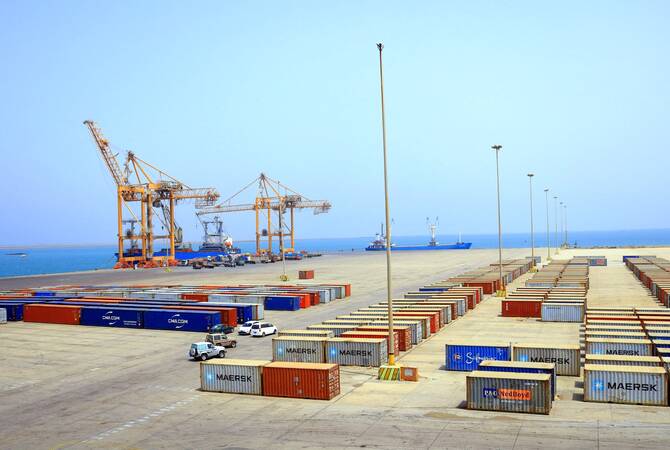
A picture taken on May 28, 2022, shows loading docks at the port of Yemen's Red Sea coastal city of Hodeida, around 230 kilometres west of the capital. (Photo by AFP)
Short Url
Updated 11 June 2025
Follow

Israel strikes Yemen’s Houthi-held Hodeida port

  • Houthi-run Al-Masirah TV said Israel carried out two strikes on the docks of Al Hodeida port
  • Israeli military on Monday urged the evacuation of the Houthi-controlled ports of Ras Isa, Hodeidah and Salif

SANAA: Israeli forces struck Yemen’s Houthi-held port of Hodeida on Tuesday, the latest attack targeting the Iran-backed militia which Israel’s military said was followed by a missile launched at its territory.

An Israeli military statement said that navy ships “struck terror targets belonging to the Houthi terrorist regime” in Hodeida, on Yemen’s Red Sea coast, “to stop the use of the port for military purposes.”

It said the port was “used to transfer weapons.”

Israel has carried out numerous attacks on Houthi-controlled areas of Yemen, including on ports and the airport in the capital Sanaa, since the militia began launching missiles and drones after the start of the Gaza war in October 2023.

The Iran-backed Houthis, who say they are acting in solidarity with Palestinians, paused their attacks during a two-month Gaza ceasefire that ended in March, but renewed them after Israel resumed its military campaign in the Palestinian territory.

Late Tuesday, the Israeli military said it had “identified the launch of a missile from Yemen toward Israeli territory,” adding that sirens were sounded in several areas.

AFP reporters heard loud booms over Jerusalem, similar to past interceptions.

In Hodeida earlier, the Houthis’ Al-Masirah TV channel said “two strikes by the Israeli enemy targeted the docks of the port.”

In a post on X, Israeli Defense Minister Israel Katz said: “We warned the Houthi terror organization that if they continued firing toward Israel, they would face a powerful response and be subjected to a naval and aerial blockade.”

Military spokesman Avichay Adraee had warned civilians to evacuate three Houthi-held ports including Hodeida “for their own security,” in a post on X and Telegram.

Israeli air defenses have intercepted most of the projectiles fired by the Houthis throughout the Gaza war, which broke out with the October 7, 2023 attack by Houthi-allied Palestinian group Hamas.

One missile fired in early May hit inside the perimeter of Ben Gurion airport, Israel’s main international gateway, gouging a hole near the terminal building and wounding several people.

Last month, Israeli air strikes blew up the last remaining plane at the Sanaa airport, weeks after an earlier attack inflicted major damage.

Israel has also threatened to target the Houthi leadership.


Sudan’s war puts charity kitchen workers feeding displaced families at risk

Updated 7 sec ago
Follow

Sudan’s war puts charity kitchen workers feeding displaced families at risk

CAIRO: Enas Arbab fled Sudan’s western region of Darfur after her hometown fell to Sudanese paramilitary forces, taking only her year-old son with her and the memory of her father, who was killed, she said, simply for working at a charity kitchen serving people displaced by the fighting.
The Rapid Support Forces — or RSF, a paramilitary group that has been at war with the Sudanese army since April 2023 — had laid siege on el-Fasher in the western Darfur region, starving people out before it overran the city.
UN officials say several thousand civilians were killed in the RSF takeover of el-Fasher last October. Only 40 percent of the city’s 260,000 residents managed to flee the onslaught, thousands of whom were wounded, the officials said. The fate of the rest remains unknown.
During the fighting, Arbab says RSF fighters took her father, Mohamed ِArbab, from their home after beating him in front of the family, and demanded a ransom. When the family couldn’t pay, they told them they had killed him, she says. To this day, the family doesn’t know where his body is.
When her husband disappeared a month later, Enas Arbab decided to flee north, to Egypt. “We couldn’t stay in el-Fasher,” she said. “It was no longer safe and there was no food or water.”
Her father was one of more than 100 charity kitchen workers who have been killed since the war began, according to workers who spoke with The Associated Press and the Aid Workers Security database, a group that tracks major incidents around the world impacting aid workers.
In areas of intense fighting — especially in Darfur — famine is spreading and food and basic supplies are scarce. The community-led public kitchens have become a lifeline but many working there have been abducted, robbed, arrested, beaten or killed.
Grim numbers in a brutal war
Volunteer Salah Semsaya with the Emergency Response Rooms — a group that emerged as a local initiative and now operates in 13 provinces across Sudan, with 26,000 volunteers — acknowledges the dangers faced by workers in charity kitchens.
The real number of workers killed is likely far higher than the estimated 100, he says, but the war has prevented reliable data collection and record-keeping.
Semsaya shared records showing that 57 percent of the documented killings of charity kitchen workers occurred in Khartoum, mainly while the Sudanese capital was under RSF control, before the army retook it last March. At least 21 percent of the killings were in Darfur.
More than 50 of those killed in Khartoum worked with his group, Semsaya said.
Sudan’s war erupted after tensions between the army and the RSF escalated into fighting that began in Khartoum and spread nationwide, killing thousands and triggering mass displacement, disease outbreaks and severe food insecurity. Aid workers were frequently targeted.
Dan Teng’o, communications chief at the UN office for humanitarian affairs, says it’s unclear whether charity kitchen workers are targeted because of their work or because of their perceived affiliation with one side or other in the war.
The kitchen workers are prominent in their communities because of the work they do, making them obvious targets, activists say. Ransom demands typically range from $2,000 to $5,000, often rising once families make initial payments.
“A clear deterioration in the security context ... has significantly affected local communities, including volunteers supporting community kitchens,” Teng’o said.
Kitchen workers face risks
Farouk Abkar, a 60-year-old from el-Fasher, spent a year handing out sacks of grain at a charity kitchen in Zamzam camp, just 15 kilometers (9 miles) south of the city. He survived drone strikes and remembers the day RSF fighters attacked his kitchen. One of them punched him in the face, knocking some of his teeth out.
Abkar said he fled el-Fasher at night with his daughter, walking for 10 days. Along the way, some RSF fighters fired birdshot, which hit him in the head, leaving a chronic headache.
Now in Egypt, he shares an apartment with at least 10 other Sudanese refugees and can’t afford medical care. The harrowing images from his hometown still haunt him.
“Many things happened in el-Fasher,” he said. “There was death. There was starvation.”
Mustafa Khater, a 28-year-old charity kitchen worker, fled with his pregnant wife to Egypt a few days before el-Fasher fell to the RSF.
During the 18-month siege, some el-Fasher residents collaborated with the RSF, telling the paramilitary fighters who the kitchen workers were, Khater said. Many disappeared.
“They would take you to an area where there is a dry riverbed and kill you there,” Khater said.
A volunteer working with Semsaya’s aid group in Darfur said some of his colleagues were beaten, arrested and interrogated, with their attackers accusing them of receiving “illicit funds” for the kitchen. The volunteer spoke on condition of anonymity for fear of reprisals.
Despite the challenges, many charity kitchens remain the only reliable food source in areas gripped by conflict and a place people can come to and give each other support, Semsaya said.
Struggling to feed thousands
The town of Khazan Jedid in East Darfur province has three charity kitchens feeding about 5,000 people daily, said Haroun Abdelrahman, a spokesperson for the Emergency Response Rooms’ branch in the area.
Abdelrahman says he was once interrogated by RSF fighters, while several of his colleagues have been robbed at knifepoint. Despite the fear and harassment, many kitchen workers are still volunteering and working, he said.
In Kassala in eastern Sudan, military agents questioned a volunteer with the branch there and his colleagues in January 2024, he said, after their kitchen started serving food and providing shelter to people who escaped nearby Wad Madani when RSF seized that town. He also spoke anonymously for fear of reprisals.
Khater, the 28-year-old who fled el-Fasher, said he heard from friends back home that after the RSF takeover, all charity kitchens in the city closed and his colleagues were either “killed or fled.”
Teng’o says the closures in areas of fighting have left “vulnerable households with no viable alternatives” and forced people to shop at local “markets where food prices are unaffordable.”
Arbab, the pregnant 19-year-old who fled with her baby boy, had hoped to rebuild her life in Egypt, her friends and a humanitarian worker said, speaking on condition of anonymity to talk about the young mother.
But while on the road to the northern city of Alexandria last month, she and her son were stopped by Egyptian authorities and deported back to Sudan.