

UN chief urges Yemen’s Houthis to release aid workers

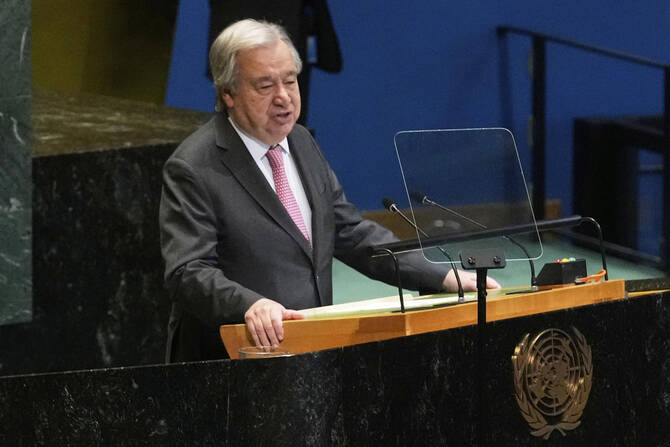
UN Secretary General Antonio Guterres addresses the United Nations General Assembly, June 2, 2025. (AP)
Short Url
Updated 03 June 2025
Follow

UN chief urges Yemen’s Houthis to release aid workers

  • “I renew my call for their immediate and unconditional release,” Guterres said
  • “The UN and its humanitarian partners should never be targeted, arrested or detained while carrying out their mandates”

DUBAI: United Nations Secretary-General Antonio Guterres on Tuesday demanded Yemen’s Houthi militants release dozens of aid workers, including UN staff, a year after their arrest.

The Iran-backed militants, who control much of the war-torn country, detained 13 UN personnel and more than 50 employees of aid groups last June.

“I renew my call for their immediate and unconditional release,” Guterres said in a statement issued by the office of his special envoy for Yemen, Hans Grundberg.

“The UN and its humanitarian partners should never be targeted, arrested or detained while carrying out their mandates for the benefit of the people they serve,” he added.

A decade of civil war has plunged Yemen into one of the world’s worst humanitarian crises, with more than half of the population relying on aid.

The arrests prompted the United Nations to limit its deployments and suspend activities in some regions of the Arabian Peninsula’s poorest country.

The Houthis at the time claimed an “American-Israeli spy cell” was operating under the cover of aid groups — an accusation firmly rejected by the UN.

Guterres also lamented the “deplorable tragedy” of the death in detention of a World Food Programme staffer in February.

The Houthis have kidnapped, arbitrarily detained and tortured hundreds of civilians, including aid workers, during their war against a Saudi-led coalition supporting the beleaguered internationally recognized government.


UN-sanctioned migrant smuggler killed in western Libya

Updated 58 min 5 sec ago
Follow

UN-sanctioned migrant smuggler killed in western Libya

  • Libyan authorities report that a notorious militia leader, Ahmed Oumar Al-Fitouri Al-Dabbashi, was killed in a raid by security forces on Friday
  • In 2018, the UN and US sanctioned him for controlling migrant departure areas and exposing migrants to fatal conditions

CAIRO: A notorious militia leader in Libya, sanctioned by the UN for migrant trafficking across the Mediterranean Sea, was killed on Friday in a raid by security forces in the west of the country, according to Libyan authorities.
Ahmed Oumar Al-Fitouri Al-Dabbashi, nicknamed Ammu, was killed in the western city of Sabratha when security forces raided his hideout. The raid came in response to an attack on a security outpost by Al-Dabbashi’s militia, which left six members of the security forces severely wounded, according to a statement issued by the Security Threat Enforcement Agency, a security entity affiliated with Libya’s western government.
Al-Dabbashi, who was also sanctioned by the US Treasury for trafficking, was the leader of a powerful militia, the “Brigade of the Martyr Anas Al-Dabbashi,” in Sabratha, the biggest launching point in Libya for Europe-bound African migrants.
Al-Dabbashi’s brother Saleh Al-Dabbashi, another alleged trafficker, was arrested in the same raid, added the statement.
In June 2018, the UN Security Council imposed sanctions on Al-Dabbashi, along with another five Libyan traffickers. At the time, the UN report said that there was enough evidence that Al-Dabbashi’s militia controlled departure areas for migrants, camps, safe houses and boats.
Al-Dabbashi himself exposed migrants, including children, to “fatal circumstances” on land and at sea, and of threatening peace and stability in Libya and neighboring countries, according to the same report.
Al-Dabbashi was also sanctioned by the US Treasury for the same reason.
Libya has been a main transit point for migrants fleeing war and poverty in Africa and the Middle East. The country was plunged into chaos following a NATO-backed uprising that toppled and killed longtime autocrat Muammar Qaddafi in 2011.
The country has been fragmented for years between rival administrations based in the east and the west of Libya, each backed by various armed militias and foreign governments.