

Peru Congress impeaches interim president after four months in office

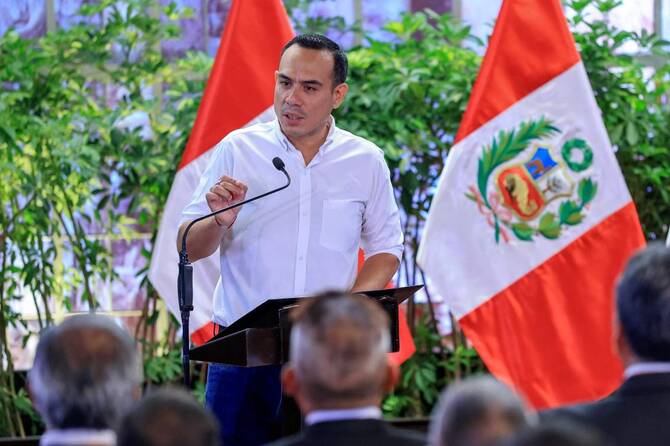
Peru’s interim president Jose Jeri addressing members of the Armed Forces in Lima, Feb. 16, 2026. (AFP)
Short Url
Updated 18 February 2026
Follow

Peru Congress impeaches interim president after four months in office

  • Jose Jeri, 39, was accused in the irregular hiring of several women in his government, and of suspected graft
  • Peru has now burned through seven presidents since 2016, several of them impeached, investigated or convicted of wrongdoing

LIMA: Peru’s Congress on Tuesday impeached interim president Jose Jeri, the Latin American country’s seventh head of state in 10 years and only the latest toppled over graft claims.
Jeri, 39, was accused in the irregular hiring of several women in his government, and of suspected graft involving a Chinese businessman.
In office since last October, Jeri took over from unpopular leader Dina Boluarte, who was also impeached amid protests against corruption and a wave of violence linked to organized crime.
Prosecutors last week opened an investigation into “whether the head of state exercised undue influence” in government appointments.
Jeri has protested his innocence.
Jeri — at the time the head of Peru’s unicameral parliament — was appointed last year to serve out the remainder of Boluarte’s term, which runs until July, when a new president will take over following elections on April 12.
He is constitutionally barred from seeking election.
Jeri has found himself in the spotlight over claims revealed by investigative TV program Cuarto Poder that five women were improperly given jobs in the president’s office and the environment ministry after meeting with Jeri.
Prosecutors said there were in fact nine women.
Jeri is also under investigation for alleged “illegal sponsorship of interests” following a secret meeting with a Chinese businessman with commercial ties with the government.

- Institutional crisis -

Some observers have pointed to possible politicking in the censure of Jeri just weeks before elections for which over 30 candidates — a record — have tossed their hat into the ring.
The candidate from the right-wing Popular Renewal party, Rafael Lopez Aliaga, who leads in opinion polls, has been among the most vocal in calling for Jeri’s ouster.
Congress is now set to elect its own new leader on Wednesday to replace a caretaker in the post. The new parliament president will automatically take over as Peru’s interim president until July.
“It will be difficult to find a replacement with political legitimacy in the current Congress, with evidence of mediocrity and strong suspicion of widespread corruption,” political analyst Augusto Alvarez told AFP ahead of Tuesday’s vote.
Peru has now burned through seven presidents since 2016, several of them impeached, investigated or convicted of wrongdoing.
The South American country is also gripped by a wave of extortion that has claimed dozens of lives, particularly of bus drivers — some shot at the wheel if their companies refuse to pay protection money.
In two years, the number of extortion cases reported in Peru jumped more than tenfold — from 2,396 to over 25,000 in 2025.


Homeless Muslims in southern Philippines observe Ramadan as month of trial

Updated 4 sec ago
Follow

Homeless Muslims in southern Philippines observe Ramadan as month of trial

  • Thousands lost their homes when parts of Bongao in Tawi-Tawi were burnt to ashes
  • Many trying to fully observe the fasting month say they are grateful to be alive

Manila: As Annalexis Abdulla Dabbang was looking forward to observing the month of Ramadan with her family, just days before it began they lost everything when an enormous fire tore through whole neighborhoods of their city in the southernmost province of the Philippines.

Bongao is the capital of Tawi-Tawi, an island province, forming part of the country’s Muslim minority heartland in the Bangsamoro region. The city experienced its worst fire in years in early February, when flames swept through the coastal community, leaving more than 5,000 people homeless.

“We were swimming for our lives. We had to swim to escape from the fire ... We swam in darkness, and (even) the sea was already hot because of the fire,” Dabbang, a 27-year-old teacher, told Arab News.

“Everything we owned was gone in just a few hours — our home, our memories, the things we worked hard for, everything turned to ashes.”

Trying to save their 2-year-old daughter and themselves, she and her husband left everything behind — as did hundreds of other families that together with them have since taken shelter at the Mindanao State University gymnasium — one of the evacuation centers.

Unable to secure a tent, Dabbang’s family has been sleeping on the bleachers, sharing a single mat as their bed. When Ramadan arrived a few days after they moved to the makeshift shelter, they welcomed it in a different, more solemn way. There is no family privacy for suhoor, no room or means to welcome guests for iftar.

“Ramadan feels different now. It’s painful but at the same time more real. When we lost our home, we began to understand what sacrifice really means. When you sleep in an evacuation center, you understand hunger, discomfort in a deeper way,” Dabbang said.

“We don’t prepare special dishes. We prepare our hearts.”

While she and thousands of others have lost everything they have ever owned, she has not lost her faith.

“Our dreams may have turned to ashes, but our prayers are still alive,” she said.

“This Ramadan my prayers are more emotional than ever. I pray for strength, not just for myself, but for my family and for every neighbor who also lost their family home. I pray for healing from the trauma of fire. I pray that Allah will replace what we lost with something better. I pray for the chance to rebuild not just our house, but our sense of security.”

Juraij Dayan Hussin, a volunteer helping the Bongao fire victims, observed that many of them were traumatized and the need to cleanse the heart and mind during Ramadan was what kept many of them going, because they are “thankful that even though they lost their property, they are still alive.”

But the religious observance related to the fasting month is not easy in a cramped shelter.

“It’s hard for Muslims to perform their prayers when they do not have their proper attire because they usually have specific clothes for prayer,” he said. “Sanitation in the area is also an issue ... when you fast and when you pray, cleanliness is essential.”

For Abdulkail Jani, who is staying at a basketball court with his brother and more than 70 other families, this Ramadan will be spent apart from their parents, whom they managed to move to relatives.

“The month of Ramadan this year is a month of trial ... there will be a huge change from how we observed Ramadan in the past, but we will adjust to it and try to comfort ourselves and our family. The most important thing is that we can perform the fasting,” he told Arab News.

“Despite our situation now, despite everything, as long as we’re alive, we will observe Ramadan. We’ll try to observe it well, without missing anything.”