WASHINGTON: President Donald Trump would welcome communications with North Korean leader Kim Jong Un after having had friendly relations with Kim during his first term, the White House said on Wednesday.
“The president remains receptive to correspondence with Kim Jong Un,” White House Press Secretary Karoline Leavitt told reporters.
She was responding to a report by Seoul-based NK News, a website that monitors North Korea, that the North’s delegation at the United Nations in New York had repeatedly refused to accept a letter from Trump to Kim.
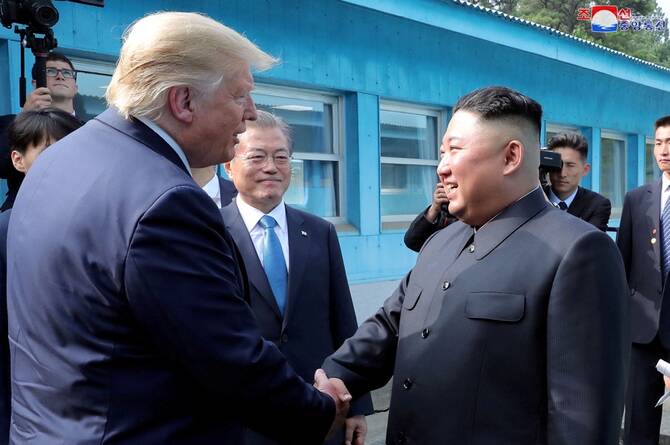
Trump and Kim held three summits during Trump’s 2017-2021 first term and exchanged a number of what Trump called “beautiful” letters. In June 2019, Trump briefly stepped into North Korea from the demilitarized zone with South Korea.
Little progress was made, however, at reining in North Korea’s nuclear program, and Trump acknowledged in March that Pyongyang is a “nuclear power.”
Since Trump’s first-term summitry with Kim ended, North Korea has shown no interest in returning to talks.
The attempts at rapprochement come after the election in South Korea of a new president, Lee Jae-myung, who has pledged to reopen dialogue with North Korea.
As a gesture of engagement on Wednesday Lee suspended South Korean loudspeakers blasting music and messages into the North at the Demilitarized Zone along their shared border.
Analysts say, however, that engaging North Korea will likely be more difficult for both Lee and Trump than it was in the US president’s first term.
Since then North Korea has significantly expanded its nuclear weapons and ballistic missile programs, and developed close ties with Russia through direct support for Moscow’s war in Ukraine, to which Pyongyang has provided both troops and weaponry.
Kim said in a message to Russian President Vladimir Putin that his country will always stand with Moscow, state media reported on Thursday.


![]()


Trump is receptive to contacts with North Korean leader, White House says
Short Url
https://arab.news/pdn7p
Trump is receptive to contacts with North Korean leader, White House says
- Trump open to communication with North Korea’s Kim Jong Un
- North Korea rejecting Trump letter, according to a report


Budget impasse shuts down US Department of Homeland Security
- Thousands of government workers, from airport security agents to disaster relief officials, will either be furloughed or forced to work without pay
WASHINGTON: The Department of Homeland Security entered a partial shutdown Saturday as US lawmakers fight over funding the agency overseeing much of President Donald Trump’s immigration crackdown.
Thousands of government workers, from airport security agents to disaster relief officials, will either be furloughed or forced to work without pay until funding is agreed upon by Congress.
At the center of the budget dispute is the department’s Immigration and Customs Enforcement (ICE), whose agents killed two US citizens amid sweeping raids and mass protests in Minneapolis.
Democrats oppose any new funding for DHS until major changes are implemented over how ICE conducts its operations.
In particular, they have demanded curtailed patrols, a ban on ICE agents wearing face masks during operations and the requirement that they obtain a judicial warrant to enter private property.
“Donald Trump and Republicans have decided that they have zero interest in getting ICE under control,” House Minority Leader Hakeem Jeffries said Friday.
“Dramatic changes are needed,” Jeffries told a news conference. “Absent that, Republicans have decided to shut down parts of the federal government.”
White House Press Secretary Karoline Leavitt put the blame on the opposition, telling Fox News that “Democrats are barreling our government toward another shutdown for political and partisan reasons.”
But while DHS faces a shutdown, ICE itself will remain operational, under funds approved in last year’s government spending bill.
Senator John Fetterman pushed against his fellow Democrats, saying: “This shutdown literally has zero impact on ICE.”
The primary impact would land on other agencies, including the Federal Emergency Management Agency (FEMA), which oversees emergency response to natural disasters.
The Transportation Security Administration, which runs airport safety, warned on X that a prolonged shutdown could result in longer wait times and canceled flights.
Negotiations stalled
The shutdown would be the third of Trump’s second term, including a record 43-day government closure last October and November.
The government just reopened from a smaller, four-day partial shutdown earlier this month, also over DHS funding.
Even if all 53 Republican senators vote to fund DHS, Senate rules require support from 60 of the body’s 100 members to advance the budget bill, meaning several Democrats would need to get on board.
In response to the Democrats’ demands, the White House said it was ready to negotiate over immigration enforcement policy.
Senate Majority Leader John Thune called it “an extremely serious offer,” but warned Democrats are “never going to get their full wish list.”
Some concessions were made during the previous shutdown amid Democratic pressure and national outcry after federal agents shot and killed Renee Good, a mother of three, and Alex Pretti, a nurse who worked with military veterans, in Minneapolis last month.
Homeland Security Secretary Kristi Noem said federal agents in the city would wear body cameras “effective immediately” in a move that would be later “expanded nationwide.”
The Senate went into recess for a week starting Thursday, but senators could be called back to Washington in case of a rapid leap in negotiations.
For the moment, however, talks between the White House and Democrats appear to be at a standstill.
Thousands of government workers, from airport security agents to disaster relief officials, will either be furloughed or forced to work without pay until funding is agreed upon by Congress.
At the center of the budget dispute is the department’s Immigration and Customs Enforcement (ICE), whose agents killed two US citizens amid sweeping raids and mass protests in Minneapolis.
Democrats oppose any new funding for DHS until major changes are implemented over how ICE conducts its operations.
In particular, they have demanded curtailed patrols, a ban on ICE agents wearing face masks during operations and the requirement that they obtain a judicial warrant to enter private property.
“Donald Trump and Republicans have decided that they have zero interest in getting ICE under control,” House Minority Leader Hakeem Jeffries said Friday.
“Dramatic changes are needed,” Jeffries told a news conference. “Absent that, Republicans have decided to shut down parts of the federal government.”
White House Press Secretary Karoline Leavitt put the blame on the opposition, telling Fox News that “Democrats are barreling our government toward another shutdown for political and partisan reasons.”
But while DHS faces a shutdown, ICE itself will remain operational, under funds approved in last year’s government spending bill.
Senator John Fetterman pushed against his fellow Democrats, saying: “This shutdown literally has zero impact on ICE.”
The primary impact would land on other agencies, including the Federal Emergency Management Agency (FEMA), which oversees emergency response to natural disasters.
The Transportation Security Administration, which runs airport safety, warned on X that a prolonged shutdown could result in longer wait times and canceled flights.
Negotiations stalled
The shutdown would be the third of Trump’s second term, including a record 43-day government closure last October and November.
The government just reopened from a smaller, four-day partial shutdown earlier this month, also over DHS funding.
Even if all 53 Republican senators vote to fund DHS, Senate rules require support from 60 of the body’s 100 members to advance the budget bill, meaning several Democrats would need to get on board.
In response to the Democrats’ demands, the White House said it was ready to negotiate over immigration enforcement policy.
Senate Majority Leader John Thune called it “an extremely serious offer,” but warned Democrats are “never going to get their full wish list.”
Some concessions were made during the previous shutdown amid Democratic pressure and national outcry after federal agents shot and killed Renee Good, a mother of three, and Alex Pretti, a nurse who worked with military veterans, in Minneapolis last month.
Homeland Security Secretary Kristi Noem said federal agents in the city would wear body cameras “effective immediately” in a move that would be later “expanded nationwide.”
The Senate went into recess for a week starting Thursday, but senators could be called back to Washington in case of a rapid leap in negotiations.
For the moment, however, talks between the White House and Democrats appear to be at a standstill.
Latest updates


Recommended



© 2026 SAUDI RESEARCH & PUBLISHING COMPANY, All Rights Reserved And subject to Terms of Use Agreement.