

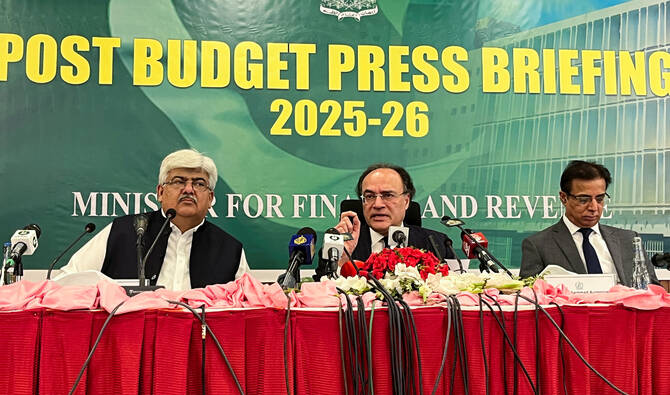

KARACHI: Pakistan plans to cut its overall tariff regime by more than 4% over the next five years, part of sweeping reforms aimed at boosting exports and shifting the country towards an export-led growth model, Finance Minister Muhammad Aurangzeb said on Wednesday.
At a post-budget press conference in Islamabad, Aurangzeb outlined details of the proposed tariff rationalization, saying the government had already removed additional customs duties on 4,000 tariff lines and reduced them on another 2,700, out of a total 7,000.
The reforms align with Pakistan’s commitments under a $7 billion IMF program approved last year and signal a shift toward an export‑oriented growth model built on a leaner tariff structure, protection of social welfare, and improved tax collection.
“First, the goal is to change the overall protected regime. When you lower protection and dismantle walls around it, you improve the economy’s resource allocation, better capital allocation, better human resource allocation, so that’s the overall macroeconomic framework," Aurangzeb said, adding that the changes would reduce input costs for exporters and improve competitiveness.
The reforms are part of the National Tariff Policy 2025–30 under which the government plans to abolish additional customs duties, regulatory duties, and the fifth schedule of the Customs Act, 1969. The policy envisions a streamlined customs structure with just four duty slabs ranging from 0 to 15%, which would become the maximum rate.
“According to the World Bank, after the successful implementation of these reforms, Pakistan’s average tariff will decline to the lowest level in the region,” Aurangzeb had said during his full-year budget speech on Tuesday, when he presented the Rs17.6 trillion ($62 billion) federal budget for FY2025–26.

Pakistan’s Finance Minister Muhammad Aurangzeb speaks during a media briefing in Islamabad on June 11, 2025, a day after presenting the 2025–26 fiscal budget. (AFP)
Describing the initiative as Pakistan’s “East Asia moment” during the post-budget speech, the minister said the plan was designed to help the country avoid recurring balance-of-payments crises.
“So that when we go toward growth we don’t get into the dollar situation, we don’t get into a balance of payment problem,” he said. “So that we can continue to grow at a certain pace which is export-led.”
Aurangzeb emphasized that the tariff cuts would be phased in gradually, starting this year.
“This I am talking about year one. We will take it towards a more than 4 percent reduction in the overall tariff regime in Pakistan,” he said.
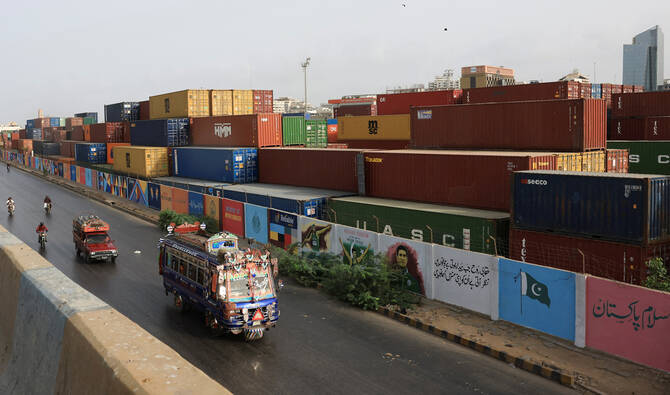
Vehicles move past a shipping container yard along a road in Karachi, Pakistan, on June 10, 2025. (REUTERS)
The government is aiming to lift exports, which grew more than 6% year-on-year to $26.9 billion during July-April, against imports of $48.3 billion, up 8% in the same period.
ENFORCEMENT, ADDITIONAL TAXES
Aurangzeb also warned that the government could be forced to impose Rs400–500 billion ($1.4-1.75 billion) in additional taxes if the Pakistani parliament failed to pass enabling legislation needed to implement enforcement provisions tied to Rs312 billion ($1.1 billion) in proposed new tax measures for the coming fiscal year.
“The parliament should help us in enabling amendments so we don’t opt for additional measures to stop the leakages in the system,” he said.
The minister noted that enforcement actions in the current fiscal year had already yielded Rs400 billion ($1.4 billion) in additional revenue. Without legislative support, the government may be compelled to introduce further taxation to close gaps.
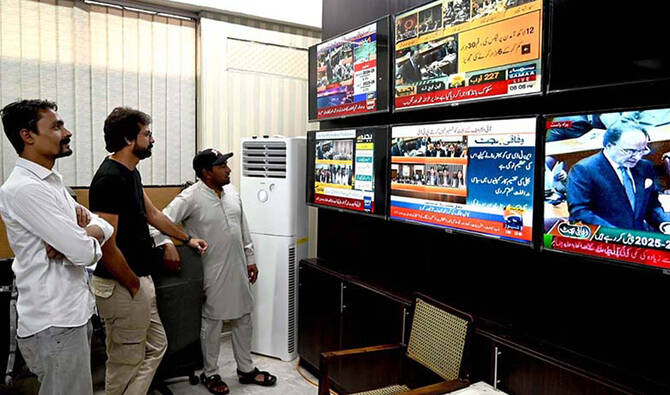
Corporate employees watching television screens as Pakistan Finance Minister Muhammad Aurangzeb presents Pakistan’s $62 billion federal budget for fiscal year 2025–26, in Islamabad on June 10, 2025. (APP)
Without naming them directly, Aurangzeb said international financial institutions had signed off on Rs389 billion ($1.36 billion) in additional taxes for FY26 as part of budget negotiations.
“We now have the credibility and trust internally and externally that we can do the enforcement,” he said.
BUDGET NUMBERS “LOCKED” WITH IMF
Flanking the finance minister, Finance Secretary Imdadullah Bosal said the government had “locked” all key budget numbers with the IMF. The $7 billion loan program the lender approved for Pakistan in 2024 comes with a strict reforms agenda on fiscal consolidation, debt rationalization, revenue mobilization, among other issues.
The IMF, in a recent statement, confirmed Pakistan had committed to continued fiscal consolidation while safeguarding social and priority spending in the new budget.
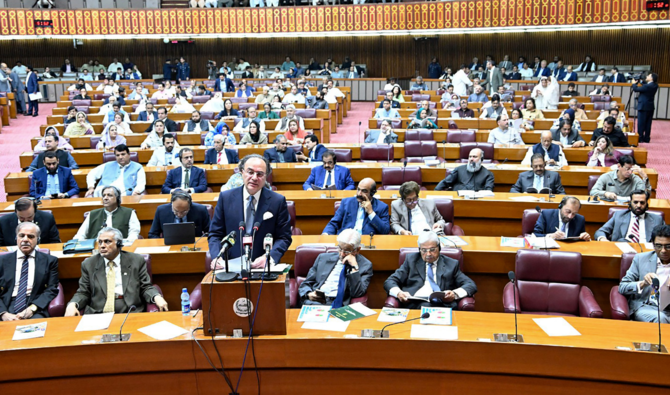
This handout photograph taken on June 10, 2025, and released by Pakistan's National Assembly shows Finance Minister Muhammad Aurangzeb presenting the 2025–26 fiscal budget at the Parliament House in Islamabad. (AFP)
Bosal said the government had managed to reduce current expenditures to under 2% growth in FY25 from 26% in FY24.
“This is our response back to those people who are paying taxes in this country,” Aurangzeb said, adding that the budget had attempted to extend relief to pensioners, salaried individuals, and businesses, despite fiscal constraints.
“The federal government, whatever it is giving, is from the loans that we are taking because we start [the new year] with a deficit.”


