

Maersk, Panattoni, JD Property sign major deals with Saudi entities at Munich logistics expo 

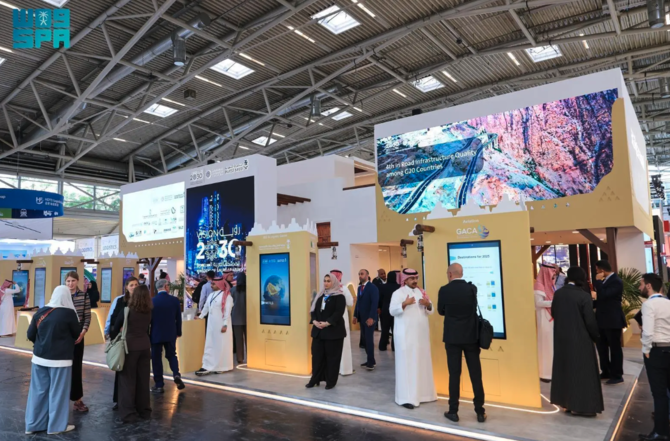
The Saudi pavilion attracted strong interest from global investors, industry leaders, and technology partners. SPA
Short Url
Updated 10 June 2025
Follow

Maersk, Panattoni, JD Property sign major deals with Saudi entities at Munich logistics expo 

  • Kingdom’s pavilion brought together 22 key government and private sector stakeholders
  • First day witnessed the signing of several strategic agreements to strengthen Saudi Arabia’s logistics capabilities

RIYADH: Global supply chain players, including Maersk, Panattoni, and JD Property, signed agreements with Saudi entities at Transport Logistic 2025, underscoring the Kingdom’s emergence as a key player in the sector.

The deals — involving partnerships with firms such as GFS Express, Hefei Logistics Group, Scan Global, and Koppern — were unveiled as part of Saudi Arabia’s expansive presence at the trade fair, held in Munich, Germany.

Led by the National Industrial Development and Logistics Program and Invest Saudi, the Kingdom’s pavilion brought together 22 key government and private sector stakeholders.

Saudi Arabia has emerged as a central hub in the global logistics sector, with its market valued at $136.3 billion in 2024. It is also projected to grow at an annual rate of 6.5 percent, reaching $198.9 billion by 2030, according to Eurogroup Consulting. 

“From hosting tech giants like Apple and iHerb in smart hubs to launching our national car Ceer, Saudi Arabia is becoming an industrial and automotive powerhouse,” said Suliman Al-Mazroua, CEO of NIDLP, according to a post on the organization’s official X account. 

He added: “This isn’t just our story, it’s an invitation to dreamers and innovators. The future is happening now.” 

Speaking at the three-day event that started on June 3, Al-Mazroua highlighted Saudi Arabia’s economic diversification success.  

“For the first time in our history, non-oil activities contribute 55 percent of Saudi Arabia’s gross domestic product. This isn’t a future target, it’s today’s reality,” he said. 

Key deals signed 

The first day of the exhibition witnessed the signing of several strategic agreements aimed at strengthening Saudi Arabia’s logistics capabilities and fostering international cooperation. 

Among the key deals, GFS Express and Hefei Logistics Group inked a memorandum of understanding to enhance logistics collaboration and develop innovative supply chain solutions. 

SAL partnered with GCL to create specialized logistics solutions for the entertainment, sports, and arts sectors. 

MODON and JD Property agreed to work on advanced logistics infrastructure and the localization of tech solutions, while JTM, Silk Mile, and Assaat formed an investment partnership to establish a logistics joint venture in the Kingdom. 

MODON signed an MoU with US-based Panattoni to develop a logistics project in Jeddah, boosting supply chain efficiency. 

Further agreements included SPL, Scan Global, and Maersk collaborating to enhance air freight, delivery solutions, and digital logistics infrastructure, as well as NIDLP partnering with Germany’s Koppern to explore the localization of roller press systems and compaction machines. 

The Saudi pavilion attracted strong interest from global investors, industry leaders, and technology partners as it highlighted the Kingdom’s achievements in transport, logistics, and industrial development.

These developments align with Saudi Vision 2030 goals to position the country as a leading global logistics hub connecting three continents. 

The event featured six specialized workshops covering infrastructure, digital transformation, and human capital development. A key session, “It’s Happening: Saudi Logistics Now,” emphasized the Kingdom’s logistics transformation through public-private partnerships.  

Saudi Arabia continued to demonstrate its commitment to becoming a top-tier logistics and industrial destination, attracting global investors and innovators to join its growth journey. 


Saudi non-oil exports jump 21% as trade balance improves: GASTAT 

Updated 5 sec ago
Follow

Saudi non-oil exports jump 21% as trade balance improves: GASTAT 

RIYADH: Saudi Arabia’s non-oil exports, including re-exports, rose 20.7 percent year on year in November to SR32.69 billion ($8.72 billion), official data showed. 

According to preliminary figures released by the General Authority for Statistics, national non-oil exports, excluding re-exports, increased by 4.7 percent in November compared with the same month in 2024. 

The strong performance highlights progress under the Kingdom’s Vision 2030 strategy, which aims to diversify the economy and reduce its long-standing dependence on crude oil revenues. 

In its latest report, GASTAT stated: “The ratio of non-oil exports, including re-exports, to imports increased in November 2025, reaching 42.2 percent, compared with 34.9 percent in November 2024. This increase was driven by a 20.7 percent rise in non-oil exports, alongside a 0.2 percent decline in imports over the same period.”  

It added: “The value of re-exported goods increased by 53.1 percent during the same period, driven by an 81.9 percent increase in ‘machinery, electrical equipment and parts’, which accounted for 51.5 percent of total re-exports.”  

Machinery, electrical equipment and parts also led the non-oil export basket, making up 24.2 percent of outbound shipments and recording an 81.5 percent annual increase. This was followed by products of the chemical industries, which represented 20.3 percent of total non-oil exports and rose 0.5 percent year on year. 

The data adds to signs of resilience in Saudi Arabia’s non-oil economy, with S&P Global’s Purchasing Managers’ Index at 57.4 in December, well above the 50 threshold that separates expansion from contraction. 

Top non-oil destinations 

The UAE was the leading destination for Saudi non-oil exports in November, with shipments valued at SR10.48 billion. 

India ranked second at SR3.01 billion, followed by China at SR2.32 billion, Singapore at SR1.76 billion and Bahrain at SR900.7 million. 

Exports to Egypt totaled SR815.5 million during the month, while Turkiye and Jordan received goods worth SR799.1 million and SR773.3 million, respectively. 

GASTAT said ports and airports played a central role in facilitating non-oil shipments in November. 

By sea, Jeddah Islamic Seaport handled the largest volume of non-oil exports at SR3.57 billion, followed by King Fahad Industrial Seaport in Jubail at SR3.51 billion. 

Ras Al-Khair Seaport was the exit point for non-oil goods valued at SR2.66 billion, while Jubail Seaport and King Abdulaziz Seaport in Dammam handled outbound shipments worth SR2.32 billion and SR2.14 billion, respectively. 

By air, King Abdulaziz International Airport handled goods worth SR5.60 billion, while King Khalid International Airport in Riyadh processed exports valued at SR3.53 billion. 

Exports and imports 

Saudi Arabia’s total merchandise exports reached SR99.73 billion in November, representing a 10 percent increase compared with the same month in 2024. 

“Merchandise exports in November 2025 increased by 10.0 percent compared to November 2024, and oil exports increased by 5.4 percent. The percentage of oil exports in total exports declined from 70.1 percent in November 2024 to 67.2 percent in November 2025,” GASTAT added.  

China remained the Kingdom’s largest export destination, accounting for 13.5 percent of total exports, followed by the UAE at 11.7 percent and Japan at 9.9 percent. India, South Korea, the US, Egypt, Singapore, Bahrain and Poland were also among the top 10 destinations, which together accounted for 71.4 percent of total exports. 

Imports declined by 0.2 percent year on year in November to SR77.38 billion, while the merchandise trade surplus surged by 70.2 percent, the report showed. 

China was the Kingdom’s largest source of imports, accounting for 26.7 percent of inbound shipments, followed by the US at 10.2 percent and the UAE at 6.2 percent.  

“Germany, Japan, India, Italy, France, Switzerland, and Egypt were also among the top ten import sources, with total imports from these ten countries representing 68.6 percent of Saudi Arabia’s overall imports,” added GASTAT.  

King Abdulaziz Port in Dammam was the leading entry point for goods, handling 22.8 percent of imports in November. Jeddah Islamic Port followed with 22.6 percent, ahead of King Khalid International Airport in Riyadh at 17 percent and King Abdulaziz International Airport in Jeddah at 11.9 percent.