Pakistan likely to hike defense spending but slash overall budget in 2025-26

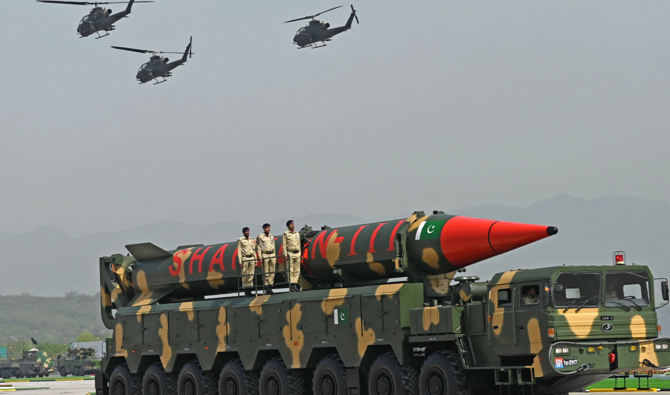
Pakistani military helicopters fly past a vehicle carrying a long-range ballistic Shaheen III missile during the military parade to mark Pakistan's National Day in Islamabad on March 25, 2021. (AFP/File)
Short Url
Updated 10 June 2025
Follow

Pakistan likely to hike defense spending but slash overall budget in 2025-26

  • Media reports say government likely to present Rs17.6 trillion ($62.45 billion) budget for budget 2025-26
  • Analysts expect increase of around 20 percent in defense budget likely offset by cuts in development spending

ISLAMABAD: Pakistan will unveil its annual federal budget for the coming fiscal year later on Tuesday, seeking to kickstart growth while finding resources for an expected hike in defense expenditure following the conflict with India last month.

Islamabad will also have to contend with remaining within the discipline of its International Monetary Fund program and the uncertainty from new trade tariffs being imposed by the United States, its biggest export market.

Media reports say the government is likely to present a 17.6 trillion rupee ($62.45 billion) budget for the fiscal year beginning July 1, down 6.7 percent from this fiscal year. It has projected a fiscal deficit of 4.8 percent of GDP, against a targeted 5.9 percent deficit in 2024-25, the reports say.

Analysts said they expect an increase of around 20 percent in the defense budget, likely offset by cuts in development spending.

Pakistan allocated 2.1 trillion Pakistani rupees ($7.45 billion) for defense in the outgoing fiscal year, including $2 billion for equipment and other assets. An additional 563 billion rupees ($1.99 billion) was set aside for military pensions, which are not counted within the official defense budget.

India’s defense spending in its 2025–26 (April-March) fiscal year was set at $78.7 billion, a 9.5 percent increase from the previous year, including pensions and $21 billion earmarked for equipment. It has indicated it will step up expenditure following the May conflict with Pakistan.

The government of Pakistani Prime Minister Shehbaz Sharif has projected 4.2 percent economic growth in 2025-26, saying it has steadied the economy, which had looked at risk of defaulting on its debts as recently as 2023. Growth this fiscal year is likely to be 2.7 percent, against an initial target of 3.6 percent set in the budget last year.
Pakistan’s growth lags far behind the region. In 2024, South Asian countries grew by an average of 5.8 percent and 6.0 percent growth is expected in 2025, according to the Asian Development Bank.

RATE CUTS NOT ENOUGH

Expansion of the economy should be aided by a sharp drop in the cost of borrowing, the government says, after a succession of interest rate cuts by the central bank. But economists warn that monetary policy alone may not be enough, with fiscal constraints and IMF-mandated reforms still weighing on investment.
Finance Minister Muhammad Aurangzeb said on Monday that he wanted to avoid Pakistan’s boom and bust cycles of the past.

“The macroeconomic stability that we have achieved, we want to absolutely stay the course,” he said. “This time around we are very, very clear that we do not want to squander the opportunity.”

The budget is expected to prioritize expanding the tax base, enforcing agriculture income tax laws, and reducing government subsidies to industry, to meet the terms of a $7 billion IMF bailout signed last summer. Just 1.3 percent of the population paid income tax in 2024, according to the tax authorities, with agriculture and the retail sector largely outside of the tax net.

The IMF has urged Pakistan to widen the tax base through reforms which include taxing agriculture, retail, and real estate.

Ahmad Mobeen, senior economist at S&P Global Market Intelligence, said that he expected the revenue target for 2025-26 will be missed.

“The shortfall will mostly be owing to lack of optimal implementation of announced measures as well as absence of meaningful structural reforms to widen the tax net in general,” said Mobeen.

 ($1 = 281.8400 Pakistani rupees)


IMF board to approve Pakistan reviews today ‘if all goes well,’ say officials

Updated 08 December 2025
Follow

IMF board to approve Pakistan reviews today ‘if all goes well,’ say officials

  • IMF’s executive board is scheduled to meet today to discuss the disbursement of $1.2 billion
  • Economists say the money will boost Pakistan’s forex reserves, send positive signals to investors

KARACHI: The International Monetary Fund’s (IMF) executive board is scheduled to meet today, Monday, to approve the release of about $1.2 billion for Pakistan under the lender’s two loan facilities, said IMF officials who requested not to be named.

The IMF officials confirmed the executive board was going to decide on the Fund’s second review under the $7 billion Extended Fund Facility (EFF) and first review under the $1.4 billion Resilience and Sustainability Facility (RSF), a financing tool that provides long-term, low-cost loans to help countries address climate risks.

“The board meeting will be taking place as planned,” an IMF official told Arab News.

“The board is on today yes as per the calendar,” said another.

A well-placed official at Pakistan’s finance ministry also confirmed the board meeting was scheduled today to discuss the next tranche for Pakistan.

The IMF executive board’s meeting comes nearly two months after a staff-level agreement (SLA) was signed between the two sides in October.

Procedurally, the SLAs are subject to approval by the executive board, though it is largely viewed as a formality.

“If all goes well, the reviews should pass,” said the second IMF official.

On approval, Pakistan will have access to about $1 billion under the EFF and about $200 million under the RSF, the IMF said in a statement in October after the SLA.

The fresh transfer will bring total disbursements under the two arrangements to about $3.3 billion, it added.

Experts see smooth sailing for Pakistan in terms of the passing of the two reviews, saying the IMF disbursements will help the cash-strapped nation to strengthen its balance of payments position.

Samiullah Tariq, group head of research at Pakistan Kuwait Investment Company Limited, said the IMF board’s approval will show that Pakistan’s economy is on the right path.

“It obviously will help strengthen [the country’s] external sector, the balance of payments,” he told Arab News.

Until recently, Pakistan grappled with a macroeconomic crisis that drained its financial resources and triggered a balance of payments crisis.

Pakistan has reported financial gains since 2022, recording current account surpluses and taming inflation that touched unprecedented levels in mid-2023.

Economists also viewed the IMF’s bailout packages as crucial for cash-strapped Pakistan, which has relied heavily on financing from bilateral partners such as Saudi Arabia, China and the United Arab Emirates, as well as multilateral lenders.

Saudi Arabia, through the Saudi Fund for Development, last week extended the term of its $3 billion deposit for another year to help Pakistan boost its foreign exchange reserves, which stood at $14.5 billion as of November 28, according to State Bank of Pakistan statements.

“In our view this [IMF tranche] will be approved,” said Shankar Talreja, head of research at Karachi-based brokerage Topline Securities Limited.

“This will help strengthen reserves and will eventually help a rating upgrade going forward,” he said.

The IMF board’s nod, Talreja said, would also send a signal to the international and local investors regarding the continuation of the reform agenda by Pakistan’s government.