

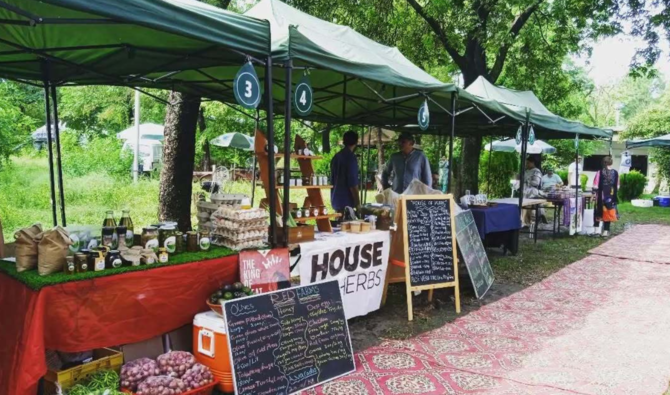

ISLAMABAD: Every Saturday morning, a quiet corner of Pakistan’s capital comes alive with the earthy scent of fresh produce, the hum of friendly chatter and the unmistakable feel of community.
This is the Islamabad Farmers Market, now more than a decade old and having grown from a humble initiative into a thriving hub of sustainability, entrepreneurship, and local connection.
Launched in 2013 with just six vendors, the market now hosts 79 approved seller, each selected through a rigorous vetting process that includes soil and water testing as well as on-site visits to farms.
The aim? To keep the food chain clean, ethical, and transparent.
“The main goal was to eliminate the middleman and help small-scale farmers and producers connect directly with customers,” said Ali Raza, a representative of the market. “Today, we have created a trusted space for clean, organic, and ethical products.”
Each stall at the market tells a different story. Beneath canopies strung with fairy lights and shaded by leafy trees, you’ll find everything from heirloom tomatoes and farm-fresh eggs to artisan sourdough and wild honey from the mountains.
Among the market’s earliest supporters is Naghma, a 70-year-old anthropologist and environmentalist who only gave her first name.
A regular since its inception, she now sells her homemade hummus and baba ghanoush, an Arab eggplant dip, prepared with hand-ground tahini, alongside a variety of other organic spreads.
“I come here every Saturday with three bags and go back with five or six,” she laughed. “I buy all my raw materials here.”
For Naghma, organic eating is more than a preference, it’s a lifelong passion rooted in gardening and the rhythms of the seasons.
“I follow seasons because organic by definition is seasonal,” she said. “So, I make French Boursin cheese. My products, I call them ‘Les Deli De Naghma,’ so there’s a definite French touch.”
The Farmers Market has also become a vital platform for small-scale growers not just from Islamabad, but also more remote northern areas of the country such as northern Gilgit-Baltistan.
Sherazam, the founder of Hunza Organic, is one such vendor who has been displaying at the market for over a decade. On his table: ruby-red dried cherries, sun-cured apricot oil, and jars of thick wild honey, all harvested by hand and brought straight from the mountains.
“Our clientele knows that our products are pure. Many others also source their raw materials from us,” he told Arab News.
Sherazam said his business model was deeply community-driven.
“In Hunza, everyone farms. The women in my village produce these items, and we handle the packaging in Islamabad,” he added.
“RELIABLE, FRESH, FAMILY-FRIENDLY“
New entrepreneurs are also finding their footing at the Islamabad Farmer’s market.
Waleed Noor Malik, representing “Guy Knows Food,” a popular kimchi brand, said the market had helped launch their business and acted as an accelerator.
“We started selling kimchi here because we couldn’t find a brand in Pakistan that matched our taste,” he said. “Sampling at the market really helps build our brand. People try it here and often follow up on social media.”
Engineer-turned-farmer, who manages 300 beehives and a young olive orchard near Taxila, shared a similar experience. His small-batch raw honey and extra virgin olive oil are bottled with care and sold directly to those who seek quality over mass production.
“It’s not easy to compete with bulk commercial sellers, but here, people appreciate authenticity,” he said.
Raza, the curator of the market, said many of its vendors had started small, with just a few pots or a home kitchen and now had full storefronts.
“Many people in and around Islamabad, from Chak Shehzad and Barakahu, were producing and running small-scale farms but they didn’t have a platform to sell their fruits and vegetables. So, the main aim was to provide them with a platform,” he added.
Much of the market’s success hinges on its rigorous commitment to quality. Vendors undergo lengthy screening processes, including environmental checks and farm inspections.
“We look for the soil test, water test, and then we do a site visit,” said Raza. “We make sure that no insecticides, pesticides, or urea are used.”
This transparency has earned the market a loyal following. Dr. Shanza Khan, a dentist and long-time visitor, summed it up simply:
“The vendors are reliable, and their products are fresh. It’s a very family-friendly environment.”
More than a market, this is clearly a community garden in motion, where each bag of microgreens or bottle of honey is part of a larger story of connection and care for the land. And with the launch of an online platform, the market has extended its reach beyond Saturdays, giving customers access to their favorite organic products throughout the week. For vendors, this means steadier sales and greater visibility in a growing wellness economy.
Another attraction lies at the far end of the market, where food and coffee stalls beckon with the smell of sourdough sandwiches, artisanal cheese, and specialty brews. Some mornings, live music plays in the background, or a spontaneous art therapy session spills onto the grassy space beside the Dino Park. Children run through the park’s dino sculptures while parents sip cappuccinos under the trees.
Mahnoor Omer, a lawyer and regular visitor, has made coming here a weekly ritual.
“Coffee, sourdough, cheese sandwiches, and sometimes, spontaneous catch-ups with friends,” she said, smiling.
“It’s a great outlet for home-based growers and vendors from northern areas to bring their produce straight to our kitchens.”


